Hover or tap a word to see its match.
Part 1
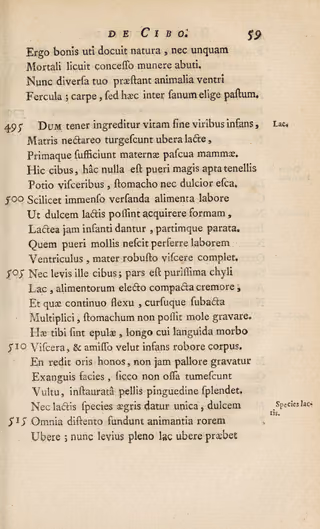
WHILE the tender infant enters upon life without strength,
the mother's breasts swell with nectareous milk,
and the maternal paps supply the first nourishment.
This is his food; no drink is more suited than this to the delicate
viscera of a child, nor is any fare sweeter to the stomach.
Indeed, nutriments that must be worked with immense labor
so that they may acquire the sweet form of milk,
are given to the infant already milky, and partly prepared.
The labor which the soft stomach of the child knows not how to
endure, the mother accomplishes with her robust viscera.
Nor is that food unsubstantial; milk is the purest part
of the chyle, compacted from the choice cream of nutriments,
and which, subdued by continuous winding and a manifold
course, cannot burden the stomach with its mass.
Let these be your feasts, you whose viscera are languid from a long
disease, and whose body, its strength lost, is like an infant.
Behold, the grace of the countenance returns; no longer is the bloodless
face weighed down by pallor, the bones do not jut out on a shrunken
visage, and the skin shines with restored plumpness.
Nor is a single kind of milk given to the sick; all
animals pour forth the sweet dew from a distended
udder; now from a full udder a lighter milk is offered by Milk. Kinds of milk.
DUM tener ingreditur vitam ſine viribus infans ,
Matris nectareo turgeſcunt ubera lacte ,
Primaque ſufficiunt maternæ paſcua mammæ.
Hic cibus, hâc nulla eſt pueri magis apta tenellis
Potio viſceribus , ſtomacho nec dulcior eſca.
Scilicet immenſo verſanda alimenta labore
Ut dulcem lactis poſſint acquirere formam ,
Lactea jam infanti dantur , partimque parata.
Quem pueri mollis neſcit perferre laborem
Ventriculus , mater robuſto viſcere complet.
Nec levis ille cibus ; pars eſt puriſſima chyli
Lac , alimentorum electo compacta cremore ,
Et quæ continuo flexu , curſuque ſubacta
Multiplici , ſtomachum non poſſit mole gravare.
Hæ tibi ſint epulæ , longo cui languida morbo
Viſcera, & amiſſo velut infans robore corpus.
En redit oris honos , non jam pallore gravatur
Exanguis facies , ſicco non oſſa tumeſcunt
Vultu, inſtauratâ pellis pinguedine ſplendet.
Nec lactis ſpecies ægris datur unica , dulcem
Omnia diſtento fundunt animantia rorem
Ubere ; nunc levius pleno lac ubere præbet Lac. Species lactis.
Part 2
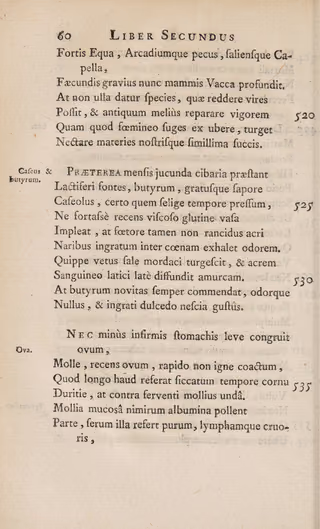
the strong Mare, the Arcadian beast, and the leaping
She-goat;
Now the Cow pours forth a heavier one from her fruitful teats.
Yet no kind is given that can restore strength
And better repair ancient vigor
Than what you suck from a woman's breast; the substance
Swells with nectar and is most like our own juices.
Cheese and butter. MOREOVER, the milk-bearing springs provide pleasant foods
For the tables: butter, and cheese pleasing in
Flavor, which you should choose pressed at a certain time,
Lest, if fresh, it perhaps fill the vessels with viscous
Gluten, and yet, not rancid with a sharp stench,
Breathe out an unpleasant odor to the nostrils during dinner.
Indeed, old cheese swells with biting salt, and widely
Spreads acrid dregs into the bloody fluid.
But freshness always commends butter, and the absence
Of odor, and a sweetness ignorant of an unpleasant taste.
Eggs. NOR does a light egg suit weak stomachs
Any less,
A soft, fresh egg, not hardened by a rapid fire,
Which, dried over a long time, does not resemble horn
In hardness, but on the contrary is softer through boiling water.
For soft egg whites are rich in a mucous
Part; that part resembles pure serum, and the lymph of the
Blood,
Fortis Equa , Arcadiumque pecus , ſalienſque Ca-
pella,
Fæcundis gravius nunc mammis Vacca profundit.
At non ulla datur ſpecies, quæ reddere vires
Poſſit , & antiquum meliùs reparare vigorem
Quam quod fœmineo ſuges ex ubere, turget
Nectare materies noſtriſque ſimillima ſuccis.
Caſeus & butyrum. PRÆTEREA menſis jucunda cibaria præſtant
Lactiferi fontes, butyrum, gratuſque ſapore
Caſeolus , certo quem ſelige tempore preſſum ,
Ne fortaſsè recens viſcoſo glutine vaſa
Impleat , at fœtore tamen non rancidus acri
Naribus ingratum inter cœnam exhalet odorem.
Quippe vetus ſale mordaci turgeſcit , & acrem
Sanguineo latici latè diffundit amurcam.
At butyrum novitas ſemper commendat, odorque
Nullus , & ingrati dulcedo neſcia guſtûs.
Ova. NEC minùs infirmis ſtomachis leve congruit
ovum ,
Molle , recens ovum , rapido non igne coactum ,
Quod longo haud referat ſiccatum tempore cornu
Duritie , at contra ferventi mollius undâ.
Mollia mucosâ nimirum albumina pollent
Parte , ſerum illa refert purum, lymphamque cruo-
ris ,
Part 3
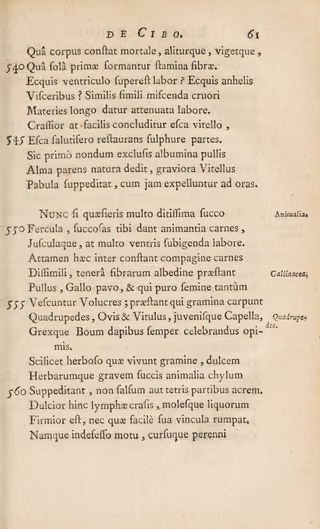
By which the mortal body subsists, and is nourished, and thrives,
By which alone the warp-threads of the first fiber are formed.
What labor remains for the stomach? What for the panting
Viscera? A similar matter, to be mixed with similar blood,
Is given, already thinned by long labor.
A thicker yet easy food is enclosed in the yolk,
A food restoring the parts with salutary sulphur.
Thus at first to the chicks not yet hatched
Nurturing mother nature gave the whites; the yolk
Supplies heavier nourishment, when they are now driven forth into the light.
NOW if you seek dishes most rich with abundant juice,
Living creatures give you juicy meats,
And broths, yet to be subdued by much labor of the belly.
Nevertheless among these, the meats consist of a dissimilar
Texture; the chicken, the turkey, and the birds
That feed only on pure seed excel in the tender whiteness
Of their fibers; the quadrupeds that pluck the grasses excel,
The sheep and the calf, and the young kid,
And the herd of cattle, ever to be celebrated at rich
Banquets.
Indeed, the animals that live on grassy herbage
Supply a chyle sweet and heavy with the juices of herbs,
Not salty or acrid with foul particles.
Sweeter hence is the crasis of the lymph, and the mass of the fluids
Is firmer, nor such as would easily break its bonds.
For by unwearied motion, and perennial course Animals. Poultry. Quadrupeds.
Quâ corpus conſtat mortale, aliturque, vigetque,
Quâ ſolâ primæ formantur ſtamina fibræ.
Ecquis ventriculo ſupereſt labor? Ecquis anhelis
Viſceribus? Similis ſimili miſcenda cruori
Materies longo datur attenuata labore.
Craſſior at facilis concluditur eſca vitello,
Eſca ſalutifero reſtaurans ſulphure partes.
Sic primò nondum excluſis albumina pullis
Alma parens natura dedit, graviora Vitellus
Pabula ſuppeditat, cum jam expelluntur ad oras.
NUNC ſi quæſieris multo ditiſſima ſucco
Fercula, ſuccoſas tibi dant animantia carnes,
Juſculaque, at multo ventris ſubigenda labore.
Attamen hæc inter conſtant compagine carnes
Diſſimili, tenerâ fibrarum albedine præſtant
Pullus, Gallo pavo, & qui puro ſemine tantùm
Veſcuntur Volucres; præſtant qui gramina carpunt
Quadrupedes, Ovis & Vitulus, juveniſque Capella,
Grexque Boum dapibus ſemper celebrandus opi-
mis.
Scilicet herboſo quæ vivunt gramine, dulcem
Herbarumque gravem ſuccis animalia chylum
Suppeditant, non ſalſum aut tetris partibus acrem.
Dulcior hinc lymphæ craſis, moleſque liquorum
Firmior eſt, nec quæ facilè ſua vincula rumpat.
Namque indefeſſo motu, curſuque perenni Animalia. Gallinacea. Quadrupedes.
Part 4
blood and humors are shaken together; being shaken,
they contract an acridity, and with the stimulus gradually increasing and the parts
dissolved, all the blood flows away completely into putrid gore.
Chyle prevents this; it blunts the bared spicula
of the salts, soothes the humors with a pleasant sweetness,
and unites the disjoined parts in a new bond.
But if a biting chyle stings with an acrid saltiness,
how will it be able to soothe the salty fluids with its juice?
From this the corruption takes increase, while flame is added
to fire, and grave diseases will arise from a putrid origin.
Sanguis & humores unà quatiuntur, acorem
Quaſſa trahunt, ſtimulo ſenſim creſcente ſolutis
Partibus, in tabum penitus cruor effluit omnis.
Præpedit hoc chylus; ſalium nudata retundit
Spicula, jucundâ humores dulcedine mulcet,
Conſociatque novo disjunctas fœdere partes.
At ſi acri pungit mordax ſalſedine chylus,
Quî poterit ſalſos ſucco mulcere liquores?
Hinc capit augmentum labes, dum ſubditur igni
Flamma, graveſque putri ſurgent ab origine morbi.