Hover or tap a word to see its match.
Part 1
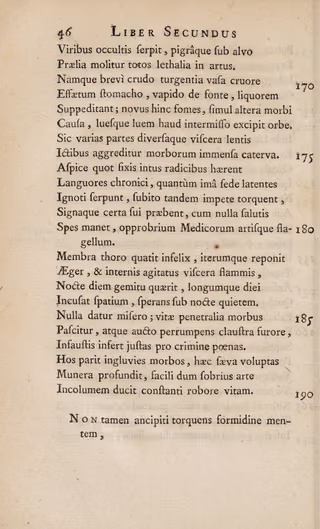
Yet, do not, torturing your mind with anxious
fear,
NON tamen ancipiti torquens formidine men-
tem,
Part 2
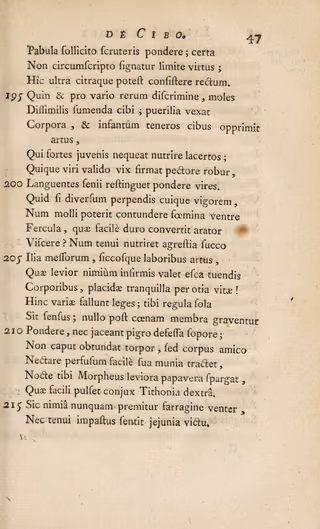
examine your food with anxious weighing; sure
virtue is not marked by a narrowly circumscribed limit;
here the right measure can stand slightly beyond or short of the mark.
Indeed, according to the varying differences of circumstances, a different
bulk of food must be taken; that food vexes boyish
bodies, and oppresses the tender limbs
of infants,
which could not nourish the strong arms of a youth;
and that which scarcely confirms strength in the stout chest of a man,
will extinguish with its weight the languishing powers of old age.
What if you weigh the different vigor in each person?
Will a woman be able to break down in her soft belly
the dishes that a plowman easily digests in his hardy
viscera? Would that overly light fare, which avails for protecting
infirm bodies through the tranquil leisure of a placid life,
nourish with its thin juice the rustic flanks of reapers,
and their limbs parched by labors?
Hence varied laws deceive; let your sole rule
be sensation; let the limbs be weighed down by no
burden after dinner, nor lie exhausted in sluggish stupor;
let not torpor dull the head, but let the body, suffused
with friendly nectar, easily perform its duties;
at night let Morpheus scatter lighter poppies for you,
which the spouse of Tithonus may dispel with an easy hand.
Thus the belly is never oppressed by an excessive mash,
nor, unfed on a thin diet, does it feel the pangs of fasting.
Pabula ſollicito ſcruteris pondere; certa
Non circumſcripto ſignatur limite virtus ;
Hîc ultra citraque poteſt conſiſtere rectum.
Quin & pro vario rerum diſcrimine , moles
Diſſimilis ſumenda cibi ; puerilia vexat
Corpora , & infantûm teneros cibus opprimit
artus ,
Qui fortes juvenis nequeat nutrire lacertos ;
Quique viri valido vix firmat pectore robur ,
Languentes ſenii reſtinguet pondere vires.
Quid ſi diverſum perpendis cuique vigorem ,
Num molli poterit contundere fœmina ventre
Fercula , quæ facilè duro convertit arator
Viſcere ? Num tenui nutriret agreſtia ſucco
Ilia meſſorum , ſiccoſque laboribus artus ,
Quæ levior nimiùm infirmis valet eſca tuendis
Corporibus , placidæ tranquilla per otia vitæ !
Hinc variæ fallunt leges ; tibi regula ſola
Sit ſenſus ; nullo poſt cœnam membra graventur
Pondere , nec jaceant pigro defeſſa ſopore ;
Non caput obtundat torpor , ſed corpus amico
Nectare perfuſum facilè ſua munia tractet ,
Nocte tibi Morpheus leviora papavera ſpargat ,
Quæ facili pulſet conjux Tithonia dextrâ.
Sic nimiâ nunquam premitur farragine venter ,
Nec tenui impaſtus ſentit jejunia victu.
Part 3
BUT the mind shudders to recall how lamentably once
Savage famine raged, which, ghastly in countenance,
Deformed by leanness, thrusts forth temples bristling
With wrinkles, deadly eyes, and a mouth gaping with a
Fierce grin; and, its hand armed with a bloody knife,
Taught mothers to feed upon the bodies of their children.
Yet too often, falsely prudent wisdom, while it
Teaches cautious men to walk in straitened circumstances,
Has prescribed by system that a life too austere
Be led, mocking poor wretches with a sad error.
For indeed, through the perpetual motion by which bodies live,
After various courses and untiring labors,
A rich part of the blood and of the subtle dew of the nerves,
Being exhausted, flees away; this the chyle restores with its
Vital nectar, and supplies the lost part with its fruitful gift.
But if the source of the milk-bearing fountain dries up,
The losses of the nervous fluid are no longer repaired,
Nor do the thirsty vessels swell with their wonted blood.
Hence the ancient vigor vanishes, the empty
Viscera languish, and the body withers with exhausted strength:
Just as the brightness of a lamp languishes when the oil is consumed,
Or a dry river fails in its channel, parched by the heat,
Which, rolling its waves in a sandy eddy,
Used to enrich the fruitful fields with its scattered dews.
Add to this that by constant motion and internal heat
The blood and the rubbed juice of the nerves may contract
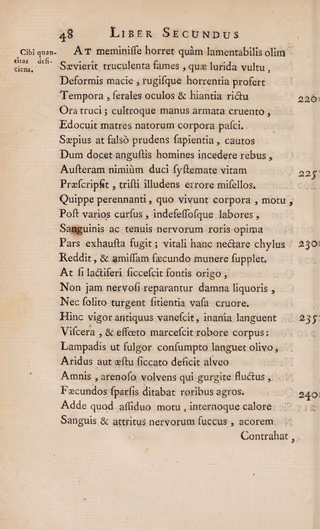
AT meminiſſe horret quàm lamentabilis olim
Sævierit truculenta fames, quæ lurida vultu,
Deformis macie, rugiſque horrentia profert
Tempora, ferales oculos & hiantia rictu
Ora truci; cultroque manus armata cruento,
Edocuit matres natorum corpora paſci.
Sæpius at falsò prudens ſapientia, cautos
Dum docet anguſtis homines incedere rebus,
Auſteram nimiùm duci ſyſtemate vitam
Præſcripſit, triſti illudens errore miſellos.
Quippe perennanti, quo vivunt corpora, motu,
Poſt varios curſus, indefeſſoſque labores,
Sanguinis ac tenuis nervorum roris opima
Pars exhauſta fugit; vitali hanc nectare chylus
Reddit, & amiſſam fæcundo munere ſupplet.
At ſi lactiferi ſicceſcit fontis origo,
Non jam nervoſi reparantur damna liquoris,
Nec ſolito turgent ſitientia vaſa cruore.
Hinc vigor antiquus vaneſcit, inania languent
Viſcera, & effœto marceſcit robore corpus:
Lampadis ut fulgor conſumpto languet olivo,
Aridus aut æſtu ſiccato deficit alveo
Amnis, arenoſo volvens qui gurgite fluctus,
Fæcundos ſparſis ditabat roribus agros.
Adde quod aſſiduo motu, internoque calore
Sanguis & attritus nervorum ſuccus, acorem
Part 4
contracts an acidity, which chyle alone, by its infused nectar,
can soothe (since all milky things
soothe) and extinguish the flames kindled within.
BUT why do I speak of these things? Hunger is known to those whom foul
poverty
keeps far from the august threshold of the Muses:
Touching my precepts with Pierian charm, I would neither
be able to refresh them with sweet-sounding song, nor did Phoebus
look upon them at their birth with a joyful light.
But you who, being rich, languish on soft purple,
lend a hand to the wretched; with praiseworthy luxury
pour forth gifts from a full horn upon your fellow men;
I shall sing of your gifts, celebrating what foods
suit you, or which ones, though harmful, deceive the palate.
ALL the dishes that adorn sumptuous tables
are not equally swelling with nectarean juice;
much compact matter in foods resists
the digestive juices, for indeed one part constitutes
the solid fibers, while the other supplies a lighter gluten.
This latter, smaller in amount, thinned by the long labor of the stomach,
having changed its nature, is converted into thin chyle,
and alone sustains the body with vital juice;
the former, gradually deprived of the sweet liquid of the feast,
is expelled, and departs from the belly as a useless weight. Various foods.
Contrahat, affuſo quem ſolus nectare chylus
Demulcere queat (demulcent omnia quando
Lactea) & accenſas intus reſtinguere flammas.
SED quid ego hæc? his nota fames quos turpis
egeſtas
Arcet ab auguſto Muſarum limine longè :
Hos nec Pierio tingens præcepta lepore
Carmine dulciſono valeam recreare, nec ipſos
Naſcentes læto conſpexit lumine Phæbus.
At vos qui molli dites languetis in oſtro
Ferte manum miſeris, laudando munera luxu
In veſtri ſimiles pleno diffundite cornu;
Dona ego veſtra canam, celebrans quæ pabula
vobis
Conveniant, vel quæ fallant nocitura palatum.
OMNIA quæ lautas exornant fercula menſas
Nectareo non ſunt æquè turgentia ſucco ;
Multa alimentorum ſuccis compacta reſiſtit
Materies, ſolidas etenim pars altera fibras
Conſtituit, levius pars ſufficit altera gluten.
Paucior hæc, ſtomachi longo tenuata labore,
Mutatâ in tenuem convertitur indole chylum ,
Solaque vitali ſuſtentat corpora ſucco ;
Illa dapum dulci ſenſim fraudata liquore
Pellitur, & ventri decedit inutile pondus. Alimenta varia.
Part 5
Hence you see how diverse is the power in foods,
How varied their gifts: this one, abounding in much moisture,
Drenches the full vessels with overflowing nectar;
That one nourishes little, for, swelling with scarce any gluten,
Dry as it is, it comprises an exhausted mass of magma:
Now a lighter gluten offers gentle nourishment
To a languid stomach, which the viscera with easy effort
May assimilate; now food, by its dense structure, harms
Languid bodies, being better suited for hairy reapers.
Thus into a twofold order the immense mass of foods
Is divided, and, heaped up under varied ranks, contends.
Inde vides epulis quantùm diverſa poteſtas,
Quàm variæ dotes: hæc, multi roris abundans,
Plena redundanti perfundit Nectare vaſa;
Illa parum nutrit, pauco nam glutine turgens
Magmatis effætam complectitur arida molem:
Nunc levius gluten languenti mollia præbet
Pabula ventriculo, facili quæ viſcera niſu
Aſſimilent; densâ nunc languida corpora lædit
Compage, hirſutis meſſoribus aptior, eſca.
Ordine ſic duplici moles immenſa ciborum
Dividitur, varioque aggeſta ſub agmine certat.