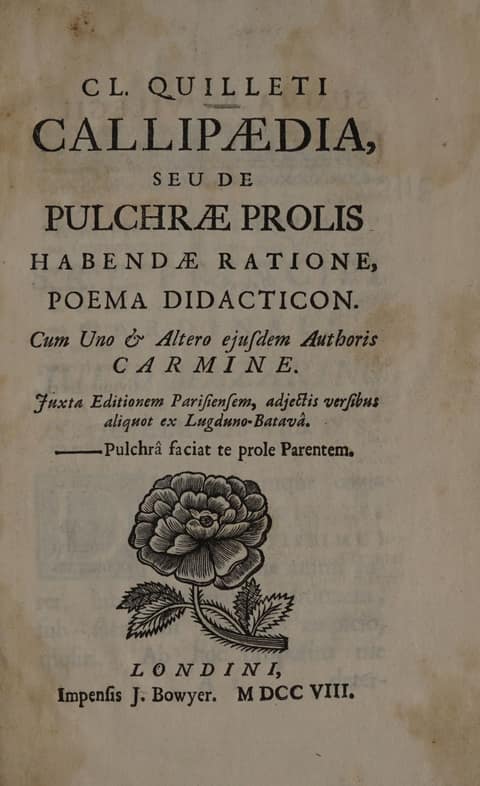
Hover or tap a word to see its match.
Part 1
Callipaedia
BOOK THREE.
Therefore, when the surest signs of a recent
conception
shine forth, such as the sweet thrill that touches
the genitals; and the pleasure that attests
the seed has been received;
and the mouth of the womb tightly closed; and the monthly
courses retained;
and from this the breasts swelling with overflowing blood:
immediately apply your care, young wives, so that the limbs of a
beautiful boy may grow together. The carelessness of pregnant women
very often spoils the embryo, and renders the bodies twisted.
But since Nature has now begun to reveal herself to
our mind, and it has pleased us to penetrate her charming recesses;
let us tell how the pregnant wife should conduct herself in the first
period of conception, so that the fetuses, which coalesce from
well-mingled seed, may take on a beautiful growth.
Only do you, Pierides, most chaste Deities, Muses,
pardon me, if my frequent page sounds the repeated name
of Venus, and brings it once again to your ears.
I shall give her no further praise; a bitter plague
of preg-
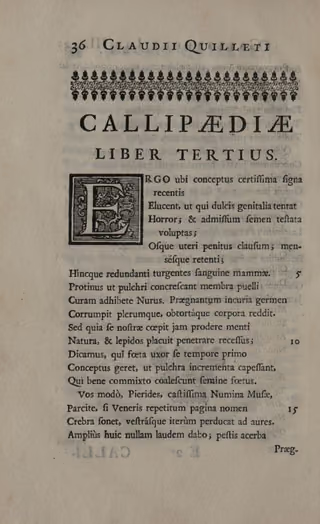
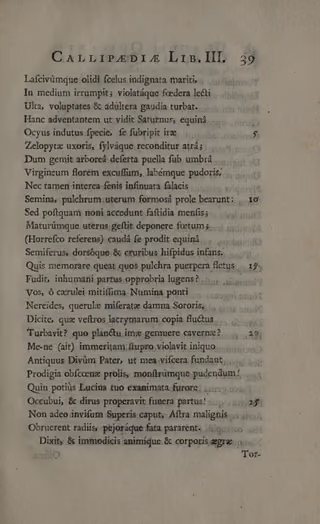
ERGO ubi conceptus certiſſima ſigna
recentis
Elucent, ut qui dulcis genitalia tentat
Horror; & admiſſum ſemen teſtatá
voluptas;
Oſque uteri penitus clauſum; men-
ſéſque retenti;
Híncque redundanti turgentes ſanguine mammæ.
Protinus ut pulchri concreſcant membra puelli
Curam adhibete Nurus. Prægnantum incuria germen
Corrumpit plerumque, obtortáque corpora reddit.
Sed quia ſè noſtræ cœpit jam prodere menti
Natura, & lepidos placuit penetrare receſſùs;
Dicamus, quî fœta uxor ſè tempore primo
Conceptus geret, ut pulchra incrementa capeſſànt,
Qui bene commixto coaleſčunt ſèmine fœtus.
Vos modò, Pierides, caſtiſſima Numina Muſæ,
Parcite, ſì Veneris repetitum pagina nomen
Crebra ſònet, veſtráſque iterùm perducat ad aures.
Ampliùs huic nullam laudem dabo; peſtis acerba
Præg-
Part 2
is Venus to pregnant women, and wickedly mars the fair work.
For if a woman itches with Cupidinous frenzy,
And disturbs the conceived seed with new seed;
Perchance superfetating, and the mouth of the yielding womb
Being reopened, she will heap upon it an ill-formed lump.
Or, the private parts being agitated by excessive coitus, not with impunity,
She will cast forth the scarcely begun fetus in a premature abortion.
Just as when in early Spring, the fertile tree of Cerasus
Has brought forth flowers, the first beginnings of the red fruit,
And has promised fair dishes for virginal tables:
If a rustic right hand shakes its tender branches
With a harmful motion, it will destroy all hope
Of summer Pomona, and ruin the first gifts.
Therefore, the frequent embraces which a pregnant woman practices,
Who will not condemn? when neither the lascivious she-goat
Nor the filthy she-wolves submit to he-goats and wolves,
While they carry bellies heavy with received seed?
But this place, and the subject matter of the work begun, might require
That I sing what nourishment is better for feeding a pregnant woman,
And the precepts of a fair diet.
Yet since learned physicians have written these things everywhere,
Now my labor is to touch upon the principal Point.
As soon as the mingled seed effervesces in the human womb,
And founds fair halls for the eternal soul;
Take care, O Pregnant woman, lest, anxious with sad cares,
You pour dark phantasms over a melancholic mind:
Neither present ugly faces nor filthy monsters
To your eyes; let images be before you everywhere
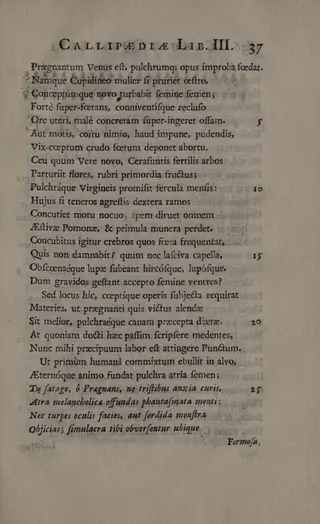
Prægnantum Venus eſt, pulchrumq; opus improba fœdat.
Namque Cupidineo mulier ſi pruriet œſtro,
Conceptúmque novo turbabit ſemine ſemen;
Fortè ſuper-fœtans, conniventíſque recluſo
Ore uteri, malè concretam ſuper-ingeret offam.
Aut motis, coïtu nimio, haud impune, pudendis,
Vix-cœptum crudo fœtum deponet abortu.
Ceu quum Vere novo, Ceraſuntis fertilis arbos
Parturiit flores, rubri primordia fructus;
Pulchráque Virgineis promiſit fercula menſis:
Hujus ſi teneros agreſtis dextera ramos
Concutiet motu nocuo; ſpem diruet omnem
Æſtivæ Pomonæ, & primula munera perdet.
Concubitus igitur crebros quos fœta frequentat,
Quis non damnabit? quum nec laſciva capella,
Obſcœnaéque lupæ ſubeant hircóſque, lupóſque,
Dum gravidos geſtant accepto ſemine ventres?
Sed locus hic, cœptíque operis ſubjecta requirat
Materies, ut prægnanti quis victus alendæ
Sit melior, pulchraéque canam præcepta diætæ.
At quoniam docti hæc paſſim ſcripſere medentes,
Nunc mihi præcipuum labor eſt attingere Punctum.
Ut primùm humanâ commixtum ebullit in alvo,
Æternóque animo fundat pulchra atria ſemen;
Tu ſatage, ô Prægnans, ne triſtibus anxia curis,
Atra melancholicæ offundas phantaſmata menti:
Nec turpes oculis facies, aut ſordida monſtra
Objicias; ſimulacra tibi obverſentur ubique
Part 3
Beautiful, and ever refreshing to a joyful gaze.
For when the work of Nature boils, a spirit poured
Down from the lofty brain mingles in the warm womb
With the prolific humor, and turns it in every direction;
And stamps with invincible strength whatever forms it bears;
Whence the underlying power follows a new law,
And the formative faculty sometimes yields to an unfavorable mold.
Thus, when in a wheaten kneading-trough, moistened with a warm
Stream and pregnant with sharp leaven, the grain
Swells, and the warm mass of fermenting flour rises:
If the baker's hand comes to it, it fashions pastries
Of all kinds, and every sort and every shape of cake.
So too do phantasms turn and shape the seminal mass.
Nor have these things been observed only in a late age,
Or lain hidden from the ancient Sages. For who does not know your
Birth, Chiron the Centaur, dreadful with half-beastly limbs?
Philyra, the most beautiful offspring of Oceanus, once
Had inflamed the breast of Saturn with a consuming love;
And as the old god, impatient of so great a flame, could not
Endure its fires for long, he lies in wait for the tender maid, in the manner
Of a loving god, and plots the defilement of the charming girl.
By chance the Nymph was playing on her native shore,
Accompanied by a chorus of Nereids, when the burning sickle-bearer
Snatches her away, and leads her into the hidden pathless places of the woods.
O what groans! O what sighs does Philyra
Pour forth, while she feels the honor of her virginity snatched
From her, and the foul-smelling kisses of the shaggy God!
Mother Cybele heard her from high heaven,
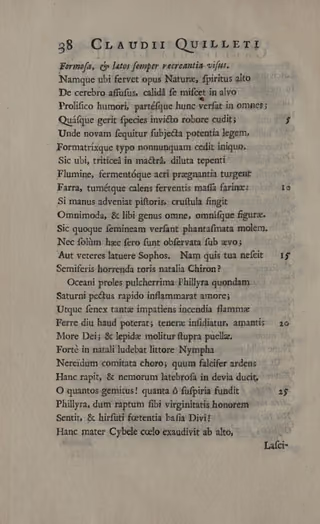
Formoſa, & lætos ſemper recreantia viſus.
Namque ubi fervet opus Naturæ, ſpiritus alto
De cerebro affuſus, calidâ ſe miſcet in alvo
Prolifico humori, partéſque hunc verſat in omnes;
Quáſque gerit ſpecies invicto robore cudit;
Unde novam ſequitur ſubjecta potentia legem,
Formatríxque typo nonnunquam cedit iniquo.
Sic ubi, triticeâ in mactrâ, diluta tepenti
Flumine, fermentóque acri prægnantia turgent
Farra, tumétque calens ferventis maſſa farinæ:
Si manus adveniat piſtoris, cruſtula fingit
Omnimoda, & libi genus omne, omníſque figuræ.
Sic quoque ſemineam verſant phantaſmata molem.
Nec ſolùm hæc ſero ſunt obſervata ſub ævo;
Aut veteres latuere Sophos. Nam quis tua neſcit
Semiferis horrenda toris natalia Chiron?
Oceani proles pulcherrima Phillyra quondam
Saturni pectus rapido inflammarat amore;
Utque ſenex tantæ impatiens incendia flammæ
Ferre diu haud poterat; teneræ inſidiatur, amantis
More Dei; & lepidæ molitur ſtupra puellæ.
Fortè in natali ludebat littore Nympha
Nereïdum comitata choro; quum falcifer ardens
Hanc rapit, & nemorum latebroſa in devia ducit.
O quantos gemitus! quanta ô ſuſpiria fundit
Phillyra, dum raptum ſibi virginitatis honorem
Sentit, & hirſuti fœtentia baſia Divi!
Hanc mater Cybele cœlo exaudivit ab alto,
Part 4
And indignant at the lascivious crime of her rank-smelling husband,
She bursts into their midst; and avenging the violated pledges of her marriage-bed,
She disrupts their pleasures and adulterous joys.
When Saturn saw her approaching, swiftly clothed
In the form of a horse, he steals himself away from the wrath
Of his jealous wife, and hides himself in the dark forest;
While the abandoned girl groans beneath the shady trees
Over her shattered virgin flower, and the stain upon her modesty.
Nor yet, meanwhile, did the implanted seed of the lustful old man
Bless her lovely womb with a shapely offspring:
But after the weariness of the ninth month draws near,
And the womb is eager to lay down its ripened fetus,
(I shudder to relate it) there comes forth with a horse's tail
A half-beast infant, bristling on its back and legs.
Who could recount what tears the lovely new mother
Poured forth, mourning the disgrace of her inhuman birth?
You, O gentlest Deities of the cerulean sea,
Nereids, taking pity on the losses of your complaining Sister,
Tell, what abundance of tears troubled your waves?
With what wailing did the deepest caverns groan?
Did the ancient Father of the Gods (she says) violate me, undeserving,
With an unjust ravishment, only that my womb should pour forth
Prodigies of an obscene offspring, and a shameful monster!
Why did I not rather fall lifeless through your fury, Lucina,
And this dreadful birth hasten my funeral!
Then the Stars would not overwhelm a head so hateful to the Gods above
With their malignant rays, and prepare a worse fate.
She spoke, and through the excessive agonies of mind and body of the sick girl
Laſcívúmque olidi ſcelus indignata mariti,
In medium irrumpit; violatáque fœdera lecti
Ulta, voluptates & adultera gaudia turbat.
Hanc adventantem ut vidit Saturnus, equinâ
Ocyus indutus ſpecie, ſfe ſubripit iræ
Zelopytæ uxoris, ſylváque reconditur atrâ;
Dum gemit arboreâ deſerta puella ſub umbrâ
Virgineum florem excuſſum, labémque pudoris.
Nec tamen interea ſfenis inſinuata ſfalacis
Semina, pulchrum uterum formoſâ prole bearunt:
Sed poſftquam noni accedunt faſftidia menſfis;
Maturúmque uterus geſftit deponere fœtum;
(Horreſco referens) caudâ ſfe prodit equinâ
Semiferus, dorſóque & cruribus hiſpidus infans.
Quis memorare queat quos pulchra puerpera fletus
Fudit, inhumani partus opprobria lugens?
Vos, ô cærulei mitiſſima Numina ponti
Nereïdes, querulæ miſeratæ damna Sororis,
Dicite, quæ veſftros lacrymarum copia fluctus
Turbavit? quo planctu imæ gemuere cavernæ?
Me-ne (ait) immeritam ſtupro violavit iniquo
Antiquus Divûm Pater, ut mea viſfcera fundant
Prodigia obſfcœnæ prolis, monſtrúmque pudendum!
Quin potiùs Lucina tuo exanimata furore
Occubui, & dirus properavit funera partus!
Non adeo inviſum Superis caput, Aſtra malignis
Obruerent radiis, pejoráque fata pararent.
Dixit, & immodicis animíque & corporis ægræ
Part 5
Torminibus, mediis languens vox faucibus hæſit;
Et gelidis maduere udi ſudoribus artus.
Hanc ubi deficientem animo, pia turba Sororum
Cernit, opem medicam ſubitò parat; atque liquore
Cardiaco, actutum dilutam porrigit Ambram,
Quam Pater Oceanus divino promit ab alveo
Ut fugientem animam recreato in pectore ſiſtat.
Utque novas ſenſit vires, lucémque reductam
Nympha gemens; cœpit mœſtas iterare querelas;
Tartareáſque domos, Stygiámque optare paludem:
Dum levis obrepit ſomnus, qui feſſa benignâ
Membra levat requie, & cerebro phantaſmata læta
Obtendens, variâ demulcet imagine mentem.
Tunc ſe ſopitæ Nymphæ dedit altera Nympha
Conſpicuam, variis rerum celeberrima formis,
Phantaſia, inſtabilis vultu; nunc mole puſilla;
Nunc ingens; nunc ſplendenti candore coruſca;
Nunc atris obſcura genis: exinde colore
Diverſo exultans, diversíſque inde figuris.
Hanc rerum innumeræ ſpecies; hanc ordine nullo
Circumſtant, ſimulacra modis volitantia miris.
Sed lepido tandem ore nitens, hac voce jacentem
Aggreditur, ſomníque leves intercipit uſus.
Parce genas lacerare, tui cauſa ipſa doloris
Phillyra; quæ crebrâ Saturnum mente revolvens
Acris equi formâ indutum; hinnitúque ferocem;
Hoc corrupiſti fœdo phantaſmate prolem.
Namque ego, quæ ſpecies humanis mentibus omnes
Part 6
Offer, and stir the internal sense through each detail;
How often I saw you recalling the shaggy limbs of the beastly
God: when he left you, ravished, in the shady
Grove, and fled the insolent quarrels of his wife.
This wild form of a quadruped, this foul image,
Constantly hovering before your mind, and received by your warm
Spirits, and raging through the lovely cavern of your womb,
Joined an equine back to a human head.
But if your mind had not been misguided while you were pregnant,
And you had not ordered me so often to paint for you so foul a form,
Your offspring from the divine seed
Would have been uncorrupted, and not mixed with a base shape.
Yet that I may bring some solace to your sick heart,
And soothe the sad grief of your mind;
Hear what most noble fate awaits your son, Chiron the Centaur.
(And let it not irk you to believe me, for I have often been
Conscious of fate, nor do I always fashion empty dreams.)
That infant who came forth, leaping from your womb,
When he has overcome the raw years of boyhood and youth,
And prudent age has made him a mature man,
Will know nothing vulgar; carried in mind above the ether,
He will penetrate all the inner chambers of the great universe:
The hidden secrets of Nature will not escape him:
The powers of herbs, and the revolutions of the swift heaven
He will master; nor will the hides of his shaggy back
Diminish the work of his mind and the zeal of his sagacious intellect.
She herself too, sprung from the eternal seed of Nereus,
Fair Thetis herself, will entrust her son to be reared by your
F Chiron the Centaur,
Offero, & internum moveo per ſingula ſenſum;
Te quoties vidi recolentem hirſuta ferini
Membra Dei: quum te ſtupratam liquit opaco
In nemore, uxoríſque procacia jurgia fugit.
Hæc fera quadrupedis ſpecies, hæc turpis imago
Uſque tuo obverſans animo, calidíſque recepta
Spiritibus, pulchrúmque uteri bacchata per antrum,
Humano dorſum capiti conjunxit equinum.
At tibi prægnanti ſi mens non læva fuiſſet;
Nec me tam fœdam toties tibi pingere formam
Juſſiſſes, tua divino de ſemine proles
Incorrupta foret, nec turpi mixta figurâ.
Ut tamen ægroto quædam ſolatia cordi
Ferre queam, triſtémque animi ſedare dolorem;
Accipe Phillyridem quæ fors manet optima natum.
(Credere nec mihi te pigeat, nam conſcia fati
Sæpe fui, nec ſemper inania ſomnia fingo.)
Ille tuo exiliens utero qui prodiit infans,
Quum pueri & juvenis crudos ſuperaverit annos;
Maturúmque virum prudens effecerit ætas;
Nil ſapiet vulgare; animo ſuper æthera vectus
Omnia pervadet magni penetralia mundi:
Abdita non illum Naturæ arcana latebunt:
Herbarum vires, rapidíque volumina cœli
Callebit; nec mentis opus ſtudiúmque ſagacis
Ingenii, imminuent villoſi tergora dorſi.
Ipſa quoque æterno Nerei de ſemine creta.
Pulchra Thetis, natum ipſa tuo concedet alendum
F Chironi,
Part 7
Chiron the Centaur, and will submit Achilles to your offspring.
Having spoken these words, quickly vanished into thin air
Imagination, and the phantasms flee the waking Nymph.
By this sleep Philyra feels her strength restored and joy,
and the dream relieves her frenzied cares:
While she ponders these things in her mind, and turns them over with frequent examination,
Light is at last restored to her eyes, and solace to her heart.
But since the sight of a foul object had brought her such cruel loathing;
hereafter she neither deigned to look upon the huge whales,
nor the ugly seals swimming in the great deep,
nor the dark-blue dolphins; nor you either, Proteus;
nor you, offspring of Triton:
But mingling in the constant dances of the Nereids,
prudently she gazed at nothing save beautiful faces.
You therefore, O pregnant women! if your purpose is to bring forth children
of exceptional body, expend skillful care,
that all beautiful things may always come before your eyes.
If a charming boy is in your prayers; let handsome Apollo
delight your sight with his handsome image:
or Alexis, who burned the unhappy Corydon.
If a female of surpassing beauty pleases you more;
gaze either upon Venus, such as Titian painted on a lovely
panel: or Danaë shining with a beautiful face,
while genial Jupiter fills her with showered gold.
Yet if you also have a mind to look up to the no ignoble glory of our age;
let the image of beautiful Phyllis be kept before you,
such as she met our senses,
when once she burned us with frenzied Love.
Chironi, ſobolíque tuæ ſubmittet Achillem.
Hæc fata, in tenues evanuit ocyus auras
Phantaſia, & vigilem fugiunt phantaſmata Nympham.
Hoc ſomno erectas vires & gaudia ſentit
Phillyra, veſanáſque levant inſomnia curas:
Quæ dum mente agitat, verſátque examine crebro,
Reddita lux oculis tandem, & ſolatia cordi.
Sed quoniam tam ſæva tulit ſibi tædia fœdi
Objecti ſpecies; poſthac nec grandia Cete;
Nec turpes magno nantes in gurgite Phocas;
Cæruleos nec Delphinas; nec te quoque, Protheu,
Cernere dignata eſt; nec vos Tritonia Proles:
Aſſiduis ſed Nereidum permixta choreis,
Nil niſi formoſos reſpexit provida vultus.
Vos ergo, ô gravidæ! ſi mens eſt edere natos
Corporis egregii, ſolertem impendite curam,
Ut ſemper ſubeant oculos pulchra omnia veſtros.
Si puer in votis lepidus; formoſus Apollo
Formosâ veſtros delectet imagine viſus:
Aut qui infelicem Corydona urebat Alexis.
Si magis arridet præſtanti fœmina formâ;
Conſpicite aut Venerem, qualem Titianus amœnâ
Depinxit tabulâ: aut Danaën pulchro ore nitentem,
Dum pluvio hanc implet Genialis Juppiter auro.
Si tamen & noſtri decus haud ignobile ſæcli
Suſpicere eſt animus; pulchræ obverſetur imago
Phyllidis, in noſtros qualis fuit obvia ſenſus,
Dum nos veſano quondam torrebat Amore.
Part 8
O how wondrously she shone in conspicuous youth!
What girl had a rosier face? Who was fairer with a snowy
brow? What more pleasing figure displayed itself in her whole
body? And charming Graces poured over her lovely limbs,
and every Cupid breathing through her members?
Yet, O the excessive inconstancy of human lot!
This blooming beauty has now begun to perish, and the unhappy
condition of age longs for the years that have slipped away:
Now wrinkles creep in; now a darkened tooth is exposed in a
gaping mouth, and a bald patch whitening with sparse hair.
And so the flame which once fed upon my inmost marrow
now rests, its fervor extinguished.
Now changed Phyllis slaughters the cruel Loves;
and she who, when beautiful, had given the illness, now, when foul, gives the cure.
Therefore, as she shows herself today so different from her
who once was, flee her, O pregnant women; lest the ugly
image brand an ugly form upon the conceived seed.
Nor let the fair birth of Chariclea pass me by here,
and her snowy face, contrary to her Ethiopian mother.
For while Persina was cherishing in her womb the received seed,
gazing too intently at a painting of Andromeda, comely with a
shining brow, she drew in the white images:
Whence the daughter, born degenerate from her mother's blackness,
how many misfortunes, tossed by land and sea,
how many repeated perils of cruel death did she undergo!
Until Sisimithres, then by chance high priest of the naked Sages,
revealed the fates of the wretched girl,
and disclosed to Hydaspes the cause of her white countenance.
O quâm conſpicuâ fulgebat mira juventâ !
Quæ roſeo ore magis? niveâ quæ fronte puella
Candidior? quæ grata magis ſe corpore toto
Exhibuit moles? & amandos fuſa per artus
Blanda Charis, ſpiránſq; omnis per membra Cupido?
Verùm ô humanæ nimia inconſtantia ſortis!
Floridus hic periiſſe decor jam cœpit, & ævi
Conditio infelix lapſos deſiderat annos:
Jam rugæ ſubeunt: jam dens obſcurus hiulco
Ore patet, raróque albeſcens area crine.
Atque adeo noſtras quæ quondam flamma medullas
Paſcebat, nunc extincto fervore quieſcit.
Nunc ſævos Phyllis mutata trucidat Amores;
Et quæ pulchra malum dederat, dat fœda medelam.
Hanc ideo ut diverſam hodie ſe monſtrat ab illâ
Quæ fuit, effugite ô fœtæ; ne turpis inurat
Effigies, turpem concepto in ſemine formam.
Nec me hîc prætereat Chariclææ candidus ortus,
Et nivea Æthiopi facies contraria matri.
Nam dum admiſſum utero ſemen Perſina fovebat,
Andromedes tabulam candenti fronte decoram
Acriùs inſpectans, ſimulacra albentia traxit:
Unde à maternâ nigredine degener orta
Filia, quot caſus, terrâ jactata maríque;
Quot ſubiit ſævæ repetita pericula mortis!
Donec nudorum antiſtes tunc fortè Sophorum
Siſimithres, miſeræ recluſit fata puellæ,
Atque albi cauſam vultus detexit Hydaſpi.
Part 9
But since, O venerable Priest of warm Meroë!
you do not explain with what strength those images—which you relate
to have changed the maiden’s native color—were endowed,
that they sufficed for so great a work; let it be permitted to me with a keen mind
to inquire in what way Nature performs these miracles.
Nor would the dogmas of the Stagirite suffice for me, chanted
in a vain school, and in need of greater light.
Rather, let it be lawful to enter your gardens, Epicurus, whence I may draw forth
the hidden principles of things, with our
Pierre Gassendi showing the way, than whom no other is more learned
nor anyone better able to unearth the secrets of hidden Nature,
and to unlock her blind recesses.
First of all, whatever is visible in the great world,
and strikes the opposing senses, scatters certain corpuscles,
like subtle cast-off skins, on this side and that in a continuous flow,
into the surrounding air:
and these are called the images of all things:
which, endowed at once with tireless wings and swift motion,
rejoice to penetrate even the smallest passages,
and with their entangled atoms wander through every sense organ.
Nor should you believe here that, by these constant effluxes, the very
mass of the bodily object must finally be recognized
as smaller, and in great part wasting away.
For when these very thin films are abundantly torn away,
others succeed them, and lightly enter from beneath;
whence by a new accession a swift compensation is made.
Indeed, you will think these effigies of things so minute and slender,
that those which have flowed away through
Sed quoniam, ô calidæ Meroës venerande Sacerdos!
Quæ ſimulacra refers patrium mutaſſe colorem
Virginis, haud aperis quo robore prædita, tanto
Suffecere operi; liceat mihi mente ſagaci
Quærere, quo Natura modo hæc miracula præſtet.
Nec mihi ſufficiant Stagiritæ dogmata, vanâ
Decantata ſcholâ, majoríſque indiga lucis.
Aſt hortis, Epicure, tuis, unde abdita rerum
Principia educam, fas ſit ſuccedere, noſtro
GASSENDO monſtrante viam, quo doctior alter
Nec melior quiſquam, Naturæ arcana latentis
Eruere, & cæcas potis eſt referare latebras.
In primis magno in mundo aſpectabile quidquid,
Oppoſitóſque ferit ſenſus, corpuſcula quædam,
Subtiles tanquam exuvias, hinc inde fluore
Continuo, circumfuſas diſpergit in auras:
Atque hæc cunctarum rerum ſimulacra vocantur:
Quæ ſimul impigris pennis, motúque volucri
Prædita, vel minimos gaudent penetrare meatus,
Implicitíſque atomis ſenſoria quæque pererrant.
Né-ve hîc, aſſiduis credas effluxibus, ipſam
Corporei objecti molem debere minorem
Agnoſci demùm, magnáque ex parte fluentem.
Namque hæ pertenues cùm deripiuntur abundè
Bracteolæ; ſubeunt aliæ, levitérque ſubintrant;
Unde novo acceſſu cita compenſatio fiat.
Imò has conciſas adeo exiléſque putabis
Effigies rerum, ut quæ defluxere per annos
Part 10
hundreds of years, heaped up together, could scarcely touch the eyes;
nor could they weave even the thread of a tiny spider.
Nor will you any more deny their swift motion:
for they outstrip the light rays of the Sun, the perennial flow
of light, and the stars of the ethereal world;
with such rapid wings are the likenesses borne!
Indeed, those very ones that have been stripped from charming things
gently affect the eyes and tickle the sense,
since they please by their smoothness; and with globules roundly
woven together, they soothe the pupil with a friendly approach,
and creep into the pores by which its interwoven structure lies open.
Soon the substance of the soul itself, exulting in the congenial
image, distends the inner chambers of the warm heart
with sweet joy; and pouring back the
pleasant likenesses of the object, scatters them through the soft
viscera, and stirs them up gathered beneath the maternal belly:
while Nature, the formative faculty, glowing in the conceived seed,
is affected by these, soon roused by a new standard,
she weaves a beautiful work, after the likeness of the beautiful image.
But if images burst forth from an ugly figure,
they will pierce with fierce roughness both the eyes and the mind:
and, as if with little darts joined in a hostile thread,
they will invade the sad senses and harass the mind.
Whence fierce hatred will soon arise, and anxious horror,
by which the contracted vitals will groan, and will thrust the foul,
the foul likenesses of the figure into the recesses of the womb.
Then therefore the Prometheus who fashions the limbs of the tender
offspring will direct his undertakings toward a hideous appearance,
Centenos, ſimul aggeſtæ vix lumina tangant;
Nec poſſint vel araneoli contexere ſtamen.
Nec magis ipſarum motum inficiere volucrem:
Namque leves Solis radios, fluxúmque perennem
Lucis, & ætherei prævertunt ſidera mundi;
Uſque adeo rapidis alis ſimulacra feruntur!
Ipſa quidem è rebus quæ ſunt derepta venuſtis,
Leniter afficiunt oculos, ſenſúmque titillant,
Quippe ſuo lævore placent; globulíſque rotundè
Contextis, pupillam aditu ſolantur amico,
Irrepúntque poris quibus intertexta pateſcit.
Mox animæ ipſius ſubſtantia convenienti
Idolo exultans, calidi penetralia cordis
Lætitiâ ſuavi diſtendit; & ipſa refundens
Jucunda ſimulacræ rei, per mollia ſpargit
Viſcera, maternâque agitat glomerata ſub alvo:
Queis dum formatrix concepto in ſemine fervens
Afficitur Natura, novâ mox concita normâ,
Pulchrum texit opus, pulchræque ad imaginis inſtar.
Ad ſi de turpi erumpent idola figurâ,
Aſperitate ferâ fodient, oculóſque, animúmque:
Et, quaſi ſpicululis infeſto ſtamine junctis,
Invadent triſtes ſenſus, mentémque laceſſent.
Unde atrox odium mox ſurget, & anxius horror,
Quo contracta gement præcordia, fœdáque trudent
In latebras uteri, fœda ſimulacra figura.
Tunc ideo teneræ prolis qui membra Prometheus
Finget, ad obſcœnam ſpeciem ſua diriget orſa,
Part 11
And the unsightly infant will be marked with an infamous stamp.
Nor should you be amazed that the fetus enclosed in the womb, more swiftly than the mother herself,
Is easily altered to take the marks of a blemish.
For indeed, just as the soft fruit that hangs from a tree
Resists more weakly the dreadful hailstones and the blasts of the savage East Wind,
And suffers heavier damage,
Than the trunk that hardens with woody strength;
So the fetus, the appendage of the womb, is allotted fluid limbs,
Even more exposed to the slightest harms.
Therefore, throughout the entire time of gestation, an image
Flourishing in the mind often directs the kindly work
Of the forming soul, and becomes the rule of a charming form.
First indeed the internal organs, and the threads of the entire bodily mass,
Nature lays down in the first period.
Then she fashions the remaining limbs with an infusion of blood;
And stuffs the fleshy parts with joined muscles;
And stretches out the skin, and adorns the brow and the face.
Wherefore revolve nothing in your mind, and gaze at nothing with a fixed eye,
Which might by chance mar the beautiful work with unjust marks,
And turn Nature from her right path.
Nor is it enough to soothe the mind with charming figures.
Immoderate movements of the body and frequent dances
Let the pregnant wife avoid; especially in the first period
Of conception; and also when the last months show
That the fetus is ripening, and portend childbirth.
For by tender ligaments, during either time,
The suspended fetus clings to the closing womb;
Whence she might expel it premature, or unsightly with a twisted body,
A cruel
Infamíque typo turpis ſignabitur infans.
Nec ſtupeas incluſum utero, matre ocyus ipsâ,
Mutari facilem vari ad ſignacula fœtum.
Nimirum ut mollis qui pendet ab arbore fructus,
Grandinibus diris, & ſævi flatibus Euri
Obſiſtit leviùs, gravioráque damna capeſſit,
Quàm qui lignoſo dureſcit robore caudex.
Sic uteri appendix fœtus, liquentia membra
Sortitur, minimis etiam magis obvia noxis.
Ergo per integrum geſtandi tempus, imago
Mente vigens, animæ formantis dirigit almam
Sæpe operam, lepidæque evadit regula formæ.
Viſcera prima quidem, & totius ſtamina molis
Corporeæ, Natura inſternit tempore primo.
Dein reliquos artus affuſo ſanguine fingit;
Carneáque adjunctis infercit membra lacertis;
Extendítque cutem, frontémque exornat & ora.
Unde nihil volvas animo; nil lumine fixo
Inſpectes, quod fortè notis deturpet iniquis
Pulchrum opus, & recto Naturam è tramite flectat.
Nec ſatis eſt animum lepidis mulcere figuris.
Corporis immodicos motus, crebráſque choræas
Vitet fœta uxor; præſertim tempore primo
Conceptus; necnon ubi matureſcere fœtum
Poſtremi oſtendunt menſes, partúmque minantur.
Quippe ligaminibus teneris, per tempus utrumque
Conniventi utero fœtus ſuſpenſus adhæret;
Unde abigat crudum, torto vel corpore turpem
Sæva
Part 12
the cruel mother, if she agitates her limbs with rapid leaps,
And shakes her springing members with a light foot.
And just as, according to the Coan elder, the lute-girl exercised by a violent leap
Cast forth the first beginnings of the congealed seed,
And destroyed the threads of the commenced offspring;
So too the young wife who dances the Bacchanalia in the eighth
Month prematurely bursts the bonds of the grown fetus;
And with a poured-out stream of overflowing blood,
In a difficult childbirth, pays the penalty for her crime.
Therefore who could bear pregnant women celebrating the Orgies in mad
Games? And, as the noisy exercise-ground invites them,
Entwined in an alternating clasp through mutual arms?
Yet when I here forbid you your accustomed dances,
O pregnant women! do not therefore believe that I praise excessive rest;
Nor let the opposite error hold you.
The best reason persuades us to keep moderation in all things.
Nor should it please a pregnant woman to indulge in sluggish lethargy,
Or to lead an idle life in unwholesome leisure.
When slothfulness accumulates a dense saburra of humors,
The native heat is overwhelmed; nor can the divine
Formative faculty exert itself in the straight outline of the fetus,
And fashion beautiful shapes of the limbs.
But moderate exertion refreshes pregnant women; and while
It gradually unlocks the unseen breathing-pores of the latent heat,
It purges the parts oppressed by thick soot;
Whence the infant, enclosed in the dark prison of the womb,
May transpire better, and strengthen itself with vigorous might,
Whereby a new citizen may burst forth into the immense world.
Sæva parens; rapidis ſi vibret ſaltibus artus,
Concutiátque lævi membra exilientia plantâ.
Utque, ſeni Coo, violento exercita ſaltu
Pſaltria, concretæ genituræ exordia prima
Prodidit; & cœptæ corrupit ſtamina prolis :
Sic etiam octavo quæ Bacchanalia ſaltat
Menſe nurus, grandis diſrumpit vincula fœtus
Præproperè; & fuſo exundantis ſanguinis amne,
Difficili partu, pœnas pro crimine pendit.
Ergo quis inſanis celebrantes Orgia ludis
Prægnantes ferat? &, ſtreperâ invitante palæſtrâ,
Alterno implicitas per mutua brachia nexu?
Quum tamen hîc ſolitis vos interdico choræis
O gravidæ! haud me ideo nimiam laudare quietem
Credatis; nec vos teneat contrarius error.
In cunctis ſervare modum ratio optima ſuadet.
Nec fœtam lento juvet indulgere veterno;
Ducere vel reſidem male-ſana per otia vitam.
Deſidiâ humorum denſam cumulante ſaburram
Nativus calor obruitur; nec ſe Enthea virtus
Formatrix, recto fœtus lineamine poſſit
Exerere, & pulchras membrorum effingere formas.
Sed gravidas modicus recreat labor; atque latentis
Dum ſenſim reſerat ſpiracula cæca caloris,
Expurgat craſsâ oppreſſas fuligine partes;
Unde infans, uteri tenebroſo carcere clauſus,
Tranſpiret meliùs; vegeto & ſe robore firmet;
Quo novus immenſum civis prorumpat in orbem.
Part 13
Yet what exercises here, or what kind of labor
should our Art teach the pregnant woman? Should she, carried in an open
carriage, or joyful in a gentle two-horse chariot toward the pleasure-gardens,
lighten her heart with a mild motion, and exercise her limbs?
Especially where the path is leafy with shady rows of elms,
where the Seine laps the green banks,
and flows with glassy waves through the soil of Paris?
O what great joys thrill the exulting breast
while, flying along on countless axles, they enter
the courses, and return through the planted grounds in frequent circles—
unshorn youths, and maidens in the beauty of their age!
This youth, borne in a gilded chariot and by swift
horses, rejoices: conspicuous for the golden hair over his ivory neck,
he airs a cloak glittering with stripes and gold,
and variegated plumes on his radiant head,
which a splendid hat unfolds from its glowing rim.
In another part, with a fair brow, and charming curls
of hair, sparkling eyes, and firm breasts,
a Maiden passes by, admirable in her unwedded youth,
visible on this side and that. A Lover bows low and adores her.
She returns his greeting with coaxing eyes;
and consoles her grateful Lover with a gracious nod.
Truly, these pleasant spectacles would cheer our
pregnant woman, and stir her heart with a sweet sensation.
But when, the excursions finished, every carriage
seeks home, and the crowded axle glows with the wheels;
then the swift charioteer rushes with rapid impetus toward the wide-open
gate: this fierce one presses hard upon another with loose reins:
Quæ tamen hîc exercitia, aut quod noſtra laboris
Ars genus edoceat prægnantem? an vecta patenti
Curriculo, aut placidis læta ad viridaria bigis
Leni corda levet motu, atque exerceat artus?
Præcipuè umbroſis ulmorum ubi ſemita frondet
Ordinibus, virides quà lambit Sequana ripas,
Pariſiúmque ſolum vitreïs interfluit undis?
O quanta exultans percellunt gaudia pectus
Dum ſeſe innumeris volitantes axibus addunt
In ſpatia, & crebris remeant loca conſita gyris
Intonſi juvenes, pulchráque ætate puellæ!
Hic curru aurato, rapidíſque invectus Ephebus
Gaudet equis: flavo per eburnea colla capillo
Conſpicuus, chlamydem clavis auróque micantem
Ventilat, & varias radianti vertice plumas,
Eximius rutilo quas pileus explicat orbe.
Parte aliâ, fronte albenti, lepidíſque comarum
Cincinnis, tremulis oculis, ſtrictíſque mamillis
Præterit innuptâ Virgo ſpectanda juventâ,
Hinc atq; inde patens. Hanc pronus Amator adorat.
Illa ſalutantem blandis reſalutat ocellis;
Et gratum nutu grato ſolatur Amantem.
Hæc ſanè jucunda hilarent ſpectacula noſtram
Prægnantem, dulcíque agitent præcordia ſenſu.
Aſt ubi, finitis excurſibus, appetit omnis
Rheda domum, fervétque rotis creberrimus axis;
Tunc rapido in patulam celer irruit impete portam
Auriga: hic laxis alium premit acer habenis:
Part 14
And another strives at full gallop to outstrip him;
Hence a crash; hence, when the spokes of the swift wheels are very often
Shattered, a girl with upturned legs exposes
Those parts which the folds of her garment hide under a chaste veil.
And—what, alas, it pains one to have seen!—thrown down at times
In a bloody fall, a tender young maiden groans over
Her injured forehead, or eyes, and blushing cheeks.
Therefore let the pregnant woman avoid these racing contests;
And, departing at a slow pace, let her be the last to close the gate.
For even though harmless fortune should favor the collided carriage,
Yet the very fear of falling, disturbing the pregnant woman,
Will perhaps torment her with a dreadful miscarriage.
For indeed the blood, compressed by icy dread, gathers
Thickly together; and overwhelms the hollow recesses of the heart and womb
With a sudden influx, and chokes the vital heat.
Wherefore I would prefer that courses resounding with crowded carriages
Be avoided; so that she who desires to make herself the mother
Of an exceptional offspring may retire into well-tended gardens,
And, walking on her own feet through pleasant lawns,
Drink in the desirable breezes as the Zephyrs gently blow.
But when the winter suns bring on piercing colds,
With gloomy ice and white hoarfrosts,
And strip the foliage from the trees, and the grass from the fields;
How then, O pregnant woman, will you conduct yourself? Enclosed beneath
A warm chamber, will you cheat Boreas and the stiffening winter,
And will the inclemency of the icy sky never oppress you?
Covered halls indeed, and dwellings impervious to the winds,
I would greatly approve, in which you may pass the harsh months,
Alter & effuſo certat prævertere curſu;
Hinc fragor; hinc, volucrum radiis perſæpe rotarum
Effractis, aperit reſupino crure Puella
Quas ſinus abſcondit caſto velamine partes.
Quódque eheu vidiſſe piget! dejecta cruento
Nonnunquam caſu, mollis virguncula, læſam
Ingemit, aut frontem, aut oculos, maláſq; rubentes.
Hæc ideo vitet curſus certamina Prægnans;
Et tardo cedens greſſu Portam ultima claudat.
Namque & colliſæ quamvis innoxia rhedæ
Sors faveat; tamen & gravidam metus ipſe cadendi
Conturbans, diro forſan vexabit abortu.
Quippe coït gelidâ preſſus formidine ſanguis
Confertim; cordíſque cavos uterique receſſus
Obruit affluxu ſubito, jugulátque calorem.
Unde ego maluerim crebro reſonantia curru
Vitari ſpatia; ut cultos ſecedat in hortos,
Et pedibus ſpatiata ſuis per amœna vireta,
Hauriat optandas Zephyris mulcentibus auras,
Quæ facere eximiâ cupiet ſe prole Parentem.
Quum verò hiberni penetralia frigora Soles
Inducent, triſti glacie, caniſque pruinis;
Arboribúſque comas vellent, & gramina campis;
Quò tandem te fœta geres? An clauſa tepenti
Sub thalamo, Boream falles brumamque rigentem,
Nec te uſquam gelidi premet inclementia cœli?
Atria operta quidem, ventíſque impervia multùm
Tecta probem, quibus immites traducere menſes,
Part 15
And happily bring forth a vigorous fetus.
Yet since a serene winter sometimes smiles with a moderate
North wind, and the brief sun offers bright hours;
Spend these cheerfully and courteously in visiting
Matrons and young wives, whom the nearest crossroads
And a pleasing neighborhood with bordering roofs join to you.
Here let it be permitted to mingle sweet jests; here to dilute
Serious matters with games, as well as the weariness of a swollen womb.
And that which I ought faithfully to have enjoined upon your pious self
Long ago: Above all, venerate the Supreme Parent,
Who granted that you conceive a living fetus from fertile
Seed, and preserves it until the time of birth.
Approach His sacred temples frequently; and heap the altars,
Ever to be worshipped, with gifts and holy honors:
So that at last your offspring, poured forth by an auspicious Deity,
May pass a blameless life with praiseworthy morals;
And return its heavenly mind to its native Olympus.
And may you observe these laws from the first movement of
Conception; until, with a strong effort, the fetus,
Bursting from the womb, batters the maternal barriers.
Indeed, even when the time of mature birth is just now
At hand, and the boy, in need of a greater light,
Eagerly desires at last to bring himself forth into the ethereal breezes;
Then also take care lest the infant rush forth with a faulty impulse,
And distort its body in a difficult birth.
At this time, if you do not know, the waxen limbs of the poor little one
Are awkwardly drawn (alas!) into whatever shape;
And an Agrippa often receives an ungraceful figure.
Et validum poſſis felix educere fœtum.
Sed quoniam modico nonnunquam Aquilone ſerena
Ridet hyems, nitidáſque brevis ſol exhibet horas;
Has læta impendas civiliter in viſendis
Matronis nuribúſque, tibi quas proxima jungunt
Compita, confiníque placens vicinia tecto.
Hîc dulces miſcere jocos; hîc ſeria ludis
Diluere, & tumidi liceat faſtidia ventris.
Quódque piæ dudum tibi præcepiſſe fidelis
Debueram. In primis ſummum venerare Parentem;
Qui te fœcundo vivum de ſemine fœtum
Concepiſſe dedit, partûſque ad tempora ſervat.
Hujus adi ſacra templa frequens; ſempérq; colendas
Muneribus cumula, ſanctis & honoribus Aras:
Ut demum fauſto proles tua Numine fuſa,
Tranſigat inocuum laudandis moribus ævum;
Et mentem patrio cœleſtem reddat Olympo.
Atque has à primo conceptus momine leges
Obſerves; donec, valido conamine, fœtus
Erumpens utero, materna repagula pulſet.
Imò & maturi quum jam jam tempora partus
Inſtabunt; lucíſque Puer majoris egenus
Geſtiet æthereas tandem ſe prodere in auras;
Tunc quoque provideas ne proruat impete pravo,
Difficilíque ortu corpus diſtorqueat infans.
Cerea, ſi neſcis, hoc tempore, membra miſelli
In quamcumque (nefas!) formam ducuntur ineptè;
Et ſæpe illepidam ſortitur Agrippa figuram.
Part 16
And therefore if it comes forth with feet extended; or if
it stretches this or that hand toward the female portals;
or with its buttocks turned attempts a painful birth;
soon let the faithful midwife, by the effort of her skillful right hand,
correct the erring motion, and guide it back for the better:
until with the head brought forth first, and the rest of the body
following, the child brings itself out with an easy effort.
For this is the only suitable way for all who are born;
that they present themselves into the light of heaven with the crown of the head first.
Nor is it enough that a charming infant has emerged with an agile exit;
unless, as new pledges of a lawful bed,
the tender nursling is cherished in a cradle placed nearby.
Especially beware lest the swaddling-band with a tight coil
compress the soft limbs; or lest from the very threshold of life
an improvident Nurse induce a twisted shape.
Do not the tight bonds, which often with an disorderly roll
gird the side of the Boy, and his tender ribs,
make his back hunched with a deformed hump;
and add raised wings to his rising shoulders?
Moreover, many diseases vex childish
bodies, to which you should hasten to apply a gentle remedy;
if you desire to preserve the innate grace of your offspring.
Above all, the exanthemata which the impurity of maternal
blood begets, and the pustules threatening unsightly
ulcers, Paean will heal with his skillful art.
Lest by chance a foul scar corrupt the smiling eyes,
and the nose, and the cheeks, and the smoothness of the skin.
Alas! how many maidenly charms with a monstrous slaughter
Atque ideo extentis pedibus ſi prodeat; aut ſi
Hanc illám-ve manum muliebria ad oſtia tendat;
Vel clune obverſo natales tentet acerbos;
Mox fida obſtetrix, habilis molimine dextræ,
Corrigat errantem motum, in meliúſque reducat:
Dum capite educto primùm, reliquóque ſequente
Corpore, ſe facili promat conamine Natus.
Unicus hic etenim cunctis naſcentibus aptus
Eſt modus; ut primo in cœlum ſe vertice prodant.
Nec ſatis eſt egreſſu agili emerſiſſe venuſtum
Infantem; ni legitimi nova pignora lecti,
Appoſitíſ-ve tener cunis foveatur alumnus.
Præcipuè caveas ne duro faſcia gyro
Mollia membra premat; né-ve ipſo à limine vitæ
Inducat tortam Nutrix improvida formam.
Nónne incompoſito quæ fæpe volumine cingunt
Vincula ſtricta latus Pueri, coſtáſque tenellas,
Gibboſum faciunt deformi tubere dorſum;
Elatáſque humeris alas ſurgentibus addunt?
Quin etiam multi vexant puerilia morbi
Corpora, queis lenem properes adhibere medelam;
Si cupis innatum prolis ſervare decorem.
Imprimis quæ materni exanthemata gignit
Sanguinis illuvies; papuláſque inhoneſta minantes
Ulcera, ſollerti Pæan medicabitur arte.
Ridentes ne fortè oculos, nasúmque, genáſque,
Lævorémque cutis corrumpat fœda cicatrix.
Heu! quot Virgineos immani ſtrage lepores
Part 17
has this foul pestilence destroyed! How many lilies has it snatched
from Chloris's brow, and slain how many tender loves!
Galatea herself, once like a goddess, before
she had felt the filthy contagion of this loathsome plague,
now, through the savagery of so great a disease, mourns the pitted marble
of her cheeks, and the sharp affliction of a weeping eye.
Even handsome Amyntas, the delight of his sex,
for whom countless maidens once pined with love,
after the dread scars of the pestilence defiled his face,
is now everywhere spurned by every lover.
Yet since this dutiful care belongs to the descendants of Paeon,
and exceeds the endeavors of a slender bard,
I would scarce venture to bring aid against so great a disease.
Besides, who could bear the bold undertakings of our Muse,
if those things which we read sung in learned measure, great
Sainte-Marthe, by your Camenae,
I should vainly repeat with ungraceful din?
Rather, you who delight to know thoroughly the plagues of tender youth,
and to avert this blemish from a lovely face,
ply the divine poems of Sainte-Marthe with frequent
hand, and unroll his learned pages.
He drank all the waters of Helicon; he drained all the rivers
of Pindus; there is no art of Apollo he did not know.
Meanwhile, let leisure succeed to my pen;
and she who, borne up to heaven in Pegasean flight,
looked down upon the lowly earth, now sinking down in swift descent,
let her rest at last in the peaceful shade.
Perhaps it will be that one day my breast will admit Phoebus
Perdidit hæc immunda lues! quot lilia fronti
Chloridis eripuit, teneróſque occidit amores!
Ipſa Deæ quondam ſimilis Galatæa, priuſquam
Sordida ſenſiſſet tetræ contagia labis,
Nunc tanti morbi feritate, cavata genarum
Marmora, & acre malum luget ſtillantis ocelli.
Ipſe quoque innumeræ quem deperiere puellæ,
Deliciæque ſui ſexus formoſus Amyntas;
Poſtquam dira luis fœdarunt ſtigmata vultum;
A cunctâ paſſim jam faſtiditur Amante.
Quum tamen hæc ad Pæonios pia cura Nepotes
Spectet, & exilis ſuperet molimina Vatis,
Haud ego ſuſtineam tanto ſuccurrere morbo.
Præterea noſtræ quis cœpta audacia Muſæ
Ferre queat; ſi quæ docto modulamine, Magne
SAMMARTHANE, tuâ legimus cantata Camœnâ,
Hæc eadem illepido vanus clangore recantem?
Vos potiùs teneræ ætatis pernoſcere peſtes
Quos juvat, & pulchro labem hanc avertere ab ore,
Vos SAMMARTHANI divina Poëmata, crebrâ
Pertractate manu, doctáſque evolvite chartas.
Hîc totas Heliconis aquas; hîc flumina Pindi
Tota hauſit; nullam non novit Apollinis Artem.
Interea noſtræ ſuccedant otia pennæ;
Et quæ Pegaſeo in cœlum ſubvecta volatu
Abjectam deſpexit humum, nunc præpete lapſu
Subſidens, placidâ demum requieſcat in umbrâ.
Fors erit ut quondam redeuntem pectora Phœbum
Part 18
admit him, and I may sing of the fellowship of a beautiful Mind,
And of uncorrupted morals in a handsome body.
For who indeed could bear a Soul blind with the thick darkness of errors,
Or foul with vices, moving comely
Limbs? Or who would mingle the breath poured down from the heavenly height
With the filth of the foul Earth?
Yet a work of such great reason, such great endeavors,
The iron madness of our age would scarcely deserve:
Since today the love of virtue and the pursuit of modesty
Are in exile, and scarcely any worshiper of honor appears:
Ever since, for the furious duties of perpetual Mars,
Our Gaul adopted foreign morals.
You therefore (Native Gods) whom the Celtic world
Touches, and the declining glory of the Hectorean race;
Do you change these sad fortunes; and support the faltering
Glory of the Kingdom; and bring in sweet Peace;
That at last we may cultivate anew the harmless arts of Pallas,
And the Parnassian Laurel may return to its own value.
Admittant, pulchræque canam conſortia Mentis,
Atque incorruptos formoſo in corpore mores.
Ecquis enim craſſâ errorum caligine cæcum,
Aut fœdum vitiis Animum, ſpecioſa cientem
Membra ferat? vel cœleſti de culmine fuſam
Miſceat obſcœnæ Telluris ſordibus, auram?
Sed tantæ rationis opus, conamina tanta,
Ferrea vix noſtri mereat veſania ſæcli:
Quippe hodie virtutis amor, ſtudiúmque pudoris
Exulat, apparétque ullus vix cultor honeſti:
Ex quo ad perpetui furialia munera Martis,
Noſtra peregrinos adſcivit Gallia mores.
Vos adeo (Indigetes Divi) quos Celticus orbis
Tangit, & Hectoreæ deſciſcens gloria gentis;
Vos triſtes mutate vices; Regníque fatiſcens
Suſtentate decus; dulcémque inducite Pacem;
Ut tandem innocuas recolamus Palladis artes,
Inque ſuum redeat pretium Parnaſſia Laurus.