Hover or tap a word to see its match.
Part 1
A modest priesthood, and the most pleasing comforts of a moderate income,
have long been wished for: yet, through a harsh deity,
they flee from me; and I am forbidden to pass a sweet life.
Therefore, Eudoxus, since I am pleased to inhabit a humble home
and city dwellings, and to devote myself to the peaceful Muse,
until Fortune changes her hostile course,
what shall I write with an easy pen, or in pedestrian speech?
Neither blind Love nor the accursed lust for gold
possesses me. To the highest affairs of state I neither hope to be called,
nor have I the strength; who would dare entrust himself to so great a burden?
FLAMINIUM tenue, & modico gratiſſima cenſu
Commoda jamdudum optantur: ſed, numine duro,
Me fugiunt; dulcémque vetor traducere vitam.
Ergo humiles, EUDOXE, lares, urbanáque tecta
Quum colere, & placidæ libeat me tradere Muſæ,
Dum tamen infeſtum mutet Fortuna tenorem,
Quid facili ſcribam calamo, aut ſermone pedeſtri?
Non me cæcus Amor; non auri ſacra cupido
Occupat. Ad ſummas rerum nec ſpero vocari
Nec valeo; quis tantæ auſit ſe credere moli?
Part 2
You manage the affairs of the Empire; straightway your mind is anxious:
A thousand tasks assail you all at once: you spend
Sleepless nights; no pleasure remains for you.
Should a chilling rumor leak out, that the Dutch have at last
Ratified the treaties so often refused with the Spaniards,
And are breaking off the treaty long ratified with us;
This is displeasing. Should the Austrian enemy corrupt the faithless
Bavarian, and Germany spurn its ancient loyalty;
This is harmful, this is as bitter as gall. Should our ships fight in vain
Off the shores of the Tuscans, and by a fleeing retreat—
Oh, the shame!—relieve a petty town from a long siege;
This tortures the breast, and overturns hoped-for joys.
Should a distinguished youth fall by a cruel blow,
The darling of his Father and of his Young Bride; soon impious wars
Are condemned: senseless souls cry out against savage Mars
At the crossroads; and he who sits at the arduous helm
Of the supreme scepter is loaded with unjust curses.
If annual tributes increase while the People gnash their teeth:
If each man grieves that his substance is consumed in the expenses
Of a long war; terror arises lest perchance a sedition,
Breaking out, should stir fierce hearts with insane fury,
And inflamed citizens rush into mutual wounds.
Why should I recount the various machinations of envy? the savage
Arts of striking down? and the food infected with hidden poison,
Whereby he who sustains the Orb of the Kingdom is assailed?
O wretched cares of Men! we gaze up in admiration at such great perils,
And at Swords hanging from gilded ceilings,
Nor do the precipitous summits terrify us!
Res geris Imperii; tibi protinùs anxia mens eſt:
Te ſimul invadunt ſexcenta negotia: noctes
Inſomnes ducis; ſupereſt tibi nulla voluptas.
Frigidus emanet rumor, jam fæpe negata
Fœdera cum Hiſpanis tandem ſanxiſſe Batavos,
Sancitúmque diu nobiſcum abrumpere fœdus;
Diſplicet hoc. Bavarum infidum corruperit hoſtis
Auſtriacus; veterémque fidem Germania ſpernat;
Hoc nocet, hoc felli eſt. Thuſcorum ad littora fruſtrà
Pugnarint noſtræ puppes, reditúque fugaci
Proh pudor! oppidulum longâ obſidione levarint;
Hoc cruciat pectus, ſperatáque gaudia vertit.
Occiderit duro juvenis ſpectabilis ictu,
Deliciæ Patris atque Nurus; mox impia bella
Damnantur: ſævum clamant per compita Martem
Vecordes Animæ; diríſque oneratur iniquis,
Ardua qui ſummi ſedet ad moderamina ſceptri.
Annua ſi creſcunt, Populo frendente, tributa:
Si ſua quiſque dolet, longi in diſpendia belli,
Abſumi; pavor exoritur ne fortè coorta
Seditio, inſano moveat fera corda furore,
Accensíque ruant in mutua vulnera cives.
Quid varia invidiæ memorem molimina? ſævas
Percutiendi Artes? & cæco infecta veneno
Pabula, queis petitur Regni qui ſuſtinet Orbem?
O miſeras Hominum curas! diſcrimina tanta,
Pendentéſque auratis è laquearibus Enſes
Suſpicimus, nec nos prærupta cacumina terrent!
Part 3
How much more desirable is the constancy of a tranquil Mind,
Which, scorning the trappings and vanities of the World, mingles
Only with the gods above, and aspires to the highest Olympus!
Content with little, and not overwhelmed by the weight of affairs,
It looks down upon the lower realms, and sets itself among the Stars.
As soon as Phoebus raises his ruddy head from the Eastern waves,
And bathes the lands in ethereal light,
Above all it rejoices to venerate the Parent of Men and Gods,
And pays unblemished honors at the Altars.
Then, contemplating the sacred Mysteries of our FAITH,
It marvels at the fall of the Human Head, and the abstruse work
Of a redeemed Race; and looks up in awe at the supreme decrees,
Which, alas, far surpass our comprehension.
Next, having emerged from so great a sea, the most beautiful Machine
Of the World is beheld: How the Elements renew their perennial
Struggles. How the Stars, adorning the lofty Sphere,
Change the successions of things and the fruitful seasons.
How the Earth, warmed by the new Spring, loosens itself
Into flowers, and bathes living breaths in sweet fragrance.
How the Sun ripens with its rays the gifts of Ceres,
And matures the fruits of the trees with its summer lamp.
How in Autumn the Vintage flows, pressed from swelling clusters,
And fills the casks with nectarous juice;
Which gently softens the hardships of life and the winter colds,
And distills sweet slumber through the limbs;
While mad Boreas rushes forth, and cherishes the seeds
Conceived in the earth with frozen ice and snows.
Amid these things, it recognizes the supreme Deity shining forth,
Quàm magis optanda eſt placidæ conſtantia Mentis,
Quæ ſpernens Mundi phaleras & inania, ſolis
Se miſcet ſuperis, ſummúmque affectat Olympum!
Hæc modico contenta, nec obruta pondere rerum
Deſpicit infernas ſedes, ſéque inſerit Aſtris.
Hæc ſimul Eois rutilum capit exerit undis
Phœbus, & æthereo perfundit lumine terras,
Inprimis venerari Hominum Divúmque Parentem
Gaudet, & illæſos Aris perſolvit honores.
Tum noſtræ recolens FIDEI Myſteria ſacra,
Humani Capitis lapſum, Generíſque redempti
Abſtruſum miratur opus; decretáque ſumma
Suſpicit, heu! noſtrum longè ſuperantia captum.
Dein tanto emerſi pelago, pulcherrima Mundi
Machina ſpectatur. Pugnas Elementa perennes
Ut renovent. Ut ſublimem diſtincta per Orbem
Aſtra vices rerum, fœcundáque tempora mutent.
Ut Tellus ſe Vere novo tepefacta reſolvat
In flores, ſuavíque animas perfundat odore.
Ut Sol maturet radiis Cerealia dona,
Et coquat arboreos æſtivâ lampade fœtus.
Ut fluat Autumno tumidis expreſſa racemis,
Nectareóque cados repleat Vindemia ſucco;
Qui vitæ ærumnas, hybernáque frigora lenis
Molliat, & dulcem ſtillet per membra ſoporem;
Dum ruet inſanus Boreas, conceptáque terrâ
Semina, concretâ glacie nivibúſque fovebit.
Hæc inter, ſummum agnoſcit ſplendeſcere Numen,
Part 4
Which enacted these laws, and preserves them in eternal order;
Until the ancient World, its framework shattered,
Perishes, and by its destruction reveals its first beginnings.
Nor does the Mind, swift through all particulars, stop at these;
But ranging abroad, expands itself into the wide World.
It marvels at the countless citizens of the sea, every race
Of swimmers; the painted birds; the dreadful bodies
Of wild beasts; and the powers of Man reigning over all.
Could a worthier meditation captivate our mind?
Could I better prove myself a Man, powerful in reason?
Especially if I also survey myself with the rays of my mind;
And bravely uphold the glory and noble office of human
Nature, and shatter the ranks of vices?
For what vigor is there in Man? what glory? if while
He subdues all animals beneath his rule, he can scarcely
Direct himself, and flee the contagions of a base age?
Snatched at last from these rocks by the strength of an older mind,
And stretched out upon a peaceful shore,
I rejoice, and plant kisses upon the land I have reached.
I felt indeed (nor has oblivion of my past life yet
Struck me) my breast tossed by a hostile whirlwind.
I felt the disorderly motions of Nature arise,
And depraved Sense oppose tender Reason;
While untamed heat, in the flower of madcap youth,
Scorched my liver with a more fervent tide of blood.
And I too, according to the measure of my talent, had a mind
To handle certain public affairs; lest I should pass my life
Ingloriously, worshiping slothful Penates without praise.
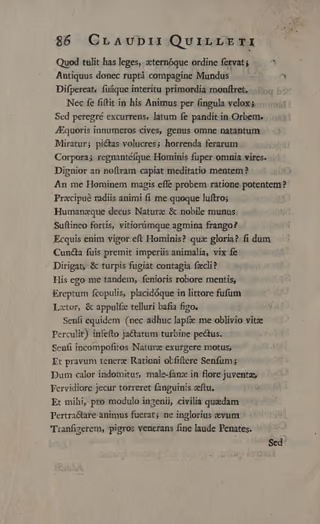
Quod tulit has leges, æternóque ordine ſervat;
Antiquus donec ruptâ compagine Mundus
Diſpereat, ſuáque interitu primordia monſtret.
Nec ſe ſiſtit in his Animus per ſingula velox;
Sed peregrè excurrens, latum ſe pandit in Orbem.
Æquoris innumeros cives, genus omne natantum
Miratur; pictas volucres; horrenda ferarum
Corpora; regnantéſque Hominis ſuper omnia vires.
Dignior an noſtram capiat meditatio mentem?
An me Hominem magis eſſe probem ratione potentem?
Præcipuè radiis animi ſi me quoque luſtro;
Humanæque decus Naturæ & nobile munus
Suſtineo fortis, vitiorúmque agmina frango?
Ecquis enim vigor eſt Hominis? quæ gloria? ſi dum
Cuncta ſuis premit imperiis animalia, vix ſe
Dirigat, & turpis fugiat contagia ſæcli?
His ego me tandem, ſenioris robore mentis,
Ereptum ſcopulis, placidóque in littore fuſum
Lætor, & appulſæ telluri baſia figo.
Senſi equidem (nec adhuc lapſæ me oblivio vitæ
Perculit) infeſto jactatum turbine pectus.
Senſi incompoſitos Naturæ exurgere motus,
Et pravum teneræ Rationi obſiſtere Senſum;
Dum calor indomitus, male-ſanæ in flore juventæ,
Fervidiore jecur torreret ſanguinis æſtu.
Et mihi, pro modulo ingenii, civilia quædam
Pertractare animus fuerat; ne inglorius ævum
Tranſigerem, pigros venerans ſine laude Penates.
Part 5
But after the harsh force of an immature mind has yielded,
And the once fierce fire of the humors has cooled down;
I love harmless delights, and a learned quiet.
O fortunate lot! O consolations of a noble
Mind, and a sweet harbor after so many perils!
Yet do not believe me so dull, as to praise only my own
Leisure, and an idle life above all things.
I have not sworn allegiance to the doctrines of the master Aristippus,
Who is wise in hiding, and keeps himself away from public affairs.
There are those whose hearts the Titan fashioned from a better clay,
And upon whom he bestowed the excellent Arts of ruling.
I would not wish these to recline idle beneath the sluggish shade,
And the innate strength of their minds to grow torpid.
For indeed the highest glory of Man is, if he shows himself
Not born for himself alone; but undertaking great duties,
He cherishes the wide world with useful Virtues.
O Gauls! O how many illustrious trophies; how many cities,
How many peoples conquered far and wide; how many kingdoms would be lacking to us;
If he had refused both his cares, and his labor, and his mind,
Jules Mazarin, the immortal glory of the Ausonian Senate!
With what strength of counsel does he excel! with what vigor
Of heart does he act, while he prudently passes his days in the lofty Court,
And restrains the unbridled rage of the fierce Iberian!
But few who can manage such great things, whom impartial Jupiter
Has loved, are to be met with. Not every Mind turns the celestial
Orbs. There is need of an Alcides if the fabric of the World
Is to be borne; or if the Earth is to be redeemed from cruel Tyrants.
Meanwhile, for those in whose noble breasts there breathe
Sed poſtquam immaturi animi vis aſpera ceſſit;
Humorûmque acer quondam deferbuit ignis;
Innocuas amo delicias, doctámque quietem.
O fortunatam ſortem! ô ſolatia mentis
Ingenuæ, & dulcem poſt tot diſcrimina portum!
Ne tamen obtuſum me ita credas, ut mea ſolùm
Otia, & ignavam laudem ſuper omnia vitam.
Non in Ariſtippi juravi ſenſa magiſtri,
Qui ſapit in latebris, ſéque à civilibus arcet.
Sunt quibus è meliore luto præcordia Titan
Finxit, & egregias regnandi contulit Artes.
Hos nolim lentâ vacuos recubare ſub umbrâ;
Ingenitûmque ipſis animi torpeſcere robur.
Gloria quippe Hominis ſumma eſt, ſi non ſibi ſoli
Se natum oſtendat; ſed munia magna capeſſens,
Utilibus latum foveat Virtutibus orbem.
O Galli! ô nobis quot clara trophæa; quot urbes,
Quot victi latè populi; quot regna deeſſent;
Si & curas, operámque ſuam, mentémque negaſſet
JULIUS Auſonii decus immortale Senatus!
Hic quo conſilii præcellit robore! quâ vi
Cordis agit, celsâ dum prudens degit in Aulâ,
Effrænémque acris rabiem compeſcit Iberi!
Sed qui tanta gerant pauci, quos æquus amavit
Juppiter, occurrunt. Non omnis Mens rotat orbes
Cœleſtes. Alcide opus eſt ſi machina Mundi
Geſtanda; aut ſævis Tellus redimenda Tyrannis.
Intereà quibus ingenuo ſub pectore ſpirant
Part 6
souls devoted to the Muses, and tranquil Virtue;
It is better to despise mad cares and the labors of men,
And to pluck eternally green laurels:
Those, namely, which flourish on the twin peak of the Aonides,
And adorn the wreathed temples with conspicuous foliage;
And which long preserve the fairest names of Heroes,
And hand down a life that will endure through the ages.
Cultivate these, therefore, according to your custom; bedew these continually
With kindly dew, Eudoxus. Kindly father Apollo urges this:
The Pierian Goddesses urge it; and the Virtue implanted within you.
Addicti Muſis Animi, tranquilláque Virtus;
Deſpicere inſanas curas, hominúmque labores
Præſtat, & æternùm virides decerpere lauros:
Scilicet Aonidum gemino quæ vertice florent,
Conſpicuáque ornant redimitos tempora fronde;
Quæque diu Heroum pulcherrima nomina ſervant,
Et duraturam tradunt per ſæcula vitam.
Has igitur pro more colas; has rore benigno
Uſque, EUDOXE, riges. Suadet ſator almus Apollo:
Pierides ſuadent Divæ; tibíque inſita Virtus.