Hover or tap a word to see its match.
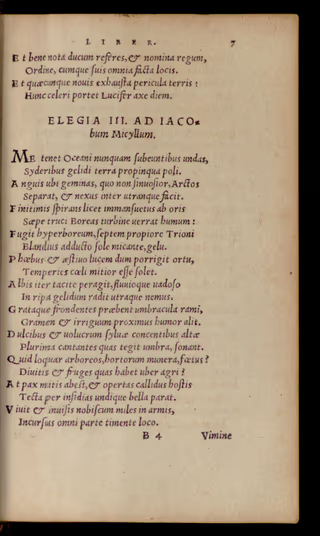
A land near the icy pole holds me, with stars
that never sink beneath the waves of the Ocean;
where the Serpent, than which none is more winding, separates
the twin Bears, and makes coils between them both.
Although untamed Boreas, blowing from neighboring coasts,
often sweeps the ground with a savage whirlwind:
the hyperborean frost flees, when the sun shines more mildly,
brought closer to the northern Wain.
And while Phoebus extends his light from his summer rising,
the weather of the sky is wont to be milder.
The Elbe makes its journey silently, and with its shallow stream
it grazes the cool grove on either bank.
And the leafy branches provide pleasing shade,
and the nearby moisture nourishes the well-watered grass.
And the deep woods resound with the sweet harmonies of birds,
which the shade conceals as they sing many a song.
Why should I speak of the tree-borne fruits, the gifts of the gardens?
And the crops which the richness of the fertile field holds?
But gentle peace is absent, and a cunning enemy, through
hidden ambushes, prepares covert wars on all sides.
And the soldier lives with us in hateful arms,
while the place fears incursions from every part.
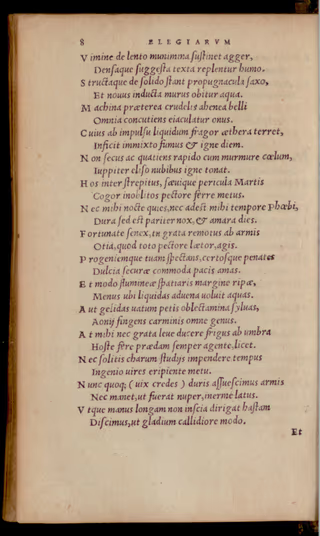
The rampart holds up its defenses with pliant wickerwork,
And the dense woven framework is filled with heaped-up earth.
And fortifications built of solid stone stand firm,
And the new wall is encompassed by channeled water.
Moreover, the cruel bronze machine of war
Hurls forth its payload, shaking everything.
From its discharge the crash terrifies the clear air,
And smoke mingled with fire pollutes the day.
Just as when, shaking the heavens with a rushing roar,
Jupiter thunders with fire struck from the clouds.
Amidst these clamors and the perils of savage Mars
I am forced to bear unforgotten fears in my breast.
Neither at night is there rest for me, nor does it come during the time of Phoebus,
But night is equally harsh, and the day bitter.
Fortunate old man, far removed from arms, you pass
Pleasing leisure, at which I rejoice with all my heart.
And gazing upon your offspring and your steadfast household gods,
You love the sweet advantages of secure peace.
And sometimes you stroll on the margin of the riverbank,
Where the arriving Main rolls its clear waters.
Or you seek the cool woods, the delights of poets,
Fashioning every kind of Aonian song.
But for me it is not permitted to draw a light coolness from the pleasing shade,
With the enemy almost constantly driving away plunder.
Nor to devote precious time to my accustomed studies,
Since fear strips the strength from my intellect.
Now also (you will scarcely believe it) we are growing accustomed to harsh weapons,
Nor does my side remain unarmed, as it was recently.
And we are learning how a practiced hand may aim the long spear,
And how to wield a sword with greater skill.
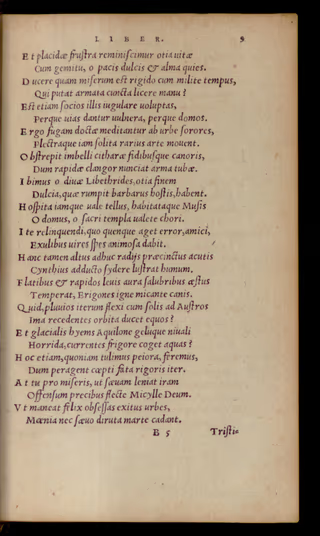
And in vain we remember the leisure of a peaceful life
with a groan, O sweet and nourishing quiet of peace!
How wretched it is to spend time with a harsh soldier,
who thinks everything is permitted to his armed hand!
It is even a pleasure for them to slaughter their allies,
and wounds are dealt through the streets and through the homes.
Therefore the learned sisters contemplate flight from the city,
and now they move their plectrums more rarely with their accustomed skill.
It drowns out the unwarlike lyre and the tuneful strings,
while the clangor of the fierce trumpet announces arms.
We shall go, O divine Libethrides, the sweet leisure,
which the barbarian enemy shatters, has come to an end.
And now farewell, hospitable land, and O home inhabited by the Muses,
farewell, O temples of the sacred choir.
Go, friends who must be left behind, wherever wandering shall drive each of you,
spirited hope will give strength to the exiles.
Yet high Cynthius, girt with sharp rays,
still illuminates this ground with his brought-near star.
And a light breeze with healthy breaths tempers the fierce heats,
while the fire of Erigone's dog gleams.
What, when the lowest orbit leads the retreating horses
of the turned sun again to the rainy South?
And icy winter, rough with the North Wind and snowy frost,
shall congeal the running waters with its cold?
This too we shall bear, since we have borne worse things,
until the fates complete the journey of the begun harshness.
But you, Micyllus, on behalf of the wretched, sway the offended God
with prayers, so that he may soften his cruel anger.
So that a happy outcome may await the besieged cities,
and the walls may not fall, destroyed by cruel war.
And may the noble arts not utterly collapse in this world
from sorrowful tumults, as the enemy puts the Muses to flight.
Pray that a more peaceful time returns for them after the wars:
thus may it be granted to you to enjoy perpetual peace.
ME tenet Oceani nunquam ſubeuntibus undas,
Syderibus gelidi terra propinqua poli.
Anguis ubi geminas, quo non ſinuoſior, Arctos
Separat, & nexus inter utranque facit.
Finitimis ſpirans licet immanſuetus ab oris
Sæpe truci Boreas turbine uerrat humum:
Fugit hyperboreum, ſeptem propiore Trioni
Blandius adducto ſole micante, gelu.
Phœbus & æſtiuo lucem dum porrigit ortu,
Temperies cœli mitior eſſe ſolet.
Albis iter tacite peragit, fluuioque uadoſo
In ripa gelidum radit utraque nemus.
Grataque frondentes præbent umbracula rami,
Gramen & irriguum proximus humor alit.
Dulcibus & uolucrum ſyluæ concentibus altæ
Plurima cantantes quas tegit umbra, ſonant.
Quid loquar arboreos, hortorum munera, fœtus?
Diuitis & fruges quas habet uber agri?
At pax mitis abeſt, & opertas callidus hoſtis
Tecta per inſidias undique bella parat.
Viuit & inuiſis nobiſcum miles in armis,
Incurſus omni parte timente loco.
V imine de lento munimina ſuſtinet agger,
Denſaque ſuggeſta texta replentur humo.
S tructaque de ſolido ſtant propugnacula ſaxo,
Et nouus inducta murus obitur aqua.
M achina præterea crudelis ahenea belli
Omnia concutiens eiaculatur onus.
C uius ab impulſu liquidum fragor æthera terret,
Inficit immixto fumus & igne diem.
N on ſecus ac quatiens rapido cum murmure cœlum,
Iuppiter eliſo nubibus igne tonat.
H os inter ſtrepitus, ſæuique pericula Martis
Cogor inoblitos pectore ferre metus.
N ec mihi nocte quies, nec adeſt mihi tempore Phœbi,
Dura ſed eſt pariter nox, & amara dies.
F ortunate ſenex, tu grata remotus ab armis
Otia, quod toto pectore lætor, agis.
P rogeniemque tuam ſpectans, certoſque penates
Dulcia ſecuræ commoda pacis amas.
E t modo flumineæ ſpatiaris margine ripæ,
Menus ubi liquidas aduena uoluit aquas.
A ut gelidas uatum petis oblectamina ſyluas,
Aonij fingens carminis omne genus.
A t mihi nec grata leue ducere frigus ab umbra
Hoſte fere prædam ſemper agente, licet.
N ec ſolitis charum ſtudijs impendere tempus
Ingenio uires eripiente metu.
N unc quoq; (uix credes) duris aſſueſcimus armis
Nec manet, ut fuerat nuper, inerme latus.
V tque manus longam non inſcia dirigat haſtam
Diſcimus, ut gladium callidiore modo.
Et placidæ fruſtra reminiſcimur otia uitæ
Cum gemitu, o pacis dulcis & alma quies.
Ducere quam miſerum eſt rigido cum milite tempus,
Qui putat armata cuncta licere manu?
Eſt etiam ſocios illis iugulare uoluptas,
Perque uias dantur uulnera, perque domos.
Ergo fugam doctæ meditantur ab urbe ſorores,
Plectraque iam ſolita rarius arte mouent.
Obſtrepit imbelli citharæ fidibuſque canoris,
Dum rapidæ clangor nunciat arma tubæ.
Ibimus o diuæ Libethrides, otia finem
Dulcia, quæ rumpit barbarus hoſtis, habent.
Hoſpita iamque uale tellus, habitataque Muſis
O domus, o ſacri templa ualete chori.
Ite relinquendi, quo quenque aget error, amici,
Exulibus uires ſpes animoſa dabit.
Hanc tamen altus adhuc radijs præcinctus acutis
Cynthius adducto ſydere luſtrat humum.
Flatibus & rapidos leuis aura ſalubribus æſtus
Temperat, Erigones igne micante canis.
Quid, pluuios iterum flexi cum ſolis ad Auſtros
Ima recedentes orbita ducet equos?
Et glacialis hyems Aquilone geluque niuali
Horrida, currentes frigore coget aquas?
Hoc etiam, quoniam tulimus peiora, feremus,
Dum peragent cœpti fata rigoris iter.
At tu pro miſeris, ut ſæuam leniat iram
Offenſum precibus flecte Micylle Deum.
Vt maneat fœlix obſeſſas exitus urbes,
Mœnia nec ſæuo diruta marte cadant.
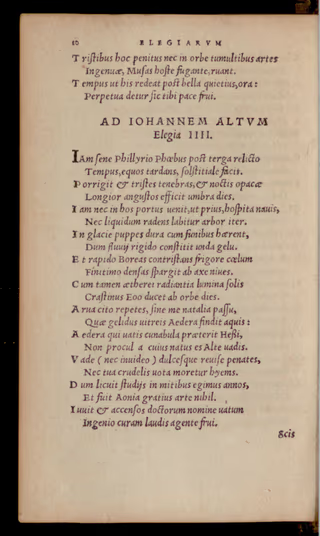
Triſtibus hoc penitus nec in orbe tumultibus artes
Ingenuæ, Muſas hoſte fugante, ruant.
Tempus ut his redeat poſt bella quietius, ora:
Perpetua detur ſic tibi pace frui.