Hover or tap a word to see its match.
Alas, unhappy rumor, just now scattered through the fields of the Rhine,
Why do you so often fill our hearts with grief?
Recently you recounted the fate of learned-speaking Philippus,
A man who was worthy to live forever.
And now do you dare to relate the fate of the outstanding poet
Lotichius? These tidings are too harsh for me.
Shall I complain, or be silent? Speyer has twice
Produced sad sorrow for me; hereafter may the Gods bring better things.
The cruelty of death snatches the best things first,
Always a dire threat to good minds.
Thus too Lotichius, in the flower of his mid-youth,
Has fallen (oh, the pain!) before his day.
Cultured Germany has brought forth many poets,
To commemorate all of whom would take long.
Ausonia's land many, and the Gallic land many too,
Each land rejoicing in its own talents.
But the Muses awarded the palm to Lotichius Secundus;
He was the prince and foremost champion of poets.
Stigelius will be a witness for me, and Sabinus a witness,
Whom I consider to be the lights of the Pierian chorus.
Thus you judged, Micyllus, refined by studies,
I heard this from your mouth, holy Philippus.
The Graces eagerly contributed all gifts to you, Secundus,
And strength to your verses.
Peter Secundus, indeed you rejoiced in such a name,
But to no poet, Peter, were you second.
How often did I see you pour forth a rapid poem?
In which, however, no erasure was seen:
Not otherwise than when a bountiful rain falls down
From the sky, or the earth is moistened with wet dew.
I will not relate the various arts of your cultivated mind,
The praises of your virtues, and the glory of your eloquence,
I pass over how fortunate a Doctor you were in the medical art,
And how knowledgeable you were of the teaching of God.
Therefore the sacred deities deservedly mourn your death,
Phoebus weeps for you, and the chorus of the Pegasides.
The Neckar itself grieves for you, the Rhine mourns you, and the Danube,
And the Elbe follows you with its tears.
The Elster also deplores you with a funereal groan,
Nor does the Oder itself contain its weeping.
But because the creator of the world, the arbiter of time, thus wished,
That the Fate should break the threads of your life:
I, that man (what remains) who loved you like a faithful Achates,
Now pray for gentle fates for you.
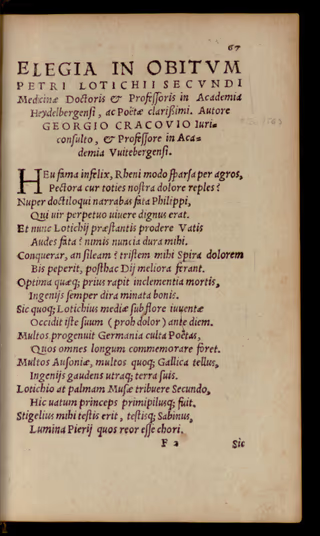
HEu fama infelix, Rheni modo ſparſa per agros,
Pectora cur toties noſtra dolore reples?
Nuper doctiloqui narrabas fata Philippi,
Qui uir perpetuo uiuere dignus erat.
Et nunc Lotichij præſtantis prodere Vatis
Audes fata? nimis nuncia dura mihi.
Conquerar, an ſileam? triſtem mihi Spira dolorem
Bis peperit, poſthac Dij meliora ferant.
Optima quæq; prius rapit inclementia mortis,
Ingenijs ſemper dira minata bonis.
Sic quoq; Lotichius mediæ ſub flore iuuentæ
Occidit iſte ſuum (proh dolor) ante diem.
Multos progenuit Germania culta Poëtas,
Quos omnes longum commemorare foret.
Multos Auſoniæ, multos quoq; Gallica tellus,
Ingenijs gaudens utraq; terra ſuis.
Lotichio at palmam Muſæ tribuere Secundo,
Hic uatum princeps primipilusq; fuit.
Stigelius mihi teſtis erit, teſtisq; Sabinus,
Lumina Pierij quos reor eſſe chori.
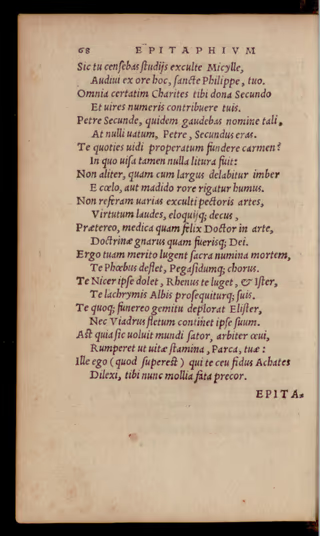
Sic tu cenſebas ſtudijs exculte Micylle,
Audiui ex ore hoc, ſancte Philippe, tuo.
Omnia certatim Charites tibi dona Secundo
Et uires numeris contribuere tuis.
Petre Secunde, quidem gaudebas nomine tali,
At nulli uatum, Petre, Secundus eras.
Te quoties uidi properatum fundere carmen?
In quo uiſa tamen nulla litura fuit:
Non aliter, quam cum largus delabitur imber
E cœlo, aut madido rore rigatur humus.
Non referam uarias exculti pectoris artes,
Virtutum laudes, eloquijq; decus,
Prætereo, medica quam felix Doctor in arte,
Doctrinæ gnarus quam fuerisq; Dei.
Ergo tuam merito lugent ſacra numina mortem,
Te Phœbus deflet, Pegaſidumq; chorus.
Te Nicer ipſe dolet, Rhenus te luget, & Iſter,
Te lachrymis Albis proſequiturq; ſuis.
Te quoq; funereo gemitu deplorat Eliſter,
Nec Viadrus fletum continet ipſe ſuum.
Aſt quia ſic uoluit mundi ſator, arbiter æui,
Rumperet ut uitæ ſtamina, Parca, tuæ:
Ille ego (quod ſupereſt) qui te ceu fidus Achates
Dilexi, tibi nunc mollia fata precor.