Hover or tap a word to see its match.
The bones of the sacred Poet Lotichius are buried beneath this tomb,
but his gentle spirit dwells in the stars.
And the immortal glory of the nine sisters has fallen,
the greatest fame of the Pegasides lies buried.
Alas, how great a genius, and how great a sweetness of character,
born of God, resided in his breast.
Cultivated by learning and studies from his tender years,
he soon yielded the fruits of his own intellect.
He had not yet reached his fifteenth year,
when he was your pupil, learned Micyllus.
Yet even then he knew how to compose melodious verses,
such as either Naso or Tibullus has.
Afterward the vigor of his intellect grew with his increasing years,
nor was his Muse content with her own weight.
The poets of Italy awarded him the first place;
would that that land had not been seen by him!
Flaminius yielded, and Cotta conceded the palm,
and Castalio was far inferior.
Beyond this praise, under a favorable star,
he was a Doctor renowned in the Machaonian art.
Exhausted nature will bring forth no such Poet again,
for she is rushing toward her own end.
Therefore, you who pass by, wish gentle fates for so learned a Poet;
in a short time the lofty fabric will fall.
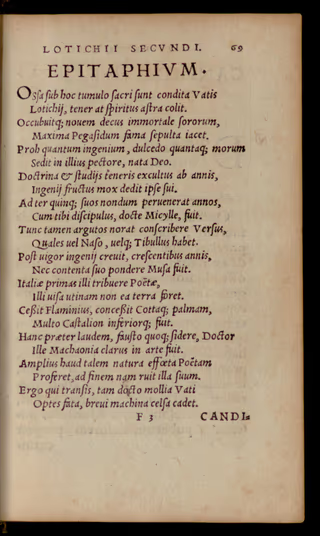
OSſa ſub hoc tumulo ſacri ſunt condita Vatis
Lotichij, tener at ſpiritus aſtra colit.
Occubuitq; nouem decus immortale ſororum,
Maxima Pegaſidum fama ſepulta iacet.
Proh quantum ingenium, dulcedo quantaq; morum
Sedit in illius pectore, nata Deo.
Doctrina & ſtudijs teneris excultus ab annis,
Ingenij fructus mox dedit ipſe ſui.
Ad ter quinq; ſuos nondum peruenerat annos,
Cum tibi diſcipulus, docte Micylle, fuit.
Tunc tamen argutos norat conſcribere Verſus,
Quales uel Naſo, uelq; Tibullus habet.
Poſt uigor ingenij creuit, creſcentibus annis,
Nec contenta ſuo pondere Muſa fuit.
Italiæ primas illi tribuere Poëtæ,
Illi uiſa utinam non ea terra foret.
Ceſsit Flaminius, conceſsit Cottaq; palmam,
Multo Caſtalion inferiorq; fuit.
Hanc præter laudem, fauſto quoq; ſidere, Doctor
Ille Machaonia clarus in arte fuit.
Amplius haud talem natura effœta Poëtam
Proferet, ad finem nam ruit illa ſuum.
Ergo qui tranſis, tam docto mollia Vati
Optes fata, breui machina celſa cadet.