Hover or tap a word to see its match.
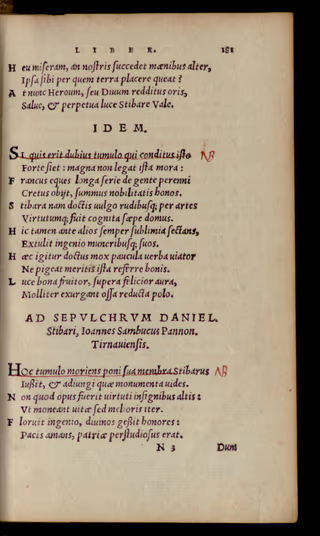
Dying, Stibarus ordered his limbs to be placed in this tomb,
and the monuments that you see to be added alongside.
Not because his virtue had need of lofty markers:
but so that they might point out the path to a better life.
He flourished in intellect, he bore divine honors:
a lover of peace, he was deeply devoted to his country.
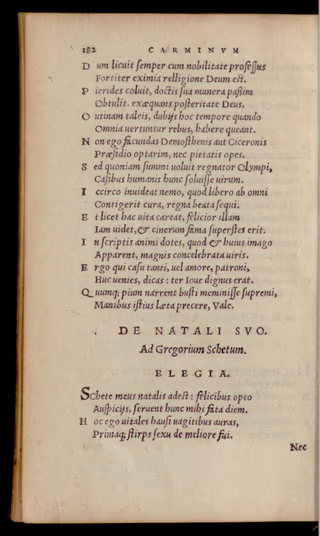
While it was permitted, he always bravely professed
God with exceptional religion, along with his nobility.
He cultivated the Muses, he offered his gifts everywhere to the learned,
equaling his glory with posterity.
Oh, would that they could have such men at this time when
all things are overturned in doubtful affairs.
I would not wish for the eloquent resources of Demosthenes or of Cicero
as a defense, nor the wealth of piety.
But since the ruler of highest Olympus wished
to free this man from human misfortunes.
Therefore let no one envy him, that it has befallen him,
free from every care, to seek the blessed realms.
And although he lacks this life, happier he now sees that one,
and the fame of his ashes will survive.
Because the gifts of his mind, and his image,
appear in writings, celebrated by great men.
Therefore, you who will come here by chance or out of love for so great a patron,
say: he was thrice worthy of Jupiter.
And since they say it is pious to remember the final tomb,
pray joyful things for his shades: Farewell.
H Oc tumulo moriens poni ſua membra Stibarus
Iuſſit, & adiungi quæ monumenta uides.
N on quod opus fuerit uirtuti inſignibus altis:
Vt moneant uitæ ſed melioris iter.
F loruit ingenio, diuinos geſſit honores:
Pacis amans, patriæ perſtudioſus erat.
D um licuit ſemper cum nobilitate profeſſus
Fortiter eximia relligione Deum eſt.
P ierides coluit, doctis ſua munera paßim
Obtulit, exæquans poſteritate decus.
O utinam taleis, dubijs hoc tempore quando
Omnia uertuntur rebus, habere queam.
N on ego facundas Demoſthenis aut Ciceronis
Præſidio optarim, nec pietatis opes.
S ed quoniam ſummi uoluit regnator Olympi,
Caſibus humanis hunc ſoluiſſe uirum.
I ccirco inuideat nemo, quod libero ab omni
Contigerit cura, regna beata ſequi.
E t licet hac uita careat, felicior illam
Iam uidet, & cinerum fama ſuperſtes erit.
I n ſcriptis animi dotes, quod & huius imago
Apparent, magnis concelebrata uiris.
E rgo qui caſu tanti, uel amore, patroni,
Huc uenies, dicas: ter Ioue dignus erat.
Q uumq; pium narrent buſti meminiſſe ſupremi,
Manibus iſtius læta precere, Vale.