Hover or tap a word to see its match.
What does it avail to fill the sky with groans: what to fill the city
with weeping, at your passing, great Stibarus?
Prayers move the gods above: but the buried too have their concerns,
and perhaps the conscious earth feels our tears.
Nor do I lament for this reason, that I might be able to call you back
from the boat of Lethe, having completed your time in the light.
Or shall I write poor verses upon the marble tomb,
And of your distinguished mind, and conspicuous loyalty.
Camerarius with his learned voice will sing of those things better,
And you, refined Secundus, part of my soul.
It is enough for me that you now in death itself know our sorrows,
That I grieve for the fatherland bereft of a parent.
Of which you were like a beautiful star amidst the clouds
And its glory: and certainly you were a wall of bronze.
Whether when the Main with tranquil stream had passed
The vine-bearing hills, and the middle of the city.
Or when a rather cruel neighboring enemy
Had brought war upon both the Gods and our cities.
You, wise in affairs, you, the Prince's other right hand,
You were the cause of sweet peace for the fatherland.
Already for your merits she was inscribing new marbles for you,
Often having prayed for long days under your auspices.
She wanted you: you were the other hope of our nation,
Often as a suppliant she had even offered you power.
Now she sighs for you (who could see your funeral rites with dry eyes?),
Sadder than the sad obsequies.
And scarcely is she torn away from the embrace of the faithful urn,
Often repeating your name and your protection.
And she pours forth mindful tears, and annual incense
She has brought, and has venerated your shades:
And on the tomb violets, and lilies mixed with costus
She scattered, and at length the marble holds these verses.
Bereft Franconia had wept at the death of the Knight Stibarus,
Death herself grieves that a Man worthy of praise dies.
Alas, pitiable death, alas, funeral rites, signs of the future,
(Yet may the Gods wish to turn the signs for the better.)
Alas for wretched me! Will another succeed to our walls,
through whom the land itself might be pleasing to itself?
But now returned to the shores of the Heroes, or of the Gods,
hail, Stibarus, and in perpetual light, farewell!
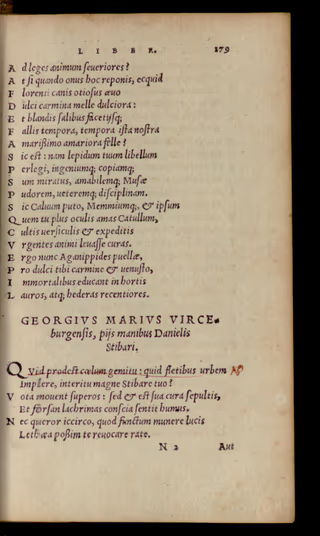
Q Vid prodeſt cœlum gemitu: quid fletibus urbem
Implere, interitu magne Stibare tuo?
V ota mouent ſuperos: ſed & eſt ſua cura ſepultis,
Et forſan lachrimas conſcia ſentit humus.
N ec queror iccirco, quod functum munere lucis
Lethæa poßim te reuocare rate.
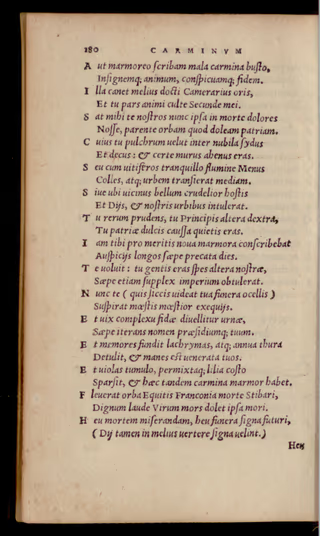
Aut marmoreo ſcribam mala carmina buſto,
Inſignemq; animum, conſpicuamq; fidem.
Illa canet melius docti Camerarius oris,
Et tu pars animi culte Secunde mei.
Sat mihi te noſtros nunc ipſa in morte dolores
Noſſe, parente orbam quod doleam patriam.
Cuius tu pulchrum uelut inter nubila ſydus
Et decus: & certe murus ahenus eras.
Seu cum uitiferos tranquillo flumine Menus
Colles, atq; urbem tranſierat mediam.
Siue ubi uicinus bellum crudelior hoſtis
Et Dijs, & noſtris urbibus intulerat.
Tu rerum prudens, tu Principis altera dextra,
Tu patriæ dulcis cauſſa quietis eras.
Iam tibi pro meritis noua marmora conſcribebat
Auſpicijs longos ſæpe precata dies.
Te uoluit: tu gentis eras ſpes altera noſtræ,
Sæpe etiam ſupplex imperium obtulerat.
Nunc te ( quis ſiccis uideat tua funera ocellis )
Suſpirat mœſtis mœſtior exequijs.
Et uix complexu fidæ diuellitur urnæ,
Sæpe iterans nomen præſidiumq; tuum.
Et memores fundit lachrymas, atq; annua thura
Detulit, & manes eſt uenerata tuos:
Et uiolas tumulo, permixtaq; lilia coſto
Sparſit, & hæc tandem carmina marmor habet.
Fleuerat orba Equitis Franconia morte Stibari,
Dignum laude Virum mors dolet ipſa mori.
Heu mortem miſerandam, heu funera ſigna futuri,
( Dij tamen in melius uertere ſigna uelint. )
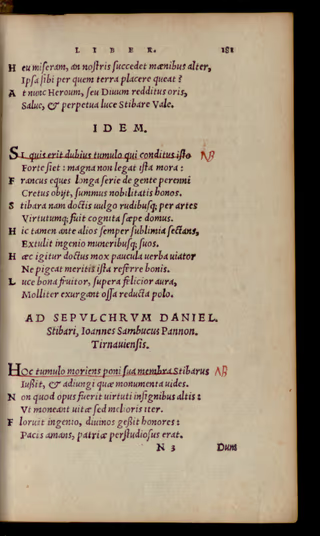
H eu miſeram, an noſtris ſuccedet mænibus alter,
Ipſa ſibi per quem terra placere queat?
A t nunc Heroum, ſeu Diuum redditus oris,
Salue, & perpetua luce Stibare Vale.