Hover or tap a word to see its match.
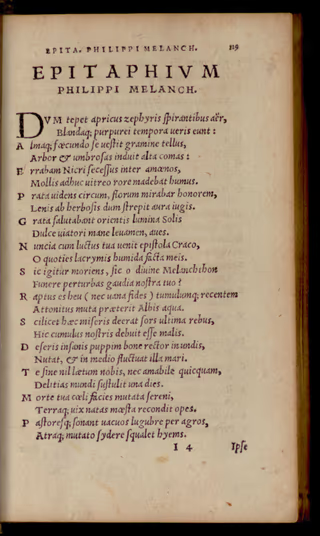
While the sunny air is warm with blowing zephyrs,
And the pleasant days of bright spring go by:
And the nourishing earth clothes itself in fertile grass,
And the tall tree puts on its shady foliage:
I was wandering among the pleasant retreats of the Neckar,
The soft ground was still wet with glassy dew.
Seeing the meadows around, I marveled at the glory of the flowers,
While a gentle breeze rustles from the grassy ridges.
The birds were greeting the welcome light of the rising sun,
A sweet solace in the morning for the traveler.
When your letter, Craco, arrived as a messenger of grief,
O how often it was made wet by my tears.
Is it thus, then, by dying, thus, O divine Melanchthon,
That you disrupt our joys with your death?
You have been taken away, alas (and the belief is not vain), and the Elbe,
Astonished, passes by your fresh tomb with silent waters.
Doubtless this ultimate fate was lacking to our wretched affairs,
This crowning blow had to be added to our misfortunes.
You abandon the ship in the raging waves, good helmsman,
It reels, and tosses in the middle of the sea.
Without you nothing is joyful for us, nor anything lovely,
A single day has taken away the delights of the world.
Through your death the face of the clear sky is changed,
And the mournful earth hides away her scarcely born wealth.
And the shepherds sound mournfully through the empty fields,
And dark winter is desolate, the star having changed.
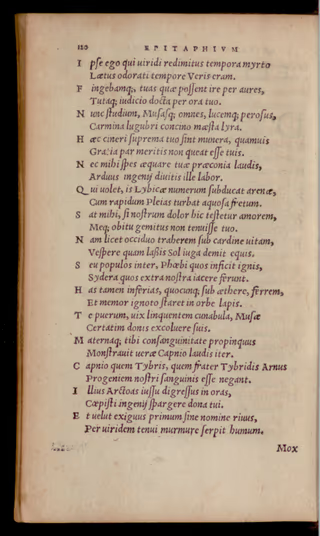
I myself, whose temples were bound with green myrtle,
was joyful in the season of fragrant Spring.
And I was composing verses that could reach your ears,
and pass safely through learned mouths by your judgment.
Now, loathing study, and all the Muses, and the light,
I sing sorrowful songs on a mournful lyre.
Let these be the final gifts for your ashes, although
gratitude cannot be equal to your merits.
Nor do I have hope to equal the heraldings of your praise;
that is the arduous labor of a rich intellect.
Whoever wishes it, let him calculate the number of the Libyan sand,
when the watery Pleiad disturbs the rushing strait.
It is enough for me, if this grief testifies to our love,
and that I did not hold back my groans at your passing.
For even if I were dragging out my life under the western pole,
when at evening the Sun removes the yokes from his weary horses;
Or among the peoples whom the fire of Phoebus darkens,
who they say lie beyond our stars;
Still I would bring these funeral offerings, under whatever sky,
and a mindful stone would stand in an unknown world.
You, as a boy, scarcely leaving the cradle, the Muses
eagerly cultivated with their gifts.
And Capnio, akin to you by maternal blood,
showed you the path of true praise.
Capnio, whom the Tiber, and the Tiber's brother the Arno,
deny to be an offspring of our blood.
Having departed for the Northern shores at his command,
you began to scatter the gifts of your intellect.
And just as a small stream at first, without a name,
creeps through the green earth with a gentle murmur.
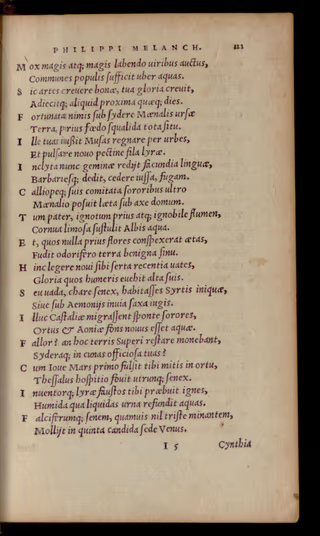
Soon, increased in strength more and more as it glides along,
abundant, it supplies common waters for the peoples.
Thus the good arts grew, your glory grew,
and each following day added something.
Too fortunate is the land beneath the star of the Maenalian bear,
formerly entirely rough with foul neglect.
He ordered your Muses to reign throughout the cities,
and to strike the strings of the lyre with a new plectrum.
Now the renowned eloquence of the twin languages has returned,
and barbarism, ordered to yield, has taken flight.
And Calliope, accompanied by her sisters, voluntarily
and joyfully established her home beneath the Maenalian axis.
Then father Elbe, formerly an unknown and ignoble river,
raised his horns from the muddy water.
And flowers, which no previous age had seen,
the bountiful earth poured forth from its fragrant bosom.
From here new poets gathered fresh garlands for themselves,
whom high glory carries aloft on her shoulders.
Whether, dear old man, you had inhabited the shallows of the hostile Syrtis,
or the impassable rocks beneath the Haemonian ridges,
Thither the Castalian sisters would have migrated of their own accord,
and there would have arisen a new fountain of Aonian water.
Am I mistaken? Or did the Gods above warn that this remained for the earth,
and the stars, dutiful toward your cradle?
With Jupiter, Mars shone mildly upon you at your very birth;
the Thessalian old man warmed both with his hospitality.
And the inventor of the lyre offered auspicious fires for you,
where the damp urn pours back its liquid waters.
And bright Venus softened the scythe-bearing old man in the fifth house,
although he threatened nothing sad.
Cynthia, at her zenith, saw her brother's opposed horses
Running through the auspicious star of the Virgin.
Hence there were so many excellent endowments in your cultivated breast,
So many gifts, which the uncultured crowd knows not.
Thanks be to the gods, that the joyful fates allowed me to be born
In your time, and to enjoy your teachings.
The seventeenth year (I remember) is now passing by,
(So quickly have so many happy days gone past)
Since I, a boy to be instructed in the noble arts,
Was entrusted to you, captivated by love of the Aonides.
I would not have preferred for myself whatever gold the Tagus has cast up,
Whatever the rich sand of the Red Sea holds.
You showed me the leafy ridges of the two-peaked mountain,
Guiding me with a faithful hand, like a father himself.
I have not seen your equal through Latium, through so many famous towns,
Nor where the Seine flows with its swelling stream.
Your fame is renowned throughout Europe and the land of Asia,
Nor is scorched Libya ignorant of your praises.
You, revealing the secret precepts of God, taught
How He rejoices to be worshipped with a pure mind and faith.
And out of pious love for heavenly doctrine, you endured,
In your old age, a thousand hazards of the road, a thousand wearinesses.
A judge no more severe on this side than on that,
Just as a true scale is balanced by an equal weight.
And even a just cause did not drive your provoked hands
Against the impious insults of a cruel tongue.
I will not wound anyone with a biting poem,
There will never be any malice in this breast.
If, however, those whom black Tisiphone drives with her furies
Dare to violate your buried shades:
We will not suffer your ashes, O venerable one, to remain unavenged;
Piety will take up arms for your tomb.
Father Elbe, father Elbe, all things have vanished into the light breezes,
for the sake of which it was sweet to live.
If the forebodings of a fearful mind hold any truth,
punishment comes late with a slow step, but it is severe.
Already I see ruin impending by the decree of fate,
and battles, and the ground rich with spilled blood.
We are tossed hither and thither, just as a skiff, deprived of its helmsman,
is carried shipwrecked through the Aegean waters.
Therefore, it was not permitted for me to speak to you, sweetest one,
at least for the last time before the day of your death.
When a dire thirst was scorching your panting breast,
and a bitter fever was burning your wretched liver,
I myself would have given you health-bringing herbs and juices,
which other hands have not learned to mix.
I myself, as a suppliant, would have called upon God in vows and prayers,
standing ever watchful by your bed.
For chaste prayers and vows are wont to drive away paling diseases
more powerfully than the Paeonian art.
It was not permitted, at least, to hear your last words,
and to speak with you as your life was failing.
I did not sprinkle your laid-out, venerable body with tears;
I did not give flowery garlands and roses to your ashes.
What I can do, I will sing sad songs for you in the early morning,
for you in the late evening, for you in the middle of the night.
Nor will this short life set an end to my sorrow,
if the Gods will wish any life still to remain.
The mildness of the spring sky does not soothe my mind,
the light breeze does not delight me with its breath.
And roses and laurels seem to die in the fertile gardens,
And lilies along with the green rosemary.
The nurturing mother earth, whose surname you bore,
Fails, and, sick, neglects her own offspring.
Even the Neckar itself, not unmindful of its old pupil,
Increases its cerulean waters with abundant weeping.
Here he was, here he studied, as a boy he played on this turf,
Here his father, here his mother, here his grandfather lived.
Beneath this hill he composed his song on a slender reed,
Here was the beauty, here the grace of his learned voice.
While he recalls such things, the river swells with a whirlpool of tears,
And the caves roar with surging waves.
And sorrowful Philomela, sitting beneath the neighboring shade,
Sings a tearful song among the mourning birds.
The bird Philomela, rival of the eloquent Melanchthon,
Equal was the honor, and the purity of tongue to both.
All things that the earth, that the sea, and the air bring forth,
Mourn at your death, great Philip.
If, however, that was the nurturing will of God (as it was),
And our prayers cannot render it undone:
Freed from the spoils of the body and the law of death,
I rejoice that you enjoy the ethereal realm.
And after so many treacherous tides of the implacable sea,
That all clouds are now beneath your feet.
Now you sing of the only-begotten Son, and the Parent of all things,
Through the cultivated green fields of the fortunate soil.
There are those who, following the commands of God,
Taught us the certain paths of justice.
There, neither diseases, nor miserable old age,
Nor harsh poverty presses down as a heavy evil.
But lyres and songs flourish, and the souls of the pious
Drink continually from the very fount of life.
And Christ, the mind and Wisdom of the eternal Father,
Refreshes glowing hearts with divine light.
Hail, great father, now heir to the high heaven,
And enjoy the eternal blessings which have been obtained for you.
And acknowledge the final voice of your disciple,
And let not this devotion be burdensome to your ashes.
May the earth adorn your tomb with violets and laurel,
May your blessed urn flourish with eternal roses,
And may your bones always rest in a tranquil seat,
May your voice live forever by the waters of the Elbe.
This I pray, assent at least to these vows, O creator of the world,
Take up yourself, O Christ, the care of the wandering flock.
O venerable one, by your name, and by our salvation,
Which was restored to us wretched ones by your blood.
And by your labors, while your body was mortal,
I pray by the majesty of your divinity.
I pray by the dreadful mockeries of your final death,
Look upon the deserted sheep, O best of shepherds.
Look upon us when our spirit will pass into the thin air,
And when that final day shall shine upon the earth.
On which the dreadful trumpet will give its sound through the trembling clouds,
And flame will dissolve this threefold work of the world.
And it is well: for, O sweetest father, I do not prophesy
That the time of your coming is far off.
Meanwhile we shall sing your praises and your name,
Only grant us, O Christ, to enjoy sweet rest.
DVM tepet apricus zephyris ſpirantibus aër,
Blandaq; purpurei tempora ueris eunt:
Almaq; fœcundo ſe ueſtit gramine tellus,
Arbor & umbroſas induit alta comas:
Errabam Nicri ſeceſſus inter amœnos,
Mollis adhuc uitreo rore madebat humus.
Prata uidens circum, florum mirabar honorem,
Lenis ab herboſis dum ſtrepit aura iugis.
Grata ſalutabant orientis lumina Solis
Dulce uiatori mane leuamen, aues.
Nuncia cum luctus tua uenit epiſtola Craco,
O quoties lacrymis humida facta meis.
Sic igitur moriens, ſic o diuine Melanchthon
Funere perturbas gaudia noſtra tuo?
Raptus es heu (nec uana fides) tumulumq; recentem
Attonitus muta præterit Albis aqua.
Scilicet hæc miſeris deerat ſors ultima rebus,
Hic cumulus noſtris debuit eſſe malis.
Deſeris inſanis puppim bone rector in undis,
Nutat, & in medio fluctuat illa mari.
Te ſine nil lætum nobis, nec amabile quicquam,
Delitias mundi ſuſtulit una dies.
Morte tua cœli facies mutata ſereni,
Terraq; uix natas mœſta recondit opes.
Paſtoreſq; ſonant uacuos lugubre per agros,
Atraq; mutato ſydere ſqualet hyems.
I pſe ego qui uiridi redimitus tempora myrto
Lætus odorati tempore Veris eram.
F ingebamq; tuas quæ poſſent ire per aures,
Tutaq; iudicio docta per ora tuo.
N unc ſtudium, Muſaſq; omnes, lucemq; peroſus,
Carmina lugubri concino mæſta lyra.
H æc cineri ſuprema tuo ſint munera, quamuis
Gratia par meritis non queat eſſe tuis.
N ec mihi ſpes æquare tuæ præconia laudis,
Arduus ingenij diuitis ille labor.
Q ui uolet, is Lybicæ numerum ſubducat arenæ,
Cum rapidum Pleias turbat aquoſa fretum.
S at mihi, ſi noſtrum dolor hic teſtetur amorem,
Meq; obitu gemitus non tenuiſſe tuo.
N am licet occiduo traherem ſub cardine uitam,
Veſpere quam laſsis Sol iuga demit equis.
S eu populos inter, Phœbi quos inficit ignis,
Sydera quos extra noſtra iacere ferunt.
H as tamen inferias, quocunq; ſub æthere, ferrem,
Et memor ignoto ſtaret in orbe lapis.
T e puerum, uix linquentem cunabula, Muſæ
Certatim donis excoluere ſuis.
M aternaq; tibi conſanguinitate propinquus
Monſtrauit ueræ Capnio laudis iter.
C apnio quem Tybris, quem frater Tybridis Arnus
Progeniem noſtri ſanguinis eſſe negant.
I llius Arctoas iuſſu digreſſus in oras,
Cœpiſti ingenij ſpargere dona tui.
E t uelut exiguus primum ſine nomine riuus,
Per uiridem tenui murmure ſerpit humum.
M ox magis atq; magis labendo uiribus auctus,
Communes populis ſufficit uber aquas.
S ic artes creuere bonæ, tua gloria creuit,
Adiecitq; aliquid proxima quæq; dies.
F ortunata nimis ſub ſydere Mænalis urſæ
Terra, prius fœdo ſqualida tota ſitu.
I lle tuas iuſsit Muſas regnare per urbes,
Et pulſare nouo pectine fila lyræ.
I nclyta nunc geminæ redijt facundia linguæ,
Barbarieſq; dedit, cedere iuſſa, fugam.
C alliopeq; ſuis comitata ſororibus ultro
Mænalio poſuit læta ſub axe domum.
T um pater, ignotum prius atq; ignobile flumen,
Cornua limoſa ſuſtulit Albis aqua.
E t, quos nulla prius flores conſpexerat ætas,
Fudit odorifero terra benigna ſinu.
H inc legere noui ſibi ſerta recentia uates,
Gloria quos humeris euehit alta ſuis.
S eu uada, chare ſenex, habitaſſes Syrtis iniquæ,
Siue ſub Aemonijs inuia ſaxa iugis.
I lluc Caſtaliæ migraſſent ſponte ſorores,
Ortus & Aoniæ fons nouus eſſet aquæ.
F allor? an hoc terris Superi reſtare monebant,
Syderaq; in cunas officioſa tuas?
C um Ioue Mars primo fulſit tibi mitis in ortu,
Theſſalus hoſpitio fouit utrunq; ſenex.
I nuentorq; lyræ fauſtos tibi præbuit ignes,
Humida qua liquidas urna refundit aquas.
F alciferumq; ſenem, quamuis nil triſte minantem,
Mollijt in quinta candida ſede Venus.
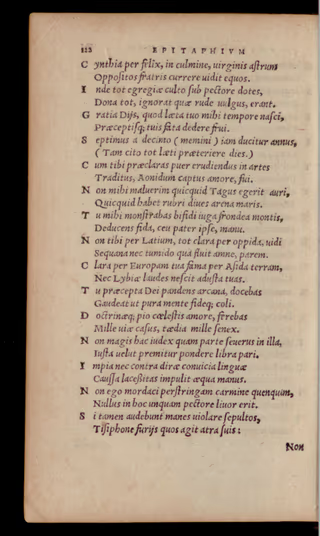
C ynthia per felix, in culmine, uirginis aſtrum
Oppoſitos fratris currere uidit equos.
I nde tot egregiæ culto ſub pectore dotes,
Dona tot, ignorat quæ rude uulgus, erant.
G ratia Dijs, quod læta tuo mihi tempore naſci,
Præceptiſq; tuis fata dedere frui.
S eptimus a decimo (memini) iam ducitur annus,
(Tam cito tot læti præteriere dies.)
C um tibi præclaras puer erudiendus in artes
Traditus, Aonidum captus amore, fui.
N on mihi maluerim quicquid Tagus egerit auri,
Quicquid habet rubri diues arena maris.
T u mihi monſtrabas bifidi iuga frondea montis,
Deducens fida, ceu pater ipſe, manu.
N on tibi per Latium, tot clara per oppida, uidi
Sequana nec tumido qua fluit amne, parem.
C lara per Europam tua fama per Aſida terram,
Nec Lybiæ laudes neſcit aduſta tuas.
T u præcepta Dei pandens arcana, docebas
Gaudeat ut pura mente fideq; coli.
D octrinæq; pio cœleſtis amore, ferebas
Mille uiæ caſus, tædia mille ſenex.
N on magis hac iudex quam parte ſeuerus in illa,
Iuſta uelut premitur pondere libra pari.
I mpia nec contra diræ conuicia linguæ
Cauſſa laceßitas impulit æqua manus.
N on ego mordaci perſtringam carmine quenquam,
Nullus in hoc unquam pectore liuor erit.
S i tamen audebunt manes uiolare ſepultos,
Tiſiphone furijs quos agit atra ſuis:
Non cineres uenerande tuos patiemur inultos,
Pro tumulo Pietas induet arma tuo.
Albi pater, pater Albi, leues abiere per auras
Omnia, quæ propter uiuere dulce fuit.
Si quid habent ueri timidæ præſagia mentis,
Pœna uenit lento ſera, ſed ampla, pede.
Iam uideo inſtantes fatali lege ruinas,
Præliaq;, & fuſo pingue cruore ſolum.
Voluimur huc illuc, ueluti ſpoliata magiſtro
Cymba per Aegæas naufraga fertur aquas.
Ergo nec affari mihi te dulcißime ſaltem
Extremum licuit funeris ante diem.
Cum pectus tibi dira ſitis torreret anhelum,
Vreret & miſerum febris acerba iecur.
Ipſe ſalutiferas herbas, ſuccoſq; dediſſem,
Quos miſcere aliæ non didicere manus.
Ipſe Deum ſupplex in uota preceſq; uocaſſem,
Aßiſtens lecto peruigil uſq; tuo.
Namq; preces caſtæ pallentes pellere morbos
Votaq;, Pæonia fortius arte, ſolent.
Non licuit ſaltem uoces audire ſupremas,
Atq; anima tecum deficiente loqui.
Non poſitum lacrymis ſparſi uenerabile corpus,
Florida non cineri ſerta roſaſq; dedi.
Quod poſſum, tibi mane nouo, tibi ueſpere ſero,
Mœſta tibi media carmina nocte canam.
Nec breuis hæc finem ſtatuet mihi uita doloris,
Si quid adhuc uitæ Dij ſupereſſe uolent.
Non animum uerni mulcet clementia cœli,
Non leuis afflatu me iuuat aura ſuo.
Fœcundiſq; roſæ Lauriq; uidentur in hortis,
Cumq; maris uiridi lilia rore mori.
Alma parens tellus, cuius cognomen habebas
Deficit, & fœtus negligit ægra ſuos.
Ipſe etiam ueteris Nicer haud oblitus alumni
Cæruleas largis fletibus auget aquas.
Hic fuit, hic ſtuduit, puer hoc in ceſpite luſit,
Hic pater, hic genitrix, hic habitauit auus.
Colle ſub hoc tenui deduxit carmen auena,
Hic decor, hæc doctæ gratia uocis erat.
Talia dum recolit, lacrymarum gurgite flumen
Creſcit, & undoſis fluctibus antra fremunt.
Mæſtaq; uicina reſidens Philomela ſub umbra
Flebile mœrentes concinit inter aues.
Aemula facundi Philomela Melanchthonis ales,
Par honor, & linguæ candor utriq; fuit.
Omnia quæ tellus, quæ pontus, & educat aër,
Interitu lugent, magne Philippe, tuo.
Si tamen illa Dei fuit (ut fuit) alma uoluntas,
Noſtra nec infectum reddere uota queunt:
Corporis exuuijs & mortis lege ſolutum
Gratulor ætherea te regione frui.
Poſtq; tot infidos maris inplacabilis æſtus,
Nubila iam pedibus cuncta ſubeſſe tuis.
Iam canis unigenam natum, rerumq; parentem
Per fortunati culta uireta ſoli.
Illic ſunt, quicunq; Dei præcepta ſecuti
Iuſticiæ certas nos docuere uias.
Non illic Morbi, non ærumnoſa ſenectus,
Non graue pauperies urget acerba malum.
S ed citharæ, cantuſq; uigent, animæq; piorum
Ipſius e uitæ fonte perenne bibunt.
A eterniq; patris mens & Sapientia CHRISTVS
Feruida diuino lumine corda rigat.
S alue magne parens, alti nunc ætheris hæres,
Et fruere æternis, quæ tibi parta, bonis.
D iſcipuliq; tui uocem cognoſce ſupremam,
Nec pietas cineri ſit grauis iſta tuo.
T erra tuum uiolis ornet, lauroq; ſepulchrum,
Floreat æternis urna beata roſis,
O ſſaq; tranquilla ſemper tua ſede quieſcant,
Semper ad Albiacas uox tua uiuat aquas.
H oc precor, his ſaltem, mundi ſator, annue uotis,
Ipſe uagi curam ſuſcipe CHRISTE gregis.
P er nomen uenerande tuum, noſtramq; ſalutem,
Sanguine quæ miſeris eſt reparata tuo.
P erq; tuos, dum corpus erat mortale, labores,
Per maieſtatem numinis oro tui.
E xtremæ per dira precor ludibria mortis,
Reſpice deſertas, optime paſtor, oues.
R eſpice nos tenues cum ſpiritus ibit in auras,
Summaq; cum terris fulſerit illa dies.
Q ua tuba per trepidas ſonitum dabit horrida nubes,
Hoc triplex mundi flamma reſoluet opus.
E t bene habet: nec enim genitor dulcißime longe
Auguror aduentus tempus abeſſe tui.
I nterea laudeſq; tuas, nomenq; canemus,
Tu modo da dulci CHRISTE quiete frui.