Hover or tap a word to see its match.
You Muses, who sing to me of the marriages of kings,
To whom the long succession of time, to whom deep antiquity,
And the faithful guardianship of perpetual fame is entrusted,
While of the outstanding Duke, after wars and heavy labors,
I celebrate the happy bridal chamber, do you with your divine will
Breathe favorably upon me: and you, O renowned offspring of Jupiter,
Nurturing Venus, if the mortal songs of poets touch you,
If you care for the laws and covenants of the shared bed
And tender plays and mutual joys:
Be present here, and stroll with me through the cultivated gardens,
And gather spring roses, Goddess, and for the new bride
Weave a crown, such as shines brightly in the gleaming sky
Among the shining fires of the starry aether.
But you, Prince of young men, who by brave arms
And mighty deeds equal your celebrated ancestors,
Johann Wilhelm, do not disdain your praises:
You will read of arms and men, and your ancestors' illustrious
Names: now it is pleasing only to go along the highest peaks
Of things. The coming day reserves greater things.
Scarcely had the most beautiful Morning Star brought forth his rays
In his early rising, bringing the marriage with an auspicious
Star, when the mountains and the lofty halls resounded
With joy, where the rushing Neckar boils with swift waves
And beholds vast structures rise to the heavens.
By chance, just then under the light of the newly risen sun,
Sitting upon the green edge of a grassy bank,
I was practicing the ancient loves of Acis on a rustic reed,
And consoling my cares with idle study:
And a charming nightingale with me under the nearby shade
Was soothing the clear breezes with her melodious songs:
When suddenly (behold!) accompanied by nine sisters,
Calliope gladly advanced to meet me of her own accord.
From the shoulders of all hung lyres, the beauty of all was the same,
All were veiled in garments suffused with gold.
Green rue bound their hair, and the unwedded laurel.
They walked, and the Goddesses, with hands mutually joined,
Were singing: Hymen, o Hymenaeus, Hymen, Hymenaeus.
Soon, when the whole chorus had settled down nearby on the green grass,
And the river grew silent, and the birds grew silent,
Calliope addressed me with gentle words thus:
"Lay down your light reeds, the mountains and sacred springs
Have known enough of the hissings of the oat, the rustic flute
Has played enough of the cares of shepherds: now you shall sing
Of a glorious marriage, and a race of heroes, and the descendants of kings.
I myself, tracing the lineage of the groom from its origin,
Will lead you through the race, and the ancestors, and the mighty deeds
Of this ancient stock, which no age shall have equaled
in praises, wherever the golden Sun beholds the immense world.
Let this be the labor, this the pursuit for noble poets:
either to sing the praises of the gods above, or the heraldings of kings,
and to add mindful fame to illustrious deeds.
She spoke, and a volume adorned with gems and gold,
and shining with dark blue hyacinth, and grayish-blue jasper,
she unrolled upon her lap, the venerable gift of her mother
Mnemosyne, to whom long ages and names are a care.
There the nurturing parent had inscribed whatever from the beginnings
of time was done that was memorable, in peace or in arms,
which parents might bid their sons to remember in times to come.
Bringing this forth, and recalling the monuments of deep antiquity,
Calliope, in the shade of an overhanging beech,
sang such things by the gliding waves of the Neckar.
A vast land lies exposed to the blasts of the North Wind,
rich in fields, rich in livestock, which from on high
is watched by the Bear—which never dares to dip itself
in the waves of the hoary Ocean—with its ever-thirsty stars.
The Rhine toward the setting, and the resting places of the descending Sun,
bounds it; the Weser toward the Dawn and the Nabataean realms
looks, the Chauci, a fierce race, toward the wintry Plow-oxen,
but the side from which the dripping South Wind announces rainstorms,
is enclosed by the Obnobian mountains, from which issues the lofty
Ems, which stirs up the ebbing sands of the Ocean.
That land is the parent of kings, to whose hearts harsh
battles always were dear; they worshipped statues and groves
sacred with ancient religion. Often a bristling snake,
often an old oak terrified their conscious breasts.
Especially they sang of heroes and battles fought
amidst solemn feasts, and the great buried
They greeted kings with their voices, and invoked their souls.
First, powerful through his grandfathers and great-grandfathers, and a rich kingdom,
the great-grandson of SIGARDUS, when now everywhere the golden race
of Christians was washing away its sin with purifying waters,
VITIKINDUS, flourishing in the first bloom of spirit and age,
defended the ancient rites and the custom of sacred things,
accustomed to swear by his head, and his holy crown,
and the stars, and the groves worshipped with ancestral awe,
and the altars to endure, which she herself had dedicated to the gods.
On his shield a prancing steed, free with shaken-off reins,
flashes forth, and scatters the swift breezes with its neighing,
rearing high, seeking the heights: and next to the paternal emblem,
the bright horns of a half moon are curved.
At last, stripped so many times of his camp and arms,
now an older man, granted his life, he departed, and voluntarily
he washed away at last the contagion of ancient fault,
dipping his bared body in the ancestral stream.
Caesar Charles himself, triumphant, having long forgotten vengeance and anger,
received him, bathed by the water of the health-bringing river,
and embraced him in a friendly bosom,
and ordered him to unlearn the empty worship of the gods.
The cities roared with joy, and the North.
So very beautiful and noble it is to spare the conquered,
more beautiful than to subdue untamed nations in war.
Thence powerful far and wide, where the Lippe, where father
Elbe wanders with its waters, the Elbe renowned for its leaders, the Elbe renowned in war,
and where the greedy Weser cuts the plains with its swelling river,
he gave laws, until, sick with failing strength,
forgetful of his years and oblivious to his old age,
while he rushed against the enemy, he ended his human labors with death.
From here the son, noble heir of his father's name,
Received the ancient Mysians, and the lands to be ruled,
Which the Pleisse irrigates with its stream, which the Elster irrigates,
Useful to the fields and beautiful with its pleasant banks,
And the Saale, echoing over the rocks with its foaming waters.
From there comes the ancient lineage for the groom, and his native origin,
And the house of heroes divides itself from a single bloodline,
Of heroes, who, outstanding in virtue, beneath the North
First shaped the inflexible peoples with justice, and with equitable laws
For the practice of a better life.
From here also (if you consider the lineage from the blood of the brothers)
Is Otho the Great; give incense, leaders, give an altar to his shades.
This is the man, this is he, whose care was your honor, whose care was your glory,
And the ornament of the Empire, and Germany.
The next ruled the peoples in blameless peace,
Whose greatest care was to abolish the profane worship of the gods,
And therefore Tiagrinus established endowments and temples,
And added gold of great weight
For those who, calling the unteachable race to better things,
Might propagate the sacred rites, and be a light to the wandering.
His son Tetmarus, fond of the woods from his earliest years,
Was accustomed to endure hunger and winter's cold through hunting,
Driving the horned stags into the nets.
Energetic, he slung a quiver and bow from his shoulders:
And skilfully surrounding the high mountains with a ring of hunters
He campaigns in the woods, and vents his wrath upon the fierce bears,
And affixes their gaping jaws and bristling hides to the doors.
Surely so that better (if ever wars should call),
Hardened by showers and Hercynian frost and heat,
He might be able to endure the harsh labors of warfare.
Then THEODRICVS, his son, took up the reins of power,
Powerful in war, who added fields rich in their soil's fertility
To the borders of his homeland, where with its beautiful stream
The foreign Unstrut glides through the fruitful lands:
From which even his late descendants bore their title.
Nor was DEDO less skilled with the sword, less useful with the spear,
Nor did any commander grasp the arts of war more fittingly:
Whether there was need to measure out a camp across the widespread fields,
Or to draw up the line of battle, or to dig deep
Trenches for support when the camp was pitched,
And ramparts to defend the hollowed trenches.
While he waged wars on behalf of his kinsman the Emperor,
The Huns marveled in amazement at him, and they marveled who drink
The snowy Tanais, and the waters of the icy Borysthenes:
When he laid all things low with the sword near the streams of the swollen Saale,
And the banks could scarcely contain the sorrowful corpses.
No less did the SON advance into the bright honor of fame,
Bearing the NAME of his grandfather, who beneath his father himself
Had spent his first training and his early years:
Marveling at his father's valor from an early age.
He crushed the Apennine-born Arno, breaking its horns,
A warrior exulting in the open plain:
Just as when a torrent, swollen by winter rains,
Foaming, and boiling in a mad whirlpool, uproots
The forests, and lays waste far and wide to the harvests and fields.
Nor shall I leave you unmentioned, great THIMO, and your son
CONRADVS, distinguished in fame and outstanding in arms,
Who, the first Margrave of the Meissen region with you,
Victorious in the plain of the Eridanus and the Insubrian fields,
Filled the Ausonian Tiber with much blood.
Next Otho, his temples wreathed with the civic oak,
teeming with rich veins of silver and bronze,
founded Freiberg, and the lofty city of Phylire.
Among the Hamadryad sisters, beautiful Phylire,
a huntress, once upon a time in those mountains
used to hunt timid wild beasts with snares and on foot,
and she carried a quiver heavy with javelins, and a trembling
spear, which had grown by the clear waters of the Elster.
But when the spoil and all the glory of her virgin modesty,
while she lay, and securely plucked sweet rest,
an impious shepherd had taken in a lonely valley,
she could no longer endure such great sorrow,
and her indignant soul left her wasting limbs;
But the nourishing earth, pitying the misfortune of the innocent girl,
received her in its lap, and a green linden tree
from the bones of Phylire, it sent forth into the clear air.
Even now along the banks there, through the soft
meadows, through the cultivated gardens beneath the walls, lindens grow:
and quite often they provide pleasing shade to hunters.
From this the early natives gave the city its name.
Hence the renowned Theodoric, having acquired the name of his ancestor,
unlucky, drank black poison through the deceit of a physician.
His son, when he was scarcely reaching puberty in his early youth,
Henry, who later, most distinguished in his deeds, left all
his ancestors behind him in outstanding virtue—
to him, when his uncle had left the upper air,
Ludwig, having been buried on the furthest shore of Iapygia,
in return for his merits, the Emperor Frederick handed over the fierce
peoples of the Thuringians, and enriched him with illustrious titles.
This warrior a famous contest with equestrian arms
produced an image of war: with the blare of trumpets
the caves resounded far and wide, and the mountains roared,
with the applause of the victors alike, and the crash of the falling.
There was a plain, green woods enclosed it on all sides,
and in the middle a golden tree with spreading branches
stood. Its branches were gold, the leaves on the branches were golden:
the bark too was golden, but only the root was silver:
Around this were shining swords, the prize for the victors,
and helmets distinguished by crests, and green garlands,
and no less did the daughters of heroes, through the soft grass,
shaking their white bodies in maidenly motion,
lead the dances. Among them the daughter of the great
Emperor, is led as a wife into the bridal chambers of ALBERT,
Margaris. Born from them were FREDERICK, and fierce in arms
TIZMANNUS, slain by the sword at the solemn altars.
But the grief of the exiled mother, and the horrid wars,
while the father provokes his sons to justified anger,
(ah, driven too much by the goads of tender love)
my mind resolves to pass over in silence: the Spree flowed with blood, and the huge
Elbe, and whatever arose from the Hercynian mountains.
Rivers moisten the fertile fields of the Thuringians.
OF THE SAME NAME, lest the dire license of the sword
should go unpunished, the SON the citadels of the robbers
destroyed. Next the SON, his father having been taken away, avenging
his ancestors, filled the rebellious city with much slaughter,
where the horned Hieras forms a pool with its billowing stream:
and affixed captured arms to the iron-clad doorposts.
THE FOURTH against the opposing Bohemians his avenging standards,
for the honor of the empire, as the avenger of the noble Emperor,
moved, and FREDERICK, having obtained distinguished praise,
bore the distinguished honor of the Saxon Elector:
He, also caring for the advantages of tranquil peace,
founded a retreat for us by the river of the Elster,
and kindled minds to outstanding arts with rewards.
Next, laden with the spoils of the North,
FREDERICK imposed laws on the conquered Havel.
You too, fortunate in marriage, and in the lineage of descendants,
ERNST, the Kashubians, and the arrow-bearing Poles,
you restrain, where the Oder glides with its fish-filled stream.
The SON freed his homeland from the fear of arms,
and seeking fortunate Jerusalem, and the noble tomb,
he conquered the harsh journey of the sea, and the land of the Curetes,
Gortyna, and Knossos, and the Cyclades in the deep sea,
and saw Phoebus' Rhodes, and the blessed peoples
of the Phoenicians, and the gardens of Syria, where the Tigris, and the immense
Euphrates glides, a river most pleasing to heaven.
He also, in uncertain times for the great Caesar,
turned away the Thracian enemy from the Austrian walls,
the ruler of Asia, dragging along Thracians and Getae,
and the great wealth of the East, when the Norican rocks
and the nymphs of the Ister trembled far and wide, the waves of the Ister.
Aponus saw him, and the high citadels of Antenor,
rush into battle, and lay low the walls of Padua.
Next the Sword-bearer, neither lesser than his brother in piety, nor in arms,
fierce JOHN quelled the rustic uprisings:
just as Boreas, sent forth from northern caves,
drives away black clouds from a cleared sky.
Then, vigorous, rushing through rocks, through weapons, through fires,
he first leaped upon the walls of Alba Regalis,
and stood famous as a victor on the stormed rampart,
Raising the eagles on high: and, having mastered his bold enterprises,
He earned a mural crown of oak leaves.
Under these Dukes, golden Religion raised her head to heaven,
Who now traverses the whole world uncorrupted,
Whom honesty and holy faith accompany on her way,
And harmonious piety alone administers justice to all.
But with what voice, or with what song, John Frederick of the double name,
Could I equal your name or your renowned deeds?
What praises, what honors are not owed to you?
No ages have produced anyone like you in greatness of heart,
Nor will any ever produce. You were ready to pour out your sweet life
And your brave blood for the sake of beloved religion,
And to accept death for the glory of God:
Never moved by the prospect of imminent death;
For indeed, no force of iron, nor fires of lightning,
Can subdue a breast inflamed with divine love:
Just as the very father of life, the Sun, the source of light,
The Sun, the eye of the world, sometimes labors
In blind night, but soon emerges golden once the clouds are vanquished.
Glory to your German courage, and glory to your mighty deeds,
Thus also beloved by God, because, proven
And tested in a thousand ways, your most faithful wife
Saw you return, and hung upon the dear neck of her lord
Before his death: his sons saw their sweet parent:
And now his ashes rest in his native soil.
But among his ancient forefathers, and the assembly of the pious,
His spirit exults in freedom, and enjoys perennial
Joy, and balances his trials with eternal blessings.
Hail, great father of your country, your glory will live,
As long as they roll to the sunset from the rosy dawn
... stars, as long as the waters of Aganippe's spring shall exist.
Sprung from thence, the groom joins the wedding torches in a fortunate pact,
and enters the illustrious bedchamber of the now marriageable
Dorothea, and prepares to unite their first slumbers:
and the Gods attend the harmonious vows of both.
And now the trumpets and songs sound, the spacious house echoes,
and the cliffs resound with joy: "Let us rise, O Aonides,
and let us climb the high citadel of the Prince, the father-in-law:
so that when Hesperus brings forth the night with his dew-bearing rise,
we may sing wedding songs at the bride's bedchamber,
good signs of a happy marriage bed, and an omen for the bridal couple."
She had spoken, and they were filling baskets woven of pliant withy
with varied flowers, all equal in age
and in face and dress, and they sought the city.
Now you for me, O Neckar, who water the cultivated fields with foaming waves
(for it must be thought that you are ignorant neither of the deeds of ancient forefathers,
nor of the noble glory of the fatherland),
since indeed you have washed these hills since the first origin of the world,
recount yourself the lineage of the bride, the deeds of her fathers,
and her ducal ancestors, and forbid the silence of fame.
For you are able, and it is a welcome delight to sing and to remember.
So may the Rems and the Jagst, so may the Kocher increase your river,
and may willows and alders always grow for you,
where you mingle with the Rhine among the green shadows.
Thus I spoke: when the cerulean Neckar raised his wet head
from his broad cave, and shaking his temples green with soft moss,
said: "Sprung from these mountains
(I shall speak indeed, nor shall I delay you with a long speech),
great-souled heroes once, in better years,
founded cities for the peoples, and the long-haired nation
They taught them to follow justice, and not to despise the gods:
But antiquity has wrapped their splendid deeds in darkness,
Since, although powerful in peoples and resources,
They lacked the sweet gift of sacred bards:
A gift which makes those who have completed the duty of fragile life
Equal to the gods above, and feeds them with joyous nectar.
But as for the bride (if the first origin of her house is sought),
The illustrious line flows from the blood of the Franks,
Both her race, and the numerous offspring of her ancient race,
But her ancestors did not then cultivate those hills,
Nor these fields: but where the Danube presses the fields
With its sounding river, and where, rising from the Hercynian mountains,
The Naab flows into the Danube from above, and the Regen from below,
And where you, gliding Pegnitz, see the setting sun.
From here arose the greatest LUTHOLDUS; against the fierce Hungarians
He led both wedges of infantry and squadrons of cavalry,
And, surpassing the famous deeds of his ancestors,
He calmed the troubled Ister by subduing the enemies,
And filled the river Enns with Pannonian blood.
Golden on his shield, the bearing of his ancient ancestors,
A lion gleamed, and opened wide its vast jaws.
Nor was ARNULFUS lesser in war, nor his SON of the same
Name, souls like the gods: I saw, I saw horrid
Battles, when they sought a beautiful death through wounds.
He believed peaceful deaths in peacetime an ignoble
Fate, and he led the Huns from their native shores,
VERNERUS, a fugitive burning with hope for his ancestral realm.
He was the first to go against the enemy, and to stir up the battle,
He knew in what place and order the soldiers were best led,
And an innate force was present in his great words.
What battles did the Lech see on its bank, what deaths,
Choked by thick slaughters? Where it divides the fierce
Vindelici and the Rhaetians, how many unburied bodies of men
Did it bring into the foaming waves of the Danube?
Just as if by chance he has left flames in a tree trunk,
That shepherd returning home late already at evening,
If a storm has arisen in the night, with the East winds rising:
Fires fly over everything, a torrent of flames
Goes pouring out with a vast whirlwind into the deep woods.
In order, you THREE OTHOS succeeded them,
All outstanding in courage and illustrious deeds.
Among whom the third, excelling in fierce arms,
Through various tracts of the sea, through shores far inhospitable,
Shores very distant from ours,
Making use of the stars, and oars, and carrying breezes,
A hero, with many from great Europe accompanying him,
Sought ancient Jerusalem, and, green with cedar,
The hills of palm-bearing Lebanon: then again famous
Jerusalem was brought under his power: then Ascalon, and itself
Which is so often celebrated by the song of prophets, Bethlehem:
And Gaza, and Joppa which is pounded by the sea waves,
Joppa, a station most pleasing to Adriatic sailors.
Happy souls, for whom it befell to be born at that time,
And equally to set sail through the great sea,
And to decorate the blessed sepulcher with spoils.
I could believe that the hills themselves, and the mountain of Zion,
Rejoicing, threw their voices to the high stars,
When now the victorious, triumphing army, having laid down its arms,
Falling prone, gave kisses to the holy earth:
And the venerable sign of the Cross shone everywhere.
Afterward OTHO, a lover of peace, and the GREATEST, second from him,
SON, a distinguished warrior, is borne
Through Latium, towering on his Iapygian horse, where the Adda
Is murky with gold, where with sluggish course the fertile plains
The Oglio cuts, and the ruler of the Hesperian waters
The Eridanus, where, its hair bound with tender reeds,
The Mincio, and the Adige rolls down with rapid waves,
And the river that separates the Italian world from the Gauls.
First into these, LUDWIG, father of Otho the sixth,
Migrated to the hills, the ELECTOR, and left ample lands
Both to his SON, and to late descendants to be ruled.
Both distinguished in virtues, both in the arts
Of peace, and in the studies of arms. The father rejoices
In the character of his excellent offspring, nor is the rival virtue displeasing.
Then first this rock became habitable for the renowned dukes,
Which overhangs the edge of the city from above.
Here I saw your beginnings, LUDWIG, whose trustworthiness
In deeds and words is greatest. Here I saw the cradle
Of RUDOLF, here the SON spent his first years.
Often I wiped the sweat from the weary ones with my pure stream,
And refreshed them with my waters and gentle breezes.
Whether they were bringing home ample spoils gained in war.
Or, joyful with the spoils of the groves and the booty of wild beasts,
They were returning weary from the hunt late at night.
I always saw gifts hung along the banks,
Either the bristly head of a boar, or the horns of a stag.
From here the pious duke built halls for the Aonian Muses,
RUPERT, struck by the sweet love of praise,
O glory, O never to be passed over in silence through any years,
Fortunate old man. To you confesses that it owes
... Posterity. You adorn the fatherland with learned arts,
and you command noble customs to reign throughout the towns.
Previously, I used to flow, known only to wandering shepherds,
through woods and valleys, a sluggish and obscure river.
Now the Rhine, now the Viadrus, now the Ister, and the Albis,
rise up in respect to me, and, crowned with ivy,
the Aonides lead dances around my streams, and sing songs:
and not one Tityrus alone blows the tuneful reeds.
Fortunate old man, to the heavens your name is raised by
Glory, who flies around the world on broad wings.
But had you not generously given these gifts to the Muses,
alas, in what darkness, under how great a night would you lie
lamentable, and entirely covered in black gloom?
For him also, on the plains of the Nemetes, by the gift of the gods,
a victory was gained twice in a single day, with great applause.
Twice defeated, the enemies fell, and turned their backs.
After this, the power of the Empire was granted to the son,
who enriched the city with temples and immense gifts,
and, fostering the gardens and pleasant green spaces of the Muses,
RUPERT gave sweet peace to his paternal lands.
Returning at last from Latium and the Tuscan Arno,
he stripped his long-lived years of mortal cares.
But surpassing his ancestors, to the ancestral scepters
Stephen joined peoples as a dowry and fierce nations,
who drink the Lutra and the Sara, and through whose fields
its downward courses with a surging flood
the foaming Rhine extends, and having arisen from the crags of the Vogesi,
the Mosella now seeks the master Rhine with its descending stream.
Next you succeed your father, FREDERICK, and you leave a son,
JOHN: from whose blood, called by the same
name, the SON, suited to the tranquil arts of peace,
filled the great world with his virtues,
a cultivator of justice, and a minister of law and equity.
Rich Nature herself had revealed all her
wealth to him, and sublime in mind he approached the heavens,
and he knew the settings of the stars, the risings of the stars,
and the health-bringing herbs with their proper powers,
what the barren asplenium, what the joyful sisymbria could do,
and green mints, and fragrant calamints,
and bugloss, and thyme, and the twining plant of hops.
And now counting ten six-year periods of his lived life,
with twice three years added, robust and intact,
he sought the heavenly seats, which the Maker of things
fills with perpetual light, with eternal splendors.
He rescued the obscure monuments of the dukes from thick
darkness, and commanded the whole lineage, and the praises of the parents,
to pass through the ages, and through the mouths of the descendants.
Now the renowned FREDERICK, beloved by all
the people, having obtained the honors and titles of his great-grandfather
(thus God the just arbiter dispenses all
times, and often restores the offspring of dukes to their pristine
state), governs the green tracts of the Rhine with great praise.
Whose standards, when his years were scarcely yet reaching puberty,
the Danube saw against the Mahometan forces of the arrow-bearing
Crescent, a specimen of exceptional virtue, and the first fruits
of a lofty character, bearing the martial eagle
through the squadrons: the strong cohorts were astounded.
Blessed in your early trials, Prince, the gods protecting
our defenses have preserved you for the realms of your ancient
parents, and to govern the lands in placid peace,
And a more blessed fortune fulfills the delays of years.
What vigor of intellect? How great a love of heavenly
learning burns within his breast? How faithful is the duke's
care for his people? What rewards does he bestow upon the learned Muses?
But if ever he rushes as a hunter against grim boars,
And stirs up the images of war, and wearies the woods,
Towering, the swift steed, branded with the chariot of Phaëthon,
Which the grassy Mincius raised in the forest of Andes,
He spurs on; flying, it pricks up its sharp ears
With neck held high, and at the same time swifter than the East Wind
It gathers its curving legs over the sunny plains.
But as for his sons, observing the deeds of their famous parent,
The splendid image of magnificent virtue spurs them on,
And the world rejoices with new hope for such great blood.
This is the lineage, this is the ancient origin of the bride to be married.
But now the higher Sun pours down its devouring heat from above,
While I speak, and the air has grown hot, touched by its rays,
And now the trumpets and clarions resound: the groom proceeds to the altars,
To confirm the marriage with the Gods as his sponsors.
The Nicer had finished speaking, then immediately his overturned urn
Resounded, and sent forth new flows of waters,
And he hid his bull-like horns beneath the glassy waves:
His horns always green with river moss.
Fortunate both, and born under favoring stars,
Both the happy maiden, and the prince happy with the maiden,
Behold, the Titan bathes the green mountains with a better light,
And clears the sky, having scattered the clouds,
And the gentle breezes congratulate the twin lovers,
The artful earth herself puts forth new flowers,
Pliant ivies, and eryngion useful for brides:
By whose flower, and the known use of its sprout,
Phaon earned the sweet kisses of Permessian Sappho,
the secret sea holly, which bristles with sharp thorns.
Whether the new bride carries this in her bosom or hides it in her mouth,
her spouse never contemplates illicit loves.
Just as the nuptial marjoram in a cultivated garden,
which a shining Hamadryad nourishes with spring waters,
rises, and diffuses its ambrosial fragrance far and wide:
So blooming with the pleasant flower of tender youth,
the bride shines, and surpasses soft roses and lilies.
A bright fire of a Garamantian gem radiates from her neck,
and her golden garment descends to her very feet,
a golden band covers her golden hair,
and golden necklaces hang from her snow-white breast.
But modesty, and probity, and royal honor surpass
her attire, and the reverence for chaste fame excel:
For gold is worthless unless joined with virtues.
With the sight of her the groom feeds his blazing eyes,
whom the swift Meuse in the summer dust,
and the Somme saw among many thousands of heroes,
while relying on the gods, lofty on his horse and with his spear,
he strikes like lightning, and the leader triumphs with a great shout,
and looks around at the joyful ranks with a tranquil face:
Just as the brightest Lucifer, going before Aurora
with his beautiful star, unfolds his blazing fires.
And now the joyful day flows by, as the nobles
recline in a long line for the feast, and lay to rest the lingering light
either with soft dances, or with varied contest.
And now having traversed the sky the Sun sets, and now
raises larger shadows from the lofty mountains,
And the Moon obscures the lesser fires of the stars.
Behold, nimble flames crackling with black sulfur
flit upwards, and glowing red seek the lofty heights of heaven,
and fill the empty air with rapid hissing.
May it be happy and auspicious, I pray: the bird of Jupiter from on high
claps with swift wings, and the queen of birds favors
the omen, while the great father leads his daughter as she goes
into the bedchamber, trembling at her lot,
before the gods, and having first proclaimed the sacred honor of the marriage bed,
he entrusts her to his son-in-law, and leaves them in one bed
joined, and comforts them both with friendly words.
Meanwhile the Muses, wreathed with Parnassian laurel,
before the doors, begin to pour forth sweet songs in a ring,
and the leader of the choir, and of her companions,
Calliope, leads her learned sisters with her voice.
Bright Hesperus has left behind the natal waves of the Ocean,
bearing torches, and the nuptial night:
Now beautiful Dorothea rests in the dear arms of her Lord,
joining her first slumbers with her husband.
But you, unwed maidens, to whom the undefiled bed
of lovers, and the inner care of the bedchamber is entrusted,
having attended them with omens, and good wishes, and song,
so that sweet harmony may reign in an eternal pact.
"Hymen, O Hymenaeus, Hymen," repeat, O girls.
We say, O Hymenaeus, Hymen, be present, O Hymenaeus:
Just as if an elm, struck by the fire of Jupiter, has withered,
bare, lacking leaves, now a disgrace to the cultivated garden,
it nurtures tender vines no more, no more grapes
does it yield: but had it not been for the wrath of the swift thunderbolt,
It would bend its branches, heavy with Autumn's bounty.
Thus an unwed maiden, as she grows old in a celibate life,
sees the rosy flower of her age wither away.
But betrothed to a dear husband, a mother gazes
upon her children, and rejoices in the longed-for name of mother,
and finds solace for all her labors in the honor of the marriage bed.
"Hymen, O Hymenaeus, Hymen," repeat, maidens.
We say, "O Hymenaeus, Hymen, be present, O Hymenaeus."
Are we deceived? Or has the voice of a turtledove reached our ears?
The loving turtledove groans and sighs in the lonely shade.
Come hither: O my life, for you beneath these mountains
I preserve kisses and embraces, and secret joys:
And the flower of Parthenius already grows for you in the damp cave.
"Hymen, O Hymenaeus, Hymen," repeat, maidens.
We say, "O Hymenaeus, Hymen, be present, O Hymenaeus."
You breezes, whose home is the surrounding air,
companions of the sun and shadows, while Sirius burns
fervently, and proclaims certain wrath to the peoples,
soothe the heavy heat with cool breaths,
and turn away the taint of the sky, and savage diseases:
and make it so that these joys are lasting for our lands.
"Hymen, O Hymenaeus, Hymen," repeat, maidens.
We say, "O Hymenaeus, Hymen, be present, O Hymenaeus."
You too, holy old man, whose light now in its rising
we see, and your bow distinguished by gleaming stars,
since rumor has it that you know the wholesome juices,
and the mother Phillyris showed you the use of herbs:
Seek new flowers, by which the glorious mother of the bride
may recover her lost vigor, with her weariness dispelled.
Hymen, O Hymenaeus, Hymen, repeat, O maidens.
We say: O Hymenaeus, Hymen, be present, O Hymenaeus.
Be together, and together prolong a sweet life,
while it is permitted, and hand down little sons to their grandmother.
For all the gliding stars in the great heaven
bid the future descendants hope for better things.
Hymen, O Hymenaeus, Hymen, repeat, O maidens.
We say: O Hymenaeus, Hymen, be present, O Hymenaeus.
Fortunate father-in-law, a new line of high blood
is born, from which a late lineage will number
its maternal descent from the very origin of the kings of the Franks.
And you too, brothers, fortunate in your father-in-law, lofty
souls, whom harmony joins in a steadfast bond:
thus (I suppose) the one whom he redeemed from Orcus by an alternating death,
his brother Castor, Pollux the son of Tyndareus loved.
You we revere, O Dukes, and your aid, while all else fails,
we implore: nor will it displease you to have aided
the arts which your ancestors fostered, which your parents fostered,
arts especially worthy of great heroes.
But first of all let a fierce zeal for piety, and of nurturing
justice, and of good peace reign within your breast:
since when a Prince neglects the care of equity,
the laws are mute, like dead corpses.
Hymen, O Hymenaeus, Hymen, repeat, O maidens.
We say: O Hymenaeus, Hymen, be present, O Hymenaeus.
Night rushes down, and the stars now advise peaceful sleep,
Now untroubled rest, shaking Lethean poppies,
holds the expanses of the boundless air, and the realms
closest to the Moon, and the bays of the sea, and the outspread lands,
and every kind of bird is silent, every kind of wild beast,
and empty dreams soothe human cares.
The new bride imagines herself in tended gardens,
or soft meadows, or in a green valley,
plucking narcissus, and savory, and roses, and soft privet,
and ripe grapes, and sweetly blushing apples,
a pleasing gift for her beloved lover,
and weaving white lilies with the golden marigold.
Hymen, O Hymenaeus, Hymen, repeat, maidens.
We say, O Hymenaeus, Hymen, be present, O Hymenaeus.
O how often at night will a flitting image bring to you
in your sleep, and bring back, your husband, whether waging grim
wars, or pursuing wild beasts through desolate lairs.
But he, in the camp, or spending the night under the bare sky,
bears rough hunting spears on his sturdy neck.
Hymen, O Hymenaeus, Hymen, repeat, maidens.
We say, O Hymenaeus, Hymen, be present, O Hymenaeus:
Sweet Hymen, we grant you deserved honors,
and rejoicing we celebrate your name and your praises.
Hail, great Neckar, let the peoples and the cities rejoice,
and the cool valleys, and the cool rivers in the valleys,
which the ruler of the gods on high deems worthy of such great offspring.
Now the sky will exude liquid dew mixed with sacred nectar,
the woods will exude balsams,
the rich fields will turn golden with unsown harvests:
And the earth will marvel at barley grown of its own accord.
Hymen, O Hymenaeus, Hymen, repeat, maidens.
We say, O Hymenaeus, Hymen, be present, O Hymenaeus.
They had finished: the citadels resounded with fresh applause:
The very rocks, the wandering rivers cry out "Dorothea,"
"Dorothea," the neighboring ridges echo "Dorothea."
Then almighty father Jupiter three times from the high ether
Thundered, and gave favorable signs from a clear sky:
And deep silences fell across the lofty mountains.
VOs mihi quæ regum canitis connubia Muſæ,
Longa quibus ſeries æui, quibus alta uetuſtas,
Fidaq; perpetuæ cuſtodia credita famæ,
Dum Ducis egregij, poſt bella graueſq; labores,
Felices celebro thalamos, uos numine ueſtro
Aſpirate mihi : tuq; o Iouis inclyta proles,
Alma Venus. ſi te uatum mortalia tangunt
Carmina, ſi ſocij leges & fœdera lecti
Et teneros luſus & mutua gaudia curas :
Huc ades, & cultos mecum ſpaciare per hortos,
Et uernas lege Diua roſas, ſponſæq; coronam
Texe nouæ, qualis fulgenti lucida cœlo
Aſtriferi nitidos inter micat ætheris ignes.
Tu uero iuuenum Princeps, qui fortibus armis
Et celebres factis proauos ingentibus æquas,
Iohannes Guilielme, tuas ne deſpice laudes :
Arma uiroſq; leges, & auorum clara tuorum
N omina: iam rerum per ſumma cacumina tantum
I re iuuat. uentura dies maiora reſeruat.
V ix matutino radios pulcherrimus ortu
L ucifer extulerat, fauſto connubia portans
S idere, lætitia montes & celſa fremebant
A tria, qua uaſtas ad cœlum ſurgere moles
A ſpicit, & rapidis torrens Nicer æſtuat undis.
F orte ſub exorti tum primum lumina ſolis,
H erboſæ uiridi reſidens in margine ripæ,
A greſti ſtipula ueteres meditabar amores
A cidis, & ſtudio curas ſolabar inani:
B landaq; uicina mecum philomela ſub umbra
A rgutis liquidas mulcebat cantibus auras:
C um ſubito ( ecce ) nouem comitata ſororibus, ultro
O buia Calliope ſeſe mihi læta ferebat.
O mnib. ex humeris citharæ, decor omnibus idem,
P erfuſis auro uelatæ ueſtibus omnes.
R uta uirens crines cingebat, & innuba laurus.
I bant, & manibus Diuæ per mutua iunctis,
H ymen, o Hymenæe, Hymen, Hymenæe canebant.
M ox ubi ſe uiridi iuxta chorus omnis in herba
C ompoſuit, ſiluitq; amnis, ſiluere uolucres,
A d me Calliope placidis ita uocibus uſa eſt:
P one leues calamos, ſat auenæ ſibila montes
E t fontes nouere ſacri, ſat ruſtica luſit
F iſtula paſtorum curas: nunc inclyta dices
C onnubia, heroumq; genus, regumq; nepotes.
I pſa ego te, ſponſi repetens ab origine ſtirpem,
P er genus, & proauos, & facta ingentia ducam
A ntiquæ ſobolis, quam nulla æquauerit ætas
Laudibus, immenſum qua Sol uidet aureus orbem.
Hic labor, hoc ſtudium generoſis uatibus eſto,
Aut ſuperum laudes canere, aut præconia regum:
Et memorem factis illuſtribus addere famam.
Dixit, & ornatum gemmis, auroq; uolumen.
Cyaneoq; nitens hyacintho, & iaſpide glauca,
Explicuit gremio, matris uenerabile donum
Mnemoſynes, cui longa dies & nomina curæ.
Illic alma parens ſignarat, quicquid ab æui
Principijs, geſtum memorabile, pace uel armis,
Quod natos olim iubeant meminiſſe parentes.
Hoc promens, repetenſq; altæ monumenta ſenectæ
Calliope, fagi ſuperimpendentis in umbra,
Talia labentes Nicri cantabat ad undas.
Vaſta iacet, Boreæ flabris obnoxia, tellus,
Diues agri, diues pecoris, quam ſpectat ab alto
Tingere quæ nunquam cani ſe fluctibus audet
Oceani, ſtellis ſemper ſitientibus Arctos.
Rhenus ad occaſum, proniq; cubilia Solis,
Terminat, Auroram Nabathæaq; regna Viſurgis
Aſpicit, Hybernos Chauci, genus acre, Triones,
At latus, unde madens imbres denunciat Auſter,
Obnobij claudunt montes, quibus arduus exit
Oceani refluas Ameſis qui turbat arenas.
Illa parens regum tellus, quibus aſpera cordi
Prælia ſemper erant, ſtatuas lucoſq; colebant
Relligione ſacros priſca. ſæpe horridus anguis,
Conſcia ſæpe uetus terrebat pectora quercus.
Præcipue heroas pugnataq; bella canebant
Solennes epulas inter, magnaq; ſepultos
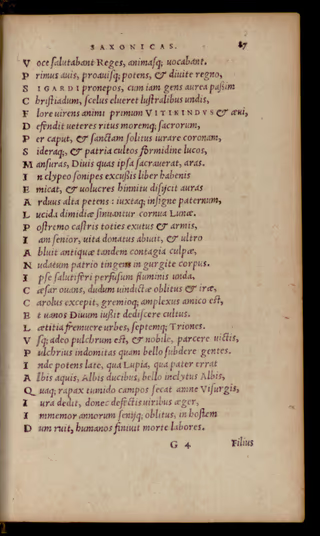
Voce ſalutabant Reges, animaſq; uocabant.
Primus auis, proauiſq; potens, & diuite regno,
SIGARDI pronepos, cum iam gens aurea paßim
Chriſtiadum, ſcelus elueret luſtralibus undis,
Flore uirens animi primum VITIKINDVS & æui,
Defendit ueteres ritus moremq; ſacrorum,
Per caput, & ſanctam ſolitus iurare coronam,
Sideraq;, & patria cultos formidine lucos,
Manſuras, Diuis quas ipſa ſacrauerat, aras.
In clypeo ſonipes excuſsis liber habenis
Emicat, & uolucres hinnitu diſijcit auras
Arduus alta petens: iuxtaq; inſigne paternum,
Lucida dimidiæ ſinuantur cornua Lunæ.
Poſtremo caſtris toties exutus & armis,
Iam ſenior, uita donatus abiuit, & ultro
Abluit antiquæ tandem contagia culpæ,
Nudatum patrio tingens in gurgite corpus.
Ipſe ſalutiferi perfuſum fluminis unda,
Cæſar ouans, dudum uindictæ oblitus & iræ,
Carolus excepit, gremioq; amplexus amico eſt,
Et uanos Diuum iuſsit dediſcere cultus.
Lætitia fremuere urbes, ſeptemq; Triones.
Vſq; adeo pulchrum eſt, & nobile, parcere uictis,
Pulchrius indomitas quam bello ſubdere gentes.
Inde potens late, qua Lupia, qua pater errat
Albis aquis, Albis ducibus, bello inclytus Albis,
Quaq; rapax tumido campos ſecat amne Viſurgis,
Iura dedit, donec defectis uiribus æger,
Immemor annorum ſenijq; oblitus, in hoſtem
Dum ruit, humanos finiuit morte labores.
FILIVS hinc patrij generoſus nominis hæres
Accepit ueteres Myſos, terraſq; regendas,
Quas fluuio Plißinna ſuo, quas utilis agris
Irrigat, & ripis formoſus Eliſter amœnis,
Saxoſumq; ſonans ſpumanti gurgite Sala.
Inde uetus ſponſo genus, & natalis origo,
Heroumq; domus ſe ſanguine ſcindit ab uno,
Heroum, qui præſtantes uirtute, ſub Arcto
Iuſticia rigidas gentes, & legibus æquis
Formarunt primi, uitæ melioris ad uſum.
Hinc quoq; (ſi fratrum ſpectes a ſanguine ſtirpem)
Magnus Otho, date thura duces, date manibus aram.
Hic uir, hic eſt, cui ueſter honos, cui gloria ueſtra,
Imperijq; decus fuit, & Germania curæ.
Proximus innocua populos in pace regebat,
Maxima cui Diuum cultus abolere profanos
Cura fuit, cenſuſq; ideo TIAGRINVS & ædes
Conſtituit, magniq; adiecit ponderis aurum
Illis, qui genus indocile ad meliora uocantes,
Sacra propagarent, lumenq; errantibus eſſent.
Filius huic, primis nemorum ſtudioſus ab annis,
Venatu tolerare famem brumamq; ſolebat,
Cornigeros TETMARVS agens in retia ceruos.
Impiger ex humeris pharetram ſuſpendit & arcum:
Solertiq; altos cingens indagine montes
Militat in ſyluis, rigidiſq; iraſcitur urſis,
Et foribus rictus præfigit, & horrida terga.
Scilicęt ut melius (ſi quando bella uocarent)
Imbribus Hercynioq; gelu duratus & æſtu,
Militiæ poſſet duros perferre labores.
S uſcipit hinc natus rerum T H E O D R I C V S habenas,
M arte potens, glebæ qui pingues ubere campos
F inibus adiecit patriæ, qua flumine pulchro
A duena fœcundos Vnſter perlabitur agros:
V nde etiam ſeri titulum geſſere minores.
N ec D E D O minus enſe bonus, minus utilis haſta,
N ec belli tenuit quiſquam dux aptius artes:
S iue opus extenſos metiri caſtra per agros,
S eu faciem pugnæ componere, ſiue profundas
S ubſidio foſſas poſitis deducere caſtris,
D efenſura cauas & propugnacula foſſas.
H unc conſanguineo pro Cæſare bella gerentem
M irati ſtupuere Hunni, ſtupuere niuoſum
P otantes Tanain, gelidiq; Boryſthenis undas:
O mnia cum ferro tumidi prope flumina Salæ
S terneret, ac caperent uix mœſta cadauera ripæ.
N ec minus in clarum famæ proceßit honorem,
N O M E N aui referens N A T V S, qui patre ſub ipſo
P rima rudimenta, & primos exegerat annos:
V irtutem primo patris miratus ab æuo.
A ppenninigenam fractis hic cornibus Arnum
C ontudit, exultans campo bellator aperto:
S icut ubi torrens, nimbis hyemalibus auctus,
S pumeus, & feruens, inſano uortice, ſyluas
P roruit, & meſſes late populatur, & agros.
N ec te magne T H I M O tacitum, natumq; relinquam
C O N R A D V M, inſignem fama & præſtantibus armis,
M archio qui primus tecum Myſneidos oræ
V ictor in Eridani campo atq; Inſubribus aruis
A uſonium multo compleuit ſanguine Tybrim.
Hinc O T H O ciuili præcinctus tempora quercu,
Ditibus argenti uenis, ærisq; ſcatentem
Fribergam, & Phylires excelſam condidit urbem.
Inter Hamadryadas Phylire formoſa ſorores
Venatrix, timidas illis in montibus olim
Inſidijs curſuq; feras agitare ſolebat,
Et grauidam iaculis pharetram tremulumq; gerebat
Mißile, quod liquidas ad Eliſtri creuerat undas.
Sed cum uirginei ſpolium & decus omne pudoris,
Dum iacet, ac dulcem carpit ſecura quietem,
Impius in ſola paſtor conualle tuliſſet,
Non ultra potuit tantum perferre dolorem,
Tabenteſq; artus anima indignata reliquit,
Alma ſed inſontis caſum miſerata puellæ
Excepit gremio tellus, tiliamq; uirentem
Oßibus ex Phylires, liquidas emiſit in auras.
Nunc quoq; per ripas illic, per mollia creſcunt
Prata, per excultos tiliæ, ſub mœnibus, hortos:
Sæpius & gratas præbent uenantibus umbras.
Vnde urbi indigenæ nomen fecere priores.
Inclytus hinc ataui T H E O D R I C V S nomen adeptus,
Infælix medici bibit atrum fraude uenenum.
Natus adhuc primo cum uix pubeſceret æuo,
H E N R I C V S, qui poſt factis clarißimus, omnes
Egregia proauos poſt ſe uirtute reliquit,
Illi, cum ſuperas liquiſſet auunculus auras,
Conditus extrema Ludouicus Iapygis ora,
Pro meritis, Cæſar Fridericus, tradidit acres
Tyrigetum populos, tituliſq; illuſtribus auxit.
Belliger hic clarum certamen equeſtribus armis
E didit, effigiem belli: clangore tubarum
A ntra reſultabant late, monteſq; fremebant,
V incentum plauſu pariter, ſonituq; cadentum.
C ampus erat, uirides claudebant undiq; ſyluæ,
A ureaq; in medio diffuſis frondibus arbor
S tabat. erant aurum rami, folia aurea ramis:
A ureus & cortex, at ſola argentea radix:
H anc circum nitidi, precium uictoribus, enſes,
E t galeæ inſignes criſtis, uirideſq; coronæ,
N ec minus heroum, per gramina mollia, natæ
C andida uirgineo quatientes corpora motu
D ucebant choreas. quas inter filia magni
C æſaris, in thalamos A L B E R T I ducitur uxor
M argaris. inde ſati F R I D E R I C V S, & acer in armis
S olennes ferro cæſus T I Z M A N N V S ad aras,
S ed profugæ luctus genitricis, & horrida bella,
D um genitor natos iuſtas irritat ad iras,
(A h nimium teneri ſtimulis agitatus amoris)
M ens reticere mihi: Sprea ſanguine fluxit, & ingens
A lbis, & Hercynijs quæcunq; e montibus orta.
T yrigetum pingues humectant flumina campos.
N O M I N I S E I V S D E M, ne dira licentia ferri
I mpunita foret, latronum F I L I V S arces
D iruit. hinc N A T V S, ſublato patre, rebellem
V ltus auos, multis impleuit cædibus urbem,
C orniger undoſo qua flumine ſtagnat Hieras:
C aptaq; ferratis affixit poſtibus arma.
Q V A R T V S in aduerſos ultricia ſigna Bohemos,
P ro decore imperij, generoſi Cæſaris ultor,
M ouit, & inſigni F R I D E R I C V S laude potitus,
S axonici clarum tulit Electoris honorem:
I lle etiam curans tranquillæ commoda pacis,
H oſpitium nobis ad Eliſtri condidit amnem,
E gregiaſq; animos precijs accendit ad artes.
P roximus Arctoi ſpolijs Aquilonis onuſtus,
I mpoſuit leges domito F R I D E R I C V S Hauelo.
T u quoq; coniugio felix, & prole nepotum
C aſſubios, E R N E S T E, ſagittiferoſq; Polonos,
O dera piſcoſo qua labitur amne, coërces.
F I L I V S armorum patriam formidine ſoluit,
F eliceſq; petens Solymos, & nobile buſtum,
V icit iter durum pelagi, & Curetida terram,
G ortynam, Gnoſonq;, & in æquore Cycladas alto,
P hœbeamq; Rhodon uidit, genteſq; beatas
P hœnicum, Syriæq; hortos, qua Tigris, & ingens
L abitur Euphrates, cœlo gratißimus amnis.
I lle etiam dubijs magno pro Cæſare rebus,
T hreicium Auſtriacis auertit mœnibus hoſtem,
R egnatorem Aſiæ, Thracaſq; Getaſq; trahentem,
E t magnas Orientis opes, cum Norica ſaxa
E t tremerent late Nymphæ Iſtrides, Iſtrides undæ.
I llum Aponus uidit, celſæq; Antenoris arces,
I n ferrum ruere, & Pataui proſternere muros.
E nſifer hinc, nec fratre minor pietate, nec armis,
I O H A N N E S motus compeſcuit acer agreſtes:
Q ualiter Arctois Boreas emiſſus ab antris,
A tra ſerenato depellit nubila cœlo.
S trenuus hinc per ſaxa ruens, per tela, per ignes,
I nſilijt primus Regalis mœnibus Albæ,
I nq; expugnato clarus ſtetit aggere uictor,
S ublimes tollens aquilas: auſiſq; potitus
M uralem querna meruit de fronde coronam.
H is Ducibus cœlo caput extulit aurea, quæ nunc
R elligio totum ſincera perambulat orbem,
Q uam probitas & ſancta fides comitantur euntem,
E t concors pietas ius omnibus una miniſtrat.
A t nomen qua uoce tuum, quoue inclyta facta
C armine, I O H A N N E S Friderice binominis æquem?
Q uæ tibi non laudes, qui non debentur honores?
P ectore magnanimo ſimilem tibi nulla tulerunt
S ecula, nulla ferent. dulcem profundere uitam
E t fortem, chara pro relligione, cruorem
P romptus eras, mortemq; Dei pro laude paciſci:
C ommotus nunquam præſentis imagine lethi,
S cilicet accenſum diuino pectus amore,
N on uis ulla domat ferri, non fulminis ignes:
Q ualiter ipſe pater uitæ, Sol lucis origo,
S ol oculus mundi, cæca ſub nocte laborat
I nterdum, uictis mox nubibus aureus exit.
M acte animo Germano, & macte ingentibus auſis,
S ic etiam dilecte Deo, quod mille probatum
T entatumq; modis, reducem fidiſsima coniunx
V idit, & in cara domini ceruice pependit
A nte obitus: dulcem nati uidere parentem:
E t nunc in patria cineres tellure quieſcunt.
A t ueteres inter proauos, cœtuſq; piorum,
S piritus exultat liber, fruiturq; perenni
L æticia, æterniſq; bonis diſcrimina penſat.
S alue magne pater patriæ, tua gloria uiuet,
D onec in occaſum roſeo uoluentur ab ortu
S idera, donec erunt latices Aganippidos undæ.
I nde ſatus, fauſto coniungit fœdere tædas
S ponſus, & illuſtres thalamos iam nubilis intrat
D orotheæ, primoſq; parat coniungere ſomnos:
A mborumq; Dei uotis concordibus adſunt.
Iamq; tubæ cantuſq; ſonant, domus ampla reſultat,
L æticiaq; fremunt rupes, Surgamus, & altam
A onides ſoceri ſcandamus Principis arcem:
V t cum rorifero noctem produxerit ortu
H eſperus, ad ſponſæ thalamos Hymenæa canamus,
F elicis bona ſigna thori, & nubentibus omen.
D ixerat, & uarijs lento de uimine textos
F loribus implebant calathos ætatibus omnes
E t facie cultuq; pares, urbemq; petebant.
Tu mihi nunc qui culta rigas ſpumantibus undis
A rua Nicer, ( nam te ueterum nec facta parentum,
N obile nec patriæ decus ignorare putandum eſt )
Q uandoquidem hos prima colles ab origine mundi
A lluis, ipſe genus ſponſæ, patrumq; recenſe
F acta, Duceſq; atauos, prohibeq; ſilentia famæ.
N am potes, & grata eſt canere, & meminiſſe uolu=
S ic Remiſus, Iaxtuſq;, tuum ſic Coccius amnem (ptas.
A ugeat, & ſalices creſcant tibi ſemper & alni,
Q ua uirides inter Rheno confunderis umbras.
S ic ego: cum lato madidum caput extulit antro
C æruleus Nicer, & molli uiridantia muſco
T empora concutiens, His orti montibus ( inquit )
( D icam equidem, nec te longo ſermone morabor )
M agnanimi heroes quondam, melioribus annis,
F undarunt urbes populis, gentemq; comatam
Iuſticiam docuere ſequi, nec temnere diuos:
Splendida ſed tenebris inuoluit geſta uetuſtas
Quandoquidem quamuis populis opibuſq; potentes,
Sacrorum dulci caruerunt munere uatum:
Munere quod fragilis perfunctos munere uitæ,
Dijs æquat ſuperis, & læto nectare paſcit.
At ſponſæ (ſi prima domus quæratur origo)
Inclyta Francorum ſeries a ſanguine manat,
Et genus, & generis priſci numeroſa propago,
Sed neq; tum colles iſtos, non iſta colebant
Rura ataui: ſed qua fluuio premit arua ſonanti
Danubius, quaq; Hercinijs e montibus orti
Danubium ſupra Nabus, & Regus influit infra,
Quaq; uides ſolem labens Pegneſſe cadentem.
Maximus hinc ortus, ſæuos LVTHOLDVS in Vgros
Et peditum cuneos & turmas duxit equeſtres,
Claraq; tranſcendens maiorum facta ſuorum,
Infeſtum domitis compeſcuit hoſtibus Iſtrum,
Pannonioq; Anaſi compleuit ſanguine flumen.
Aureus in clypeo ueterum geſtamen auorum
Ardebat, uaſtoſq; leo pandebat hiatus.
Nec minor ARNOLPHVS bello, nec NATVS eodem
Nomine, dijs animæ ſimiles: uidi horrida uidi
Prælia, cum pulchram peterent per uulnera mortem.
Tranquillos in pace obitus, ignobile fatum
Credebat, patrijſq; Hunnos ducebat ab oris,
Spe regni profugus flagrans VERNERVS auiti.
Primus in aduerſos ibat, pugnamq; ciebat,
Quoq; loco melius ducendus & ordine miles,
Nouerat, & magnis aderat uis inſita uerbis.
Quas Lycus in ripa pugnas, quæ funera denſis
Stragibus arctatus uidit? qua diuidit acres
Vindelicos, Rhetoſq;, quot intumulata uirorum
Corpora Danubij ſpumantibus intulit undis?
Qualiter in trunco flammas ſi forte reliquit
Ille domum ſero rediens iam ueſpere paſtor,
Tempeſtas ſi nocte, Euris ſurgentibus, orta eſt:
Omnia peruolitant ignes, it turbine uaſto
Flammarum torrens ſyluas effuſus in altas.
Ordine TRES illis uos ſucceßiſtis OTHONES,
Præſtantes animis, factiſq; illuſtribus omnes.
Quos inter ſæuis excellens tertius armis,
Per uarios pelagi tractus, per inhoſpita longe
Littora, littoribus multum diſtantia noſtris,
Sideribus, remiſq;, auriſq; ferentibus uſus,
Europæ e magna multis comitantibus heros,
Antiquos petijt Solymos, cedroq; uirentes
Palmiferi colles Libani: tunc inclyta rurſus
Acta ſub imperium Solyme: tunc Aſcalo, & ipſa
Quæ toties uatum celebratur carmine, Bethle:
Gazaq;, & æquoreis Iope quæ tunditur undis,
Hadriacis Iope ſtatio gratißima nautis.
Felices animæ, quibus illo tempore naſci
Contigit, & magnum pariter dare uela per æquor,
Et fortunatum ſpolijs decorare ſepulchrum.
Crediderim colles ipſos, montemq; Sionis
Ardua gratantes iactaſſe ad ſidera uoces,
Cum iam uictor ouans, poſitis exercitus armis,
Procumbens ſanctæ pronus daret oſcula terræ:
Fulgeretq; Crucis paßim uenerabile ſignum.
P oſt O T H O pacis amans, & M A X I M V S alter ab
F I L I V S, inſignis bellator, Iapyge fertur (illo
P er Latium, ſublimis equo, qua turbidus auro
A bdua, qua lento fœcundos agmine campos
O llius, Heſperidumq; ſecat regnator aquarum
E ridanus, tenera qua cinctus arundine crinem
M incius, & rapidis Atheſis deuoluitur undis,
A mnis & a Gallis Italum qui ſeparat orbem.
P rimus in hos, ſexti genitor L V D O V I C V S Othonis,
M igrauit colles S E P T E M V I R, & ampla reliquit
E t N A T O, & ſeris regnanda nepotibus arua.
I nſignes ambo uirtutibus, artibus ambo
P acis, & armorum ſtudijs. pater indole gaudet
E gregiæ ſobolis, nec diſplicet æmula uirtus.
T unc ducibus primum claris habitabile ſaxum
H oc fuit, extremæ quod deſuper imminet urbi.
H ic ortus L V D O V I C E tuos, cui maxima rerum
V erborumq; fides. hic incunabula uidi
R V D O L P H I, primos hic egit F I L I V S annos.
S æpe fatigatis ſudorem flumine puro
A bſterſi, fouiq; undis, & lenibus auris.
S eu ſpolia ampla domum bellando parta referrent.
S eu nemorum exuuijs læti, prædaq; ferarum,
V enatu ſera feßi iam nocte redirent.
M unera per ripas ſemper ſuſpenſa uidebam,
S etigerum caput aut apri, uel cornua cerui.
H inc pius Aonijs dux condidit atria Muſis,
P erculſus dulci R V P E R T V S laudis amore,
O decus, o nullos unquam reticende per annos,
F ortunate ſenex. tibi ſe debere fatetur
P oſteritas. patriam tu doctis artibus ornas,
I ngenuoſq; iubes regnare per oppida mores.
A nte uagis tantum notus paſtoribus ibam
P er nemora, & ualles, piger atq; ignobilis amnis.
N unc Rhenus mihi, nunc Viadrus, nunc Iſter, & Albis,
A ſſurgunt, cinctæq; hedera mea flumina circum
A onides choreas agitant, & carmina dicunt:
I nflat & argutas non Tityrus unus auenas.
F ortunate ſenex, cælo tua nomina tollit
G loria, quæ latis mundum circumuolat alis.
A t niſi munificus Muſis ea dona dediſſes,
H eu quibus in tenebris, quanta ſub nocte iaceres
F lebilis, & penitus caligine conſitus atra?
I lli etiam Nemetum in campis, bis munere Diuum
V no parta die magno uictoria plauſu.
B is uicti cecidere hoſtes, ac terga dedere.
I mperij poſt hæc nato conceſſa poteſtas,
Q ui templis urbem, doniſq; ingentibus auxit,
M uſarumq; fouens hortos, & amœna uireta,
D ulcia R V P E R T V S patrijs dedit ocia terris.
E Latio tandem Tuſcoq; reuerſus ab Arno
L ongæuos curis mortalibus exuit annos.
A t proauos ſuperans, ſceptris adiunxit auitis
D otales Stephanus populos genteſq; feroces,
Q ui Lutram, Saramq; bibunt, quorumq; per agros,
S pumeus undoſo decliues gurgite curſus
E xtendit Rhenus, Vogeſiq; e rupibus ortus
I am dominum prono Rhenum petit amne Moſella.
H inc patri F R I D E R I C E ſubis, natumq; relinquis
I O H A N N E M : cuius de ſanguine dictus eodem
Nomine, tranquillas ad pacis idoneus artes
FILIVS, impleuit magnum uirtutibus orbem,
Iuſticiæ cultor, iuriſq; miniſter, & æqui.
Ipſa ſuas illi natura recluſerat omnes
Diues opes, cœlumq; animo ſublimis adibat,
Stellarumq; obitus, ſtellarum nouerat ortus,
Atq; ſalutiferas proprijs cum uiribus herbas,
Quid ſterile aſplenum, quid læta ſyſimbria poſsint,
Et menthæ uirides, & odoriferæ calaminthæ,
Bugloſſuſq;, thymuſq;, lupiq; uolubile gramen.
Iamq; decem numerans actæ ſexennia uitæ,
Bis tribus adiectis, robuſtus, & integer, annis,
Cœleſtes petijt ſedes, quas luce perenni
Aeternis, opifex rerum, fulgoribus implet.
Is denſis obſcura ducum monumenta tenebris
Eruit, & totam ſtirpem, laudeſq; parentum,
Ire per ætates iuſsit, perq; ora nepotum.
Nunc uirides Rheni tractus, ſortitus honores
Et titulos ataui (ſic arbiter omnia iuſtus
Tempora diſpenſat Deus, atq; in priſtina reddit
Sæpe ducum ſobolem) magna cum laude gubernat
Inclytus, & populo FRIDERICVS amabilis omni.
Cuius, adhuc annis uix pubeſcentibus, Iſter
Signa ſagittiferæ contra Mahumetica Lunæ
Egregiæ ſpecimen uirtutis, & indolis altæ
Primitias uidit, bellatricemq; ferentem
Per turmas aquilam: ualidæ ſtupuere cohortes.
Macte rudimentis princeps, dij noſtra tuentes
Præſidia, ad ueterum te ſeruauere parentum
Imperia, & placida terras in pace regendas,
Annorumq; moras fortuna beatior implet.
Qui uigor ingenij? quantus ſub pectore feruet
Doctrinæ cœleſtis amor? quam fida ſuorum
Cura duci? doctis quæ confert præmia Muſis?
At toruos ſi quando ruit uenator in apros,
Et belli ſimulachra ciet, ſyluaſq; fatigat,
Arduus alipedem curru Phaëtontis inuſtum,
Herbifer eduxit, quem Mincius Andide ſylua.
Concitat, ille uolans argutas erigit aures
Sublata ceruice, ſimul pernicior Euro
Crura per apricos glomerat ſinuantia campos.
At natos, clari ſpectantes facta parentis,
Splendida magnificæ ſtimulat uirtutis imago,
Speq; noua tanti lætatur ſanguinis orbis.
Hoc genus, hæc ſponſæ uetus eſt nubentis origo.
Sed iam Sol rapidos ſuper ingerit altior æſtus,
Dum loquor, & tactus radijs incanduit aër,
Iamq; tubæ, lituiq; ſonant: procedit ad aras
Sponſus, ut auſpicibus firmet connubia Diuis.
Finierat Nicer, inuerſa tum protinus urna
Inſonuit, fluctuſq; nouos emiſit aquarum,
Cornuaq; occuluit uitreis taurina ſub undis:
Cornua flumineo ſemper uiridantia muſco.
Fortunati ambo, natiq; fauentibus aſtris,
Et uirgo felix, & felix uirgine princeps,
En uirides Titan meliori lumine montes
Irrigat, & cœlum diſcuſſa nube ſerenat,
Et placidæ geminis gratantur amantibus auræ
Ipſa nouos tellus ſubmittit Dædala flores
Flexibiles hederas, & eryngion utile nuptis:
C uius flore Phaon, & noto germinis uſu,
D ulcia promeruit Permeßidos oſcula Sapphus,
S ecretum ſpinis quod eryngion horret acutis.
H oc noua ſeu gremio fert ſponſa uel occulit ore,
I llicitos nunquam coniunx meditatur amores.
Q ualis in exculto genialis amaracus horto,
C andida fontanis quam nutrit Hamadryas undis,
S urgit, & ambroſium late diffundit odorem :
S ic teneræ uernans iucundo flore iuuentæ,
S ponſa nitet, molleſq; roſas, & lilia uincit.
L ucidus e collo gemmæ Garamantidos ignis
I rradiat, ueſtiſq; pedes deſcendit ad imos
A urea, flauentes tegit aurea uitta capillos,
A ureaq; e niueo redimicula pectore pendent.
S ed pudor, & probitas, & honeſtas regia cultum
V incit, & exuperant caſtæ reuerentia famæ :
S ordet enim niſi coniunctum uirtutibus aurum.
I llius aſpectu flagrantia lumina paſcit
S ponſus, in æſtiuo rapidus quem puluere Moſa,
S omiaq; heroum multa inter millia uidit,
D um fretus ſuperis, & equo ſublimis & haſta
F ulminat, & magno ductor clamore triumphat,
L ætaq; tranquillo circumſpicit agmina uultu :
Q ualiter Auroræ formoſo præuius aſtro,
L ucifer ardentes nitidißimus explicat ignes.
I amq; dies iucunda fluit, ſimul ordine longo
A ccumbunt epulis proceres, lucemq; morantem
M ollibus aut choreis, uario aut certamine condunt.
E t iam permenſus cœlum Sol occidit, & iam
M ontibus e celſis maiores ſuſcitat umbras,
O bſcuratq; ignes ſtellarum Luna minores.
E cce leues atro crepitantes ſulphure flammæ
S ubuolitant, rutiliq; petunt ſpacia ardua cœli,
E t rapidis uacuas implent ſtridoribus auras.
S it felix fauſtumq; precor: Iouis ales ab alto
P ræpetibus plaudit pennis, omenq; ſecundat
A lituum regina, pater dum magnus euntem
I n thalamos ducit natam, fortiq; pauentem,
A nte deos, ſacrumq; tori præfatus honorem,
C ommendat genero, lectoq; relinquit in uno
C oniunctos, dictiſq; ambos ſolatur amicis.
I nterea lauro cinctæ Parnaßide Muſæ,
A nte fores, dulces in gyrum fundere cantus
I ncipiunt, princepſq; chori, comitumq; ſuarum,
C alliope doctas præcedit uoce ſorores.
L ucidus Oceani natales Heſperus undas
D eſeruit, tædas portans, noctemq; iugalem:
I am caris Domini formoſa quieſcit in ulnis
D orothee, primos iungens cum coniuge ſomnos.
A t uos innuptæ, quibus intemeratus amantum
L ectus, & interior thalami concredita cura eſt,
O minibus, uotiſq; bonis, cantuq; ſecutæ,
D ulcis ut æterno concordia fœdere regnet.
H ymen o Hymenæe Hymen, iterate puellæ.
Dicimus, o Hymenæe Hymen ades o Hymenæe:
Q ualiter igne Iouis ſi tacta exaruit ulmus,
N uda, carens folijs, culti iam dedecus horti,
N on teneras ultra uites, non amplius uuas
E ducat: at rapidi niſi fulminis ira fuiſſet,
C uruaret grauidos Autumni munere ramos.
I nnuba ſic, uita dum cælibe uirgo ſeneſcit,
A etatis roſeum uidet emarceſcere florem.
A t caro deſponſa uiro, ſua pignora mater
S pectat, & optato genitricis nomine gaudet,
E t thalami cunctos ſolatur honore labores.
H ymen o Hymenæe Hymen, iterate puellæ.
Dicimus, o Hymenæe Hymen ades o Hymenæe.
F allimur? an noſtras uox turturis attigit aures?
T urtur amans, ſola gemit & ſuſpirat in umbra.
H uc ades: o mea uita, tibi ſub montibus iſtis
O ſcula & amplexus, ſecretaq; gaudia ſeruo:
P arthenijq; udo iam flos tibi creſcit in antro.
H ymen o Hymenæe Hymen, iterate puellæ.
Dicimus o Hymenæe Hymen ades o Hymenæe.
V os auræ, quarum domus eſt circumfluus aër
S olis, & umbrarum comites, dum Sirius ardet
F eruidus, & certas populis denunciat iras,
V os lenite graues, gelidis afflatibus, æſtus,
E t uitium cœli, ſæuoſq; auertite morbos:
E t facite ut noſtris propria hæc ſint gaudia terris.
H ymen o Hymenæe Hymen, iterate puellæ.
Dicimus o Hymenæe Hymen ades o Hymenæe.
T u quoq; ſancte ſenex, cuius iam lumen in ortu
C ernimus, inſignemq; aſtris fulgentibus arcum,
Q uandoquidem ſuccos fama eſt te noſſe ſalubres,
H erbarumq; parens monſtrauit Phillyris uſum:
Quære nouos flores, nuptæ quibus inclyta mater
Amiſſum reparet pulſo languore uigorem.
Hymen o Hymenæe Hymen, iterate puellæ.
Dicimus o Hymenæe Hymen ades o Hymenæe.
Eſte una, dulcemq; una producite uitam,
Dum licet ac paruos auiæ tranſmittite natos.
Omnia nam magno labentia ſidera cœlo
Venturos meliora iubent ſperare nepotes.
Hymen o Hymenæe Hymen, iterate puellæ.
Dicimus o Hymenæe Hymen ades o Hymenæe.
Fortunate ſocer, nouus alti ſanguinis ordo
Naſcitur, unde genus maternum ſera propago
Francorum primo Regum numerabit ab ortu.
Vos quoq; felices ſocero, ſublimia fratres
Pectora, quos ſtabili iungit concordia nexu:
Sic (reor) alterna quem morte redemit ab Orco,
Tyndarides fratrem dilexit Caſtora Pollux.
Vos colimus, ueſtramq; Duces, dum cuncta relinquunt,
Imploramus opem: nec uos iuuiſſe pigebit
Quas ueſtri fouere ataui, fouere parentes,
Præcipue dignas magnis heroibus artes.
Acre ſed inprimis ſtudium pietatis, & almæ
Iuſticiæ, paciſq; bonæ ſub pectore regnet:
Quandoquidem curam Princeps ubi negligit æqui,
Sunt mutæ, ueluti defuncta cadauera, leges.
Hymen o Hymenæe Hymen, iterate puellæ.
Dicimus o Hymenæe Hymen ades o Hymenæe.
Nox ruit, & placidos iam ſuadent ſidera ſomnos,
Iam ſecura quies, Lethæa papauera quaſſans,
Aëris immenſi tractus, & proxima Lunæ
Regna tenet, pelagiq; ſinus, terraſq; iacentes,
Et uolucrum genus omne ſilet, genus omne ferarum,
Somniaq; humanas ſolantur inania curas.
Ipſa ſibi cultis noua nupta uidetur in hortis
Mollibus aut pratis, aut in conualle uirenti,
Narciſſum, tymbramq;, roſaſq; & molle liguſtrum,
Et mites uuas, & ſuaue rubentia mala
Carpere, dilecto iucundum munus amanti,
Candidaq; aureolæ contexere lilia calthæ.
Hymen o Hymenæe Hymen, iterate puellæ.
Dicimus o Hymenæe Hymen, ades o Hymenæe.
O quoties tibi nocte uirum, ſeu bella gerentem
Horrida, ſeu deſerta feras per luſtra ſequentem
Afferet in ſomnis uolitanſq; reducet imago.
Ille ſed in caſtris, nudoue ſub æthere pernox
Aſpera robuſto geſtat uenabula collo.
Hymen o Hymenæe Hymen, iterate puellæ.
Dicimus o Hymenæe Hymen ades o Hymenæe:
Dulcis Hymen tibi nos meritos largimur honores,
Et nomen laudeſq; tuas celebramus ouantes.
Salue magne Nicer, populi lætentur, & urbes,
Et gelidæ ualles, gelidiq; in uallibus amnes,
Quos tantis ſuperum rector dignatur alumnis.
Iam liquidum ſacro commixtum nectare rorem
Sudabit cœlum, ſudabunt balſama ſyluæ,
Pinguia flaueſcent iniuſſis meſſibus arua:
Nataq; ſponte ſua mirabitur hordea tellus.
Hymen o Hymenæe Hymen, iterate puellæ.
Dicimus o Hymenæe Hymen ades o Hymenæe.
Finierant: ſonuere nouis applauſibus arces:
Dorothoen rupes ipſæ, uaga flumina clamant
Dorothoen, iuga Dorothoen uicina remittunt.
Tum pater omnipotens ter ab æthere Iuppiter alto
Intonuit, cœloq; dedit bona ſigna ſereno:
Altaq; per celſos ſunt facta ſilentia montes.