Hover or tap a word to see its match.
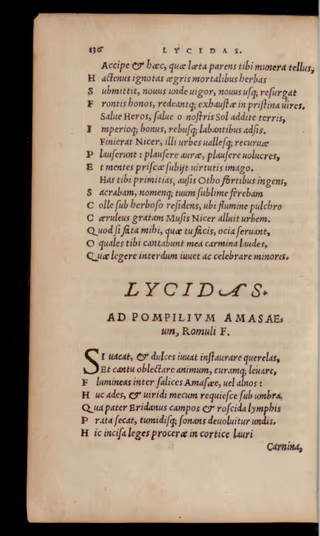
If you are at leisure, and it pleases you to renew sweet complaints,
and to delight the mind with song, and to relieve your care,
among the river willows, Amasaeus, or the alders:
come here, and rest with me under the green shade,
where father Eridanus cuts through the fields and the meadows
dewy with its waters, and rolls down roaring with its swelling waves.
Here you will read, carved in the bark of a tall laurel,
The songs, which, having recently departed from your shores,
Lycidas sang, a solace for his cruel love.
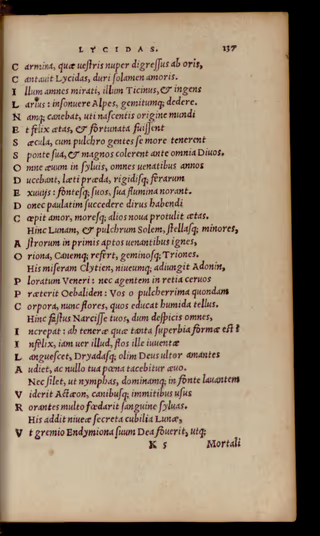
The rivers marveled at him, Ticinus at him, and the vast
Larius: the Alps resounded, and gave a groan.
For he sang how, at the origin of the newborn world,
both the age had been happy, and fortunate had been
the centuries, when nations held themselves in beautiful custom
of their own accord, and worshipped the great Gods above all.
They spent their whole life in the woods, all their years in hunting,
rejoicing in the prey, and the stiff spoils
of wild beasts: and they knew their own springs, their own rivers.
Until gradually the dire love of possessing began
to succeed, and a new age brought forth other customs.
Then the Moon, and the beautiful Sun, and the lesser stars,
the starry fires especially suited for hunters,
Orion, and the Dog, and the twin Triones he recounts.
To these he joins wretched Clytie, and snowy Adonis,
wept for by Venus: nor, driving stags into the nets,
does he pass over Oebalides: O you bodies once most beautiful,
now flowers, which the moist earth nourishes.
Next your disdain, Narcissus, as you despise all,
he rebukes: ah, what great pride is there in a tender form?
Unhappy one, soon that spring, that flower of youth
will wither, and the enamored Dryads one day the avenging God
will hear, and in no age will your punishment be kept silent.
Nor is he silent on how the nymphs, and their mistress bathing in the spring,
Actaeon saw, and, falling victim to his merciless hounds,
defiled the dewy woods with much blood.
To these he adds the secret bedchamber of the snowy Moon,
how the Goddess cherished her Endymion in her bosom, and how
Secretly she joined herself to a mortal on the cold grass,
And rested her head against the boy's rosy mouth,
While he lies there, and dewy sleep refreshes his weary limbs.
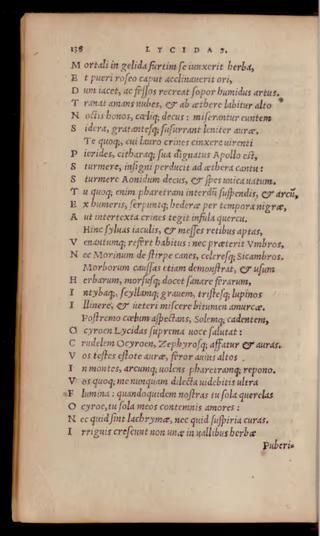
The lover swims through the clouds, and glides from the high ether,
The glory of the night, and the beauty of the sky: the stars pity her as she goes,
And the rejoicing breezes gently whisper.
You too, whose hair the Pierides have bound with green laurel,
And whom Apollo has deemed worthy of his lyre,
Sturmer, he leads to the heavens with a distinguished song:
Sturmer, glory of the Aonides, and sole hope of poets.
For you too sometimes suspend your quiver, and your bow,
From your shoulders, and black ivy creeps around your temples,
Or a fillet interwoven with oak covers your hair.
Next he recounts the woods suited for javelins, and the fields suited for nets,
And the ways of hunters: nor does he pass over the Umbrians,
Nor the dogs of Morinian stock, and the swift Sicambrians.
He also explains the causes of diseases, and the use
Of herbs, and teaches how to cure the bites of wild beasts,
And to smear on endive, and pungent squill, and bitter lupines,
And to mix bitumen with old olive lees.
Finally, gazing at the sky, and the setting Sun,
Lycidas greets Ocyroe with his last words:
Cruel Ocyroe, and he addresses the Zephyrs and the breezes.
Be witnesses, breezes, I wander pathless into the high
Mountains, and willingly I lay down my bow and quiver.
You too will never see me again, beloved
Rivers: since you alone my laments,
Ocyroe, you alone despise my love:
Nor do you care what tears are, nor what sighs mean.
Not just one kind of herb grows in the well-watered valleys
Seseli with its downy leaves, and fresh ivy,
And arum, saffron in its berries and two-colored in its leaves:
Arum is useful to bears, ivy to boars, seseli to stags.
But for me grows no medicine for my grief,
Nor does any root lighten my longing, nor ever
Does the face of Ocyroe slip from my heart.
And now farewell, harsh Ocyroe, and you who illuminate all things,
Father Sun, and the fires of the stars: you shores and rivers,
Farewell forever: let these be my final words.
Thus spoke Lycidas: and he threw himself onto the green grass
With a groan, and looked back at the Alps with welling tears.
He rose, nevertheless, and sought the deserted retreats
Of the groves, and passed beyond the sources of the Rhine, and the springs
Of the Danube, and at last returned to familiar shores.
But his fatherland did not see him joyful, nor did the eyes of his people.
Only he, wandering in the woods and in the high mountains,
Would lay to rest the unpleasing suns, the unpleasing days with song,
And press his groans deep within his heart,
If any day might be able to soothe so great a sorrow.
SI uacat, & dulces iuuat inſtaurare querelas,
Et cantu oblectare animum, curamq; leuare,
Flumineas inter ſalices Amaſæe, uel alnos:
Huc ades, & uiridi mecum requieſce ſub umbra,
Qua pater Eridanus campos & roſcida lymphis
Prata ſecat, tumidiſq; ſonans deuoluitur undis.
Hic inciſa leges proceræ in cortice lauri
Carmina, quæ ueſtris nuper digreſſus ab oris,
Cantauit Lycidas, duri ſolamen amoris.
Illum amnes mirati, illum Ticinus, & ingens
Larius : inſonuere Alpes, gemitumq; dedere.
Namq; canebat, uti naſcentis origine mundi
Et felix ætas, & fortunata fuiſſent
Sæcula, cum pulchro gentes ſe more tenerent
Sponte ſua, & magnos colerent ante omnia Diuos.
Omne æuum in ſyluis, omnes uenatibus annos
Ducebant, læti præda, rigidiſq; ferarum
Exuuijs : fonteſq; ſuos, ſua flumina norant.
Donec paulatim ſuccedere dirus habendi
Cœpit amor, moreſq; alios noua protulit ætas.
Hinc Lunam, & pulchrum Solem, ſtellaſq; minores,
Aſtrorum in primis aptos uenantibus ignes,
Oriona, Canemq; refert, geminoſq; Triones.
His miſeram Clytien, niueumq; adiungit Adonin,
Ploratum Veneri : nec agentem in retia ceruos
Præterit Oebaliden : Vos o pulcherrima quondam
Corpora, nunc flores, quos educat humida tellus.
Hinc faſtus Narciſſe tuos, dum deſpicis omnes,
Increpat : ah teneræ quæ tanta ſuperbia formæ eſt ?
Infelix, iam uer illud, flos ille iuuentæ
Langueſcet, Dryadaſq; olim Deus ultor amantes
Audiet, ac nullo tua pœna tacebitur æuo.
Nec ſilet, ut nymphas, dominamq; in fonte lauantem
Viderit Actæon, canibuſq; immitibus uſus
Rorantes multo fœdarit ſanguine ſyluas.
His addit niueæ ſecreta cubilia Lunæ,
Vt gremio Endymiona ſuum Dea fouerit, utq;
Mortali in gelida furtim ſe iunxerit herba,
Et pueri roſeo caput acclinauerit ori,
Dum iacet, ac feſſos recreat ſopor humidus artus.
Tranat amans nubes, & ab æthere labitur alto
Noctis honos, cœliq; decus : miſerantur euntem
Sidera, gratanteſq; ſuſurrant leniter auræ.
Te quoq;, cui lauro crines cinxere uirenti
Pierides, citharaq; ſua dignatus Apollo eſt,
Sturmere, inſigni perducit ad æthera cantu :
Sturmere Aonidum decus, & ſpes unica uatum.
Tu quoq; enim pharetram interdũ ſuſpendis, & arcũ,
Ex humeris, ſerpuntq; hederæ per tempora nigræ,
Aut intertexta crines tegit infula quercu.
Hinc ſyluas iaculis, & meſſes retibus aptas,
Venantumq; refert habitus : nec præterit Vmbros,
Nec Morinum de ſtirpe canes, celereſq; Sicambros.
Morborum cauſſas etiam demonſtrat, & uſum
Herbarum, morſuſq; docet ſanare ferarum,
Intybaq;, ſcyllamq; grauem, triſteſq; lupinos
Illinere, & ueteri miſcere bitumen amurcæ.
Poſtremo cœlum aſpectans, Solemq; cadentem,
Ocyroen Lycidas ſuprema uoce ſalutat :
Crudelem Ocyroen, Zephyroſq; affatur & auras.
Vos teſtes eſtote auræ, feror auius altos
In montes, arcumq; uolens pharetramq; repono.
Vos quoq; me nunquam dilecta uidebitis ultra
Flumina : quandoquidem noſtras tu ſola querelas
Ocyroe, tu ſola meos contemnis amores :
Nec quid ſint lachrymæ, nec quid ſuſpiria curas.
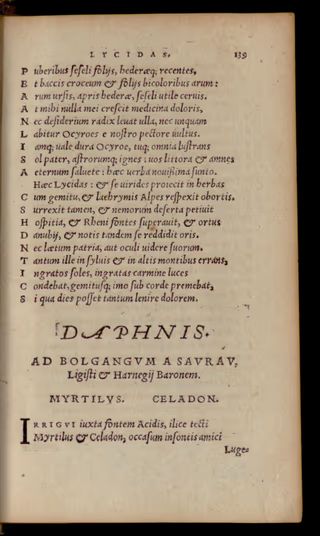
Irriguis creſcunt non unæ in uallibus herbæ
P uberibus ſeſeli folijs, hederæq; recentes,
E t baccis croceum & folijs bicoloribus arum:
A rum urſis, apris hederæ, ſeſeli utile ceruis.
A t mihi nulla mei creſcit medicina doloris,
N ec deſiderium radix leuat ulla, nec unquam
L abitur Ocyroes e noſtro pectore uultus.
I amq; uale dura Ocyroe, tuq; omnia luſtrans
S ol pater, aſtrorumq; ignes : uos littora & amnes
A eternum ſaluete : hæc uerba nouißima ſunto.
H æc Lycidas : & ſe uirides proiecit in herbas
C um gemitu, & lachrymis Alpes reſpexit obortis.
S urrexit tamen, & nemorum deſerta petiuit
H oſpitia, & Rheni fontes ſuperauit, & ortus
D anubij, & notis tandem ſe reddidit oris.
N ec lætum patria, aut oculi uidere ſuorum.
T antum ille in ſyluis & in altis montibus errans,
I ngratos ſoles, ingratas carmine luces
C ondebat, gemituſq; imo ſub corde premebat,
S i qua dies poſſet tantum lenire dolorem.