Hover or tap a word to see its match.
Next to the spring of the flowing Acis, sheltered by a holm oak,
Myrtilus and Celadon, the death of their innocent friend
They mourned equally, and in turn mingled the obscure with the true:
Equal in age, and both outstanding in verse,
Both clad in the skins of a shaggy bear:
Celadon a hunter, Myrtilus a fowler.
Then Celadon first thus began of ancient loves.
Daphnis was outstanding in beauty, and in green youth:
Daphnis, sprung from a hunter, whom his mother Sirmia
Had brought forth by birth, by the waves of the golden Meuse.
But then in the Euganean hills, around the humid
Streams of the Medoacus, he gave his leisure to the charming Muses.
Here, as he was catching the breezes and lying on the bank,
Leuce, most beautiful inhabitant of the deep groves
(As she by chance was making her way home, weary from the hunt),
Had seen him, and had caught fire in all her bones.
Even her, burdened with the spoils of woodland prey,
The handsome Daphnis looked back at with a desirous eye:
And without delay, he joined himself to the Nymph in the secret shade,
And of his own accord gave hope and faith, and consoled the lover.
Happy both, if these joys had been granted to you
As your own by the steadfast will of the fates.
To the gods it seemed otherwise: Daphnis is forced
To seek foreign lands, and to visit unknown cities.
He indeed was cherishing in his heart the vain hope of return:
But scarcely had he left the cold Alps behind his back,
When, weary, and relieving the heat on the bank and in the river,
Far from his sweet homeland, and the embrace of his people,
An immense torrent overwhelmed him with foaming waves.
But trembling Leuce, and ignorant that he was consumed by death,
While the boy in the woods, and unburied on the bare sand,
Lies cast out by the waves, a miserable corpse,
Unhappy, she wandered alone, and counting the hours
long since slipped away, she called out for you, Daphnis,
late in the evening, for you when day returned, for you all through the night.
At last, overcome by madness and cruel grief,
impious, while she does not know him snatched away by a cruel death,
she attempts to bind the absent one's mind with a magic spell,
and unbinds her hair, and ungirds her tunic,
and honoring the altars with flames, on a serene night,
she addresses her like-minded sister with such a voice:
"Take up the urn, sister, and scatter living waters
around the burning altars, and do not turn your eyes back:
it is my intention to try Haemonian arts (for what
have we achieved with tears?), while the dewy Moon courses
above the earth with her snow-white chariot, and the golden Sun below.
Scatter sulphurs for me, scatter dark blue smoke:
The fluid moisture of sulphur is born in the lap of the earth,
and it guards the causes and origins of things:
this same moisture also aids the herbs touched by magic fumigations,
and entwines the blind fires by which he is burned.
Scatter sulphurs for me, scatter dark blue smoke:
Avenging Furies, whose divine power keeps watch
over wicked crimes, and adds terror to fearful minds,
and all you gods and spirits whom this circumambient air
contains, hear these prayers: Daphnis, departing,
took away my joys, and my reputation, and my snow-white modesty.
You, punish him in turn with an avenging penalty,
and send upon him longing, and tears, and the love of death,
and aimless wanderings, and long griefs.
Scatter sulphurs for me, scatter dark blue smoke.
Just as a dog, when with the consuming heat of the summer star
Turns to madness, a thirst driven through all its marrow
Goads the terrified beast, and is quenched by no draught:
Thus let the God, avenger of lovers, drive Daphnis into furies:
Thus let the avenging God drive Daphnis, and burn him utterly,
And may he not be able to quench the fierce fires of his breast,
Though he drink up the Ocean and all the rivers.
Scatter sulfur for me, scatter cerulean smoke.
This laurel, which rises next to the old myrtle
By the water, and covers the green banks with its leafy top,
This laurel beautiful Daphnis once loved,
And tended this one more than all other trees:
Come, cut this down with its branches, and leaves, and bark, and its very
Trunk, with a sickle, and having cut it with a brazen sickle
Strew it on the ground, trampling it, and say: May Daphnis's mind feel these,
May Daphnis's impious mind feel these hidden blows.
Scatter sulfur for me, scatter cerulean smoke.
Cease, sister, to go too far, you do not know the treacherous
Will of the spirits: come now, sit beneath this altar.
And while you sit, smear your face with the soot of black
Frankincense, tomorrow you will be cleansed by the warm waters of Aponus.
Scatter sulfur for me, scatter cerulean smoke.
Do you see how that he-goat flies through the ethereal breezes?
Black is the goat's hide, black its horns, black its eyes,
That goat will carry ungrateful Daphnis through the void.
Scatter sulfur for me, scatter cerulean smoke.
Now he swims through the blackening clouds between earth and sky,
Ho, Daphnis! But what is this noise in the breeze? They approach,
Daphnis is here: I recognize the screech, I recognize the hisses,
And the dire barking of dogs, and the groaning of wolves.
Scatter sulfur for me, scatter cerulean smoke.
Alas, what shall I do? Lo, a shade fouled with sedge, without garments,
I see the tearful phantom of dead Daphnis.
Now, now, Daphnis, it grieves me: now with all my mind I repent
of what I have done: I call to witness Elysium, and the blessed seats,
which you inhabit: I shall leave the earth, and to the lowest Manes
I shall follow you: go happily, O image, and bear these things to his ashes.
Cease now, O sulfurs, from your blue smoke.
Celadon had finished; then, sad, with welling tears,
Myrtilus in turn replied these things with eloquent mouth:
We too, Daphnis, weep for your passing, your sad fate,
and we consecrate an empty tomb to you
in our native mountains; with me the Naiads mourn your death,
and Cynthius mourning with troubled waters,
and Acis, known to fowlers, known to hunters,
and the morning birds echo the laments.
Hide your light-bearing face in the clouds, O Sun, hide it,
I used to say, flee the rivers, Daphnis, avoid the wandering streams:
often I have seen ships broken by the waves, and dead
bodies along with planks, and sailors weeping on the shore.
Hide your light-bearing face in the clouds, O Sun, hide it.
These woods, Daphnis, these springs, these fields you used to inhabit
with us, while the flower of tender youth was growing:
thus you used to deceive the birds with me with snares, and with feigned
songs: happy, if you had scorned the lofty halls
of the powerful. But not for everyone is love the same.
Hide your light-bearing face in the clouds, O Sun, hide it.
Many hardships too, and storms of circumstance,
and the various frauds of men, and colds and heats
we have endured: father Apennine is a witness, and huge
Larius, and the sea that looks forth on the Zephyrs and the Austers,
And peaks never widowed of snows even up to the very
solstice: now near the extreme end of labors
you desert me, and with me your old companions, your care,
experience a bitter life, their companion lost.
Hide, O Sun, your light-bearing face in clouds, hide it.
O would that I could become, with changed body,
your flower, O Hyacinthus, and bring back the accustomed laments
among the pale violets and soft privet:
thus, a herald of rosy spring, every year beneath the risen
stars of Taurus, and the star of Atlantean Maia,
I would mourn the death of Daphnis on the green turf.
Hide, O Sun, your light-bearing face in clouds, hide it.
As much as I can, with groans and tears all the surrounding
groves I fill, dear boy, whether Hesperus draws dark shadows
over the earth, or whether Lucifer, going before in the high heaven,
summons Aurora from her natal waves.
Hide, O Sun, your light-bearing face in clouds, hide it.
Daphnis, your praises will always remain, and the monuments
of your learned genius, nor will any age refute them.
O be mindful, and from some part of the serene sky
look upon us, once driven with you by so many misfortunes.
Now rest is won for you, and you frequent the blessed councils
of the gods above, and you soothe the stars with sweet song.
There you will joyfully receive your coming friend,
stripped of the bonds of the body and its dark prison:
and together he will marvel at the vast orbs of the stars.
O what embraces, O what joys of the mind then,
joys unfailing through perpetual ages.
Reveal, O Sun, your light-bearing face from the clouds, reveal it.
These things they recently beneath the leisurely shade, O Bolgangus,
They were singing, and bathing their eyes with copious moisture,
Mindful of sweet friendship, and of former labors.
But you, offspring of Heroes, to whom Daphnis was joined
By blood, and who went willingly as a companion into every fate,
Daphnis, the same in adversity and prosperity:
You shall fashion a living effigy of the deceased from gleaming marble,
And place it in the sacred seat of the temple
To be seen, so that it may adorn the tomb with renowned honor,
An eternal monument and pledge of your love.
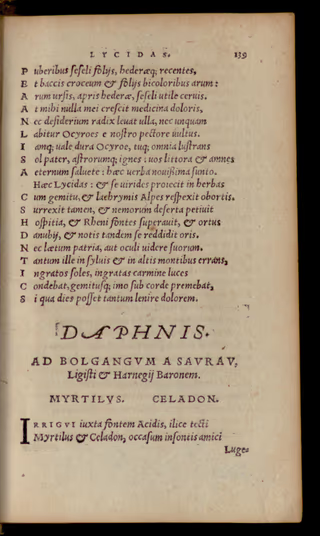
I RRIGVI iuxta fontem Acidis, ilice tecti
Myrtilus & Celadon, occaſum inſontis amici
Lugebant pariter, ueriſq; obſcura uicißim
Miſcebant: ætate pares, & uerſibus ambo
Inſignes, ambo uilloſæ pellibus urſæ
Induti: Celadon uenator, Myrtilus auceps.
Tum prior antiquos Celadon ſic orſus amores.
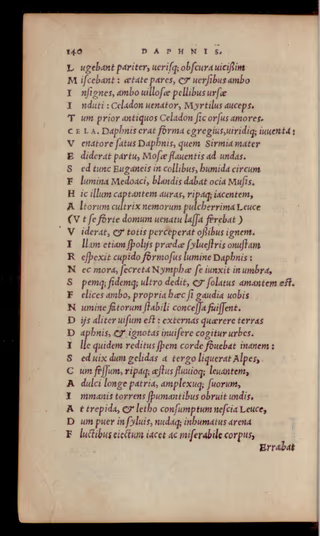
Daphnis erat forma egregius, uiridiq; iuuenta:
Venatore ſatus Daphnis, quem Sirmia mater
Ediderat partu, Moſæ flauentis ad undas.
Sed tunc Euganeis in collibus, humida circum
Flumina Medoaci, blandis dabat ocia Muſis.
Hic illum captantem auras, ripaq; iacentem,
Altorum cultrix nemorum pulcherrima Leuce
(Vt ſe forte domum uenatu laſſa ferebat)
Viderat, & totis perceperat oßibus ignem.
Illam etiam ſpolijs prædæ ſylueſtris onuſtam
Reſpexit cupido formoſus lumine Daphnis:
Nec mora, ſecreta Nymphæ ſe iunxit in umbra,
Spemq; fidemq; ultro dedit, & ſolatus amantem eſt.
Felices ambo, propria hæc ſi gaudia uobis
Numine fatorum ſtabili conceſſa fuiſſent.
Dijs aliter uiſum eſt: externas quærere terras
Daphnis, & ignotas inuiſere cogitur urbes.
Ille quidem reditus ſpem corde fouebat inanem:
Sed uix dum gelidas a tergo liquerat Alpes,
Cum feſſum, ripaq; æſtus fluuioq; leuantem,
A dulci longe patria, amplexuq; ſuorum,
Immanis torrens ſpumantibus obruit undis.
At trepida, & letho conſumptum neſcia Leuce,
Dum puer in ſyluis, nudaq; inhumatus arena
Fluctibus eiectum iacet ac miſerabile corpus,
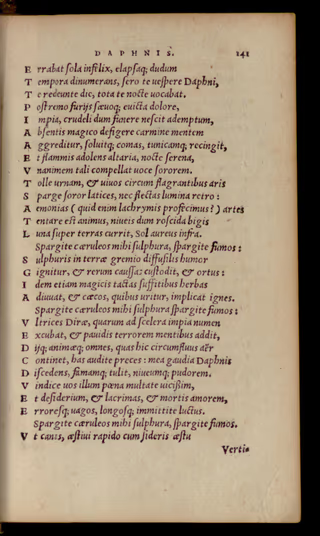
Errabat ſola infelix, elapſaq; dudum
Tempora dinumerans, ſero te ueſpere Daphni,
Te redeunte die, tota te nocte uocabat.
Poſtremo furijs ſæuoq; euicta dolore,
Impia, crudeli dum funere neſcit ademptum,
Abſentis magico defigere carmine mentem
Aggreditur, ſoluitq; comas, tunicamq; recingit,
Et flammis adolens altaria, nocte ſerena,
Vnanimem tali compellat uoce ſororem.
Tolle urnam, & uiuos circum flagrantibus aris
Sparge ſoror latices, nec flectas lumina retro:
Aemonias ( quid enim lachrymis profecimus? ) artes
Tentare eſt animus, niueis dum roſcida bigis
Luna ſuper terras currit, Sol aureus infra.
Spargite cæruleos mihi ſulphura, ſpargite fumos:
Sulphuris in terræ gremio diffuſilis humor
Gignitur, & rerum cauſſas cuſtodit, & ortus:
Idem etiam magicis tactas ſuffitibus herbas
Adiuuat, & cæcos, quibus uritur, implicat ignes.
Spargite cæruleos mihi ſulphura, ſpargite fumos:
Vltrices Diræ, quarum ad ſcelera impia numen
Excubat, & pauidis terrorem mentibus addit,
Dijq; animæq; omnes, quas hic circumfluus aër
Continet, has audite preces: mea gaudia Daphnis
Diſcedens, famamq; tulit, niueumq; pudorem.
Vindice uos illum pœna multate uiciſsim,
Et deſiderium, & lacrimas, & mortis amorem,
Erroreſq; uagos, longoſq; immittite luctus.
Spargite cæruleos mihi ſulphura, ſpargite fumos.
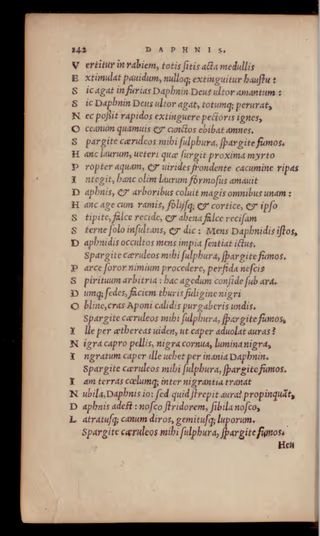
Vt canis, æſtiui rapido cum ſideris æſtu
Vertitur in rabiem, totis ſitis acta medullis
Extimulat pauidum, nulloq; extinguitur hauſtu:
Sic agat in furias Daphnin Deus ultor amantum:
Sic Daphnin Deus ultor agat, totumq; perurat,
Nec poßit rapidos extinguere pectoris ignes,
Oceanum quamuis & cunctos ebibat amnes.
Spargite cæruleos mihi ſulphura, ſpargite fumos.
Hanc laurum, ueteri quæ ſurgit proxima myrto
Propter aquam, & uirides frondente cacumine ripas
Integit, hanc olim laurum formoſus amauit
Daphnis, & arboribus coluit magis omnibus unam:
Hanc age cum ramis, folijſq; & cortice, & ipſo
Stipite, falce recide, & ahena falce reciſam
Sterne ſolo inſultans, & dic: Mens Daphnidis iſtos,
Daphnidis occultos mens impia ſentiat ictus.
Spargite cæruleos mihi ſulphura, ſpargite fumos.
Parce ſoror nimium procedere, perfida neſcis
Spirituum arbitria: hac agedum conſide ſub ara.
Dumq; ſedes, faciem thuris fuligine nigri
Obline, cras Aponi calidis purgaberis undis.
Spargite cæruleos mihi ſulphura, ſpargite fumos.
Ille per æthereas uiden, ut caper aduolat auras?
Nigra capro pellis, nigra cornua, lumina nigra,
Ingratum caper ille uehet per inania Daphnin.
Spargite cæruleos mihi ſulphura, ſpargite fumos.
Iam terras cœlumq; inter nigrantia tranat
Nubila, Daphnis io: ſed quid ſtrepit aura? propinquãt,
Daphnis adeſt: noſco ſtridorem, ſibila noſco,
Latratuſq; canum diros, gemituſq; luporum.
Spargite cæruleos mihi ſulphura, ſpargite fumos.
H eu quid agam? en fœdatam ulua ſine ueſtibus umbrã,
D aphnis extincti ſimulacrum flebile cerno.
I am iam Daphni dolet : iam tota mente, quod egi
P œnitet : Elyſium teſtor, ſedeſq; beatas,
Q uas habitas : linquam terras, maneſq; ſub imos
T e ſequar : i felix, cineriq; hæc perfer imago.
Parcite cæruleis iam ſulphura, parcite fumis.
F inierat Celadon, lachrymis tum mœſtus obortis
M yrtilus hæc contra facundo reddidit ore :
Nos quoq; Daphni tuos obitus, tua triſtia fata
D eflemus, tumulumq; tibi ſacramus inanem
M ontibus in patrijs, mecum tua funera lugent
N aiades, & mœrens turbatis Cynthius undis,
N otus & aucupibus, notus uenantibus Acis,
E t matutinæ referunt lamenta uolucres.
Occule luciferos Sol nubibus, occule uultus,
D icebam, fuge Daphni amnes, uaga flumina uita :
S æpe rates fractas undis, & mortua uidi
C orpora cum tabulis, flenteſq; in littore nautas.
Occule luciferos Sol nubibus, occule uultus.
H as ſyluas Daphni, hos fontes, hæc rura colebas
N obiſcum, teneri dum flos adoleſceret æui :
S ic laqueis uolucres mecum, fictiſq; ſolebas
F allere carminibus : felix, ſi celſa potentum
A tria ſpreuiſſes. ſed non amor omnibus idem.
Occule luciferos Sol nubibus, occule uultus.
A erumnas etiam multas, rerumq; procellas,
E t uarias hominum fraudes, & frigora & æſtus
P ertulimus : teſtis pater Appenninus, & ingens
L arius, & Zephyros mare ꝙ proſpectat & Auſtros,
Culminaq; haud unquam niuibus uiduata ſub ipſum
Solſtitium: extremo nunc me ſub fine laborum
Deſeris, & mecum ueteres, tua cura, ſodales
Amiſſo uitam ſocio experiuntur amaram.
Occule luciferos Sol nubibus, occule uultus.
O utinam fieri mutato corpore poſſem
Flos Hyacinthe tuus, ſolitaſq; referre querelas
Pallentes inter uiolas, & molle liguſtrum :
Sic roſei ueris prænuncius, orta quotannis
Sidera ſub Tauri, Maiæq; Atlantidos aſtrum
Daphnidis in uiridi lugerem ceſpite mortem.
Occule luciferos Sol nubibus, occule uultus. (cum
Quod poſſum, gemitu et lachrymis nemora omnia cir-
Impleo care puer, ſeu fuſcas Heſperus umbras
Inducit terris, cœlo ſeu præuius alto
Lucifer Auroram natalibus euocat undis.
Occule luciferos Sol nubibus, occule uultus.
Daphni tuæ ſemper laudes, doctiq; manebunt
Ingenij monumenta, nec ulla redarguet ætas.
Sis memor o, cœliq; aliqua de parte ſereni
Aſpice nos, olim tecum tot caſibus actos.
Iam tibi parta quies, ſuperumq; beata frequentas
Concilia, & dulci permulces ſidera cantu.
Illic excipies uenientem lætus amicum,
Corporis exutum uinclis, & carcere cæco:
Aſtrorumq; ſimul uaſtos mirabitur orbes.
O qui complexus, o quæ tum gaudia mentis,
Gaudia perpetuis indeficientia ſeclis.
Exere luciferos Sol nubibus, exere uultus.
Hæc illi uacua nuper Bolgange ſub umbra
C antabant, largoq; oculos humore rigabant,
D ulcis amicitiæ memores, ueterumq; laborum.
T u uero Heroum ſoboles, cui ſanguine Daphnis
I unctus erat, ſortemq; ultro comes ibat in omnem,
D aphnis in aduerſis idem rebuſq; ſecundis:
E xtincti uiuam candenti e marmore duces
E ffigiem, & templi ſacrata ſede locabis
S pectandam, ut celebri prætexat honore ſepulchrum,
A eternum ueſtri monumentum & pignus amoris.