Hover or tap a word to see its match.
By chance, Viburnus the hunter was resting in the cool shade,
Where the Varus leads its clear waters with slow bends
Into the sea through the dark silence.
There, in the early morning, among the pleasant grove of willows,
Ah, far from his sweet fatherland, he was filling the nearby
Mountains of the Ligurians with his shouting, and weeping he
Stretched his arms to the sky, and thus wept to the deaf breezes.
"O Sun, who raise your light-bringing face from the deep,
And flood the vast world with purple light,
Hide your head, great Sun, let everything around grow black,
While I lament the unspeakable misfortunes and the bitter
Exiles of my people, and pray to the Gods in this final hour.
"O fatherland, O mother of Kings, most famous in war,
Full of courage, happy in your peoples and your offspring of men,
While fortune lasted; now for a long time the will of the gods
Has been turned away: therefore has true rumor brought your sufferings
To me at the shore of the Hesperian sea, and the setting Sun.
Whence this madness? What is this great insanity of the sword?
"Tell, you rivers gliding down from the high mountains,
Father Rhine, and you, Elbe, rich in standing waters,
(For you know, and mindful you will recall it for a long age)
How many sons of Dukes have fallen? Into what open sea
Have you rolled horses, and men, and brave arms?
"You also the spoils carried away by foreign soldiery
And you have seen towns, and overthrown cities, and citadels
placed upon hills, which the impious enemy destroyed with the sword,
or which fire, more cruel than the sword, consumed.
Halt your flowing, wandering rivers, halt your waters.
The impious enemy has left us these monuments:
fields smoking with blood, and desolate lands;
but pour out your waves over the opposing banks,
and wash away the ignominies of such great evils.
Unhappy fatherland, behold what rewards of a long war,
what ample spoils do you bring back? The barbarian aspires to our honors,
and, reigning, spends his leisure in our woods.
We, driven far away, wander through places scorched by fierce heat,
and shores burnt by thirst, and empty sands.
And we who once in the silent retreats of the groves, spent all
the flower of our age, and our first years in hunting,
(alas, pitiable fate!) now we learn to pluck oysters from these rocks,
oysters, and shells clinging to the crags,
and we console our hunger with sea urchins.
And often, exhausted, we lay ourselves down on the bare seaweed.
Scarcely does the Varus supply humble willows, and green alders,
and sweet waters to thirsty sailors.
O where Cynthius, cutting through cultivated fields with liquid foot,
glides through green woodlands, and pathless haunts of wild beasts,
and hears the secret loves of the Dryads:
While the boy Acis, sitting in his accustomed cave, sings:
"Come hither, O Telethusa, come hither, O my sweet Oread."
He sings, the valleys repeat, and the hills resound.
But now nothing beautiful remains, nor anything lovable,
nor does that former pleasure inhabit the woods and the countryside:
Discord herself drives the fearful Nymphs far away
Savage, while she flies around the mountains on black wings.
And drags the kindred Fauns into fierce battles.
But you, if you are swayed by any prayers, by any tears,
Almighty father, take pity, take pity on labors
So great, we have exhausted enough your avenging wrath.
If however it is firmly fixed that we must atone for
Our offenses, it is right to pay the deserved penalties for crimes,
So that our descendants may at least grow up in calm peace:
If any day might repair the ruins of the nation.
This I pray: let me carry this hope down to the deepest shades.
Thrust forth your light-bearing face from the clouds, O Sun, thrust it forth.
Thus far Viburnus: him they heard groaning,
Lycidas, who by chance was sitting in a nearby cave,
And Acron, coming down from the lofty mountains of the Ligurians.
Companions in exile, both in the bloom of their years,
Both distinguished with the reed-pipe, both in the hunt.
They, to soothe their mounting cares with song
And console the sorrows of their old friend,
Began to sing alternate songs between themselves.
Then Lycidas first sang these things, Acron next in turn.
Nymphs, whom the Varus nourishes in its azure stream,
Let it be right for me, Nymphs, to weave a crown from the leaves
Of willows, now for the first time we come of age in our green youth,
Soon you will grant myrtles born by these very rivers.
Breezes, who inhabit the cool groves in remote places,
While I sit and sing, covered by the river shades,
Soothe the heat, and the rhythms and words of the singer
Carry to the ears of Nisa, wherever she lies weary.
Well-watered valleys in the rivers, wandering rivers in the
Banks, the banks in trees; we lovers rejoice in weeping:
We wept, and poured out full rivers of tears,
And yet (alas) with what great flames are our breasts scorched?
Under Arcturus the stags, under the star of the Dolphin the bulls,
In early spring fiery Venus rouses the stiff bears,
But that madness does not fail me through the whole year,
Nor is it permitted for me to end such great sorrows by death.
That Boar (ah) which lays waste to the fields for the wretched farmers,
If that fierce Boar pays the penalty to me with its blood,
Here I will offer its bristly head on Trivia's lofty pine.
Be gently present, guardian of the groves, Latonian virgin.
Behold four hunting spears from the branching ash,
Look, two for you, Nisa, and two shafts for the Nymphs,
With these you will strike the timid stags among the leafy groves,
Stags, and roe-deer, and fallow deer with tawny back.
Lead the dogs to the river, Daphnis (the heat calls
into the shade)
And do not let the pups frisk through the green grass:
Come now, rest, Lacon, rest, Lycarbas,
While the burning sun sinks into the Hesperian waves.
Come to the willows, my Nisa, while I stretch the nets,
Here is a grove, here are gentle breezes with cool breaths:
Come here, O my Nisa, I am keeping fresh honors of the countryside for you,
Purple grapes, and hoary quinces.
Evening is here, boys. Unfasten the knotted nets
And hang them damp to the North Wind, it is not well trusted
To the moon, this first of all: but when the harbinger of light,
Rising Aurora, has shone forth, revisit the woods.
But for me it is more pleasing to besiege the broad plains at night,
And to close off the bushy valleys with ambushes,
When both lands and sea are silent, and twinkles the Arcadian Bear's
Star, and the aether trembles all around with clear fires.
I live as an exile, and I ponder (who would believe it?) tender loves,
And it pleases me to soothe the fierce heat by which we burn.
By your river, Varus, what then, if the fates shall deny
Return to my homeland? The earth is a common tomb.
I greet you, beloved ashes, and the bones of my parents,
And the groves, and my sweet household gods.
Farewell, Cynthius: what then, if no hope of seeing my homeland
Survives? We will all lie under one sun.
These things they [said], but Varus raised his head from the midst of the waves,
And marking verses on the rough bark of a Beech tree,
He said, "You shall sing the rest by the river Eridanus."
He spoke, and hid his head again in his slanting channel.
Forte quieſcebat gelida Viburnus in umbra
Venator, liquidas ubi tardis flexibus undas
In mare deducit per opaca ſilentia Varus.
Illic, mane nouo, ſalicum nemus inter amœnum
Ah procul a dulci patria, clamore propinquos
Implebat Ligurum montes, & brachia cœlo
Tendebat lachrymans, ſurdaſqꝫ ita flebat ad auras.
Sol qui luciferos tollis de gurgite uultus,
Purpureoqꝫ rigas diffuſum lumine mundum,
Abde caput Sol magne, nigreſcant omnia circum,
Dum queror infandos caſus, & acerba meorum
Exilia, & Diuos ſuprema comprecor hora.
O patria, o Regum genitrix, clarißima bello
Plena animis, fœlix populis, & prole uirorum
Dum fortuna fuit, nunc dijs auerſa uoluntas
Iamdudum: uera ergo tuos mihi fama labores
Ad maris Heſperij littus, Solemqꝫ cadentem
Detulit, unde furor? quæ tanta inſania ferri?
Dicite uos altis lapſi de montibus amnes
Rhene pater, tuqꝫ uber aquis ſtagnantibus Albi,
(Scitis enim, & longo memores repetetis in æuo )
Quot nati cecidere Ducum? quod in æquor apertum
Quadrupedeſqꝫ, uiroſqꝫ, & fortia uoluitis arma?
Vos etiam auectas externo milite prædas
Oppidaq;, euerſaſq; urbes uidiſtis, & arces
Collibus impoſitas, ferro quas impius hoſtis
Eruit, aut hauſit ferro crudelior ignis.
Siſtite currentes uaga flumina, ſiſtite lymphas.
Impius hæc nobis hoſtis monumenta reliquit
Sanguine fumantes campos, ſqualentiaq; arua,
At uos aduerſis undas diffundite ripis
Tantorumq; ignominias abolete malorum.
Infelix patria, en longi quæ præmia belli
Quam ſpolia ampla refers? noſtros affectat honores
Barbarus, in noſtris regnans agit otia ſyluis.
Nos procul expulſi, rapido loca torrida ab æſtu
Littoraq; uſta ſiti, & uacuas luſtramus arenas.
Quiq; olim in tacitis nemorum ſeceßibus, omnem
Florem æui, & primos uenatibus egimus annos,
(Heu fortem miſerandam ) iſtis nunc Oſtrea ſaxis,
Oſtrea, & hærentes ſcopulis auellere conchas
Diſcimus, æquoreiſq; famam ſolamur Echinis.
Et ſæpe in nuda defeßi ſternimur Alga.
Vix humiles Varus ſalices, Alnoſq; uirentes
Sufficit, & dulces nautis ſitientibus undas.
O ubi culta ſecans liquido pede Cynthius arua
Per uirides ſaltus, perq; auia luſtra ferarum
Labitur, & Dryadum ſecretos audit amores :
Dum puer aſſueto reſidens canit Acis in antro
Huc ades o Telethuſa, ades o mihi dulcis Oreas.
Ille canit, ualles iterant, colleſq; reſultant.
Sed neq; iam pulchrũ ſupereſt, nec amabile quicquam
Nec prior illa colit ſyluas & rura uoluptas :
Ipſa fugat longe pauidas Diſcordia Nymphas
E ffera, dum montes nigris circumuolat alis.
E t conſanguineos trahit in fera prælia Faunos.
At tu ſi precibus, lachrymis ſi flecteris ullis,
O mnipotens miſerere pater, miſerere laborum
T antorum, ſatis ultrices exhauſimus iras.
S i tamen id fixum ſedet, ut commiſſa luamus
N oſtra, iuuat ſcelerum meritas exoluere pœnas,
V t placida ſaltem creſcant in pace nepotes :
S iqua dies poſsit gentis ſarcire ruinas.
H oc precor, hanc manes liceat ſpem ferre ſub imos.
Exere Luciferos Sol nubibus, exere uultus.
H actenus hæc Viburnus : eum audiuere gementem
V icino Lycidas qui forte ſedebat in antro
E t celſis Ligurum deſcendens montibus Acron.
E xilij comites, ambo florentibus annis
I nſignes ambo calamis, uenatibus ambo.
I lli, ut creſcentes mulcerent carmine curas
E t ueteris luctus conſolarentur amici,
I nter ſe, alternos cœperunt ædere cantus.
T um prior hæc Lycidas, hæc ordine proximus Acron.
Nymphæ, cæruleo quas nutrit Varus in amne,
S it mihi fas Nymphæ ſalicum de fronde coronam
T exere, iam primum uiridi pubeſcimus æuo,
M ox dabitis natas hæc ipſa ad flumina Myrtos.
Auræ quæ gelidos colitis per deuia lucos
D um ſedeo, & tectus canto fluuialibus umbris,
V os lenite æſtus, numeroſq; & uerba canentis
S icubi feſſa iacet, Niſæ referatis ad aures.
Fluminibus ualles riguæ, uaga flumina ri-
A rboribus ripæ, fletu gaudemus amantes : (pis,
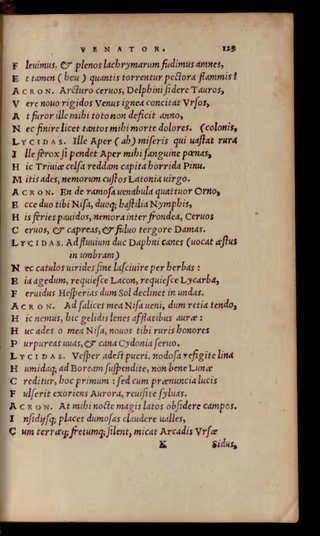
Fleuimus, & plenos lachrymarum fudimus amnes,
Et tamen ( heu ) quantis torrentur pectora flammis?
Arcturo ceruos, Delphini ſidere Tauros,
Vere nouo rigidos Venus ignea concitat Vrſos,
At furor ille mihi toto non deficit anno,
Nec finire licet tantos mihi morte dolores. (colonis,
Ille Aper ( ah ) miſeris qui uaſtat rura
Ille ferox ſi pendet Aper mihi ſanguine pœnas,
Hic Triuiæ celſa reddam capita horrida Pinu.
Mitis ades, nemorum cuſtos Latonia uirgo.
En de ramoſa uenabula quattuor Orno,
Ecce duo tibi Niſa, duoq; haſtilia Nymphis,
His feries pauidos, nemora inter frondea, Ceruos
Ceruos, & capreas, & fuluo tergore Damas.
Ad fluuium duc Daphni canes (uocat æſtus
in umbram)
Nec catulos uirides ſine laſciuire per herbas:
Eia agedum, requieſce Lacon, requieſce Lycarba,
Feruidus Heſperias dum Sol declinet in undas.
Ad ſalices mea Niſa ueni, dum retia tendo,
Hic nemus, hic gelidis lenes afflatibus auræ:
Huc ades o mea Niſa, nouos tibi ruris honores
Purpureas uuas, & cana Cydonia ſeruo.
Veſper adeſt pueri. nodoſa refigite lina
Humidaq; ad Boream ſuſpendite, non bene Lunæ
Creditur, hoc primum: ſed cum prænuncia lucis
Fulſerit exoriens Aurora, reuiſite ſyluas.
At mihi nocte magis latos obſidere campos.
Inſidijſq; placet dumoſas claudere ualles,
Cum terræq; fretumq; ſilent, micat Arcadis Vrſæ
Sidus, & argutis circumtremit ignibus æther.
Exul ago, & teneres meditor (quis
credat?) amores,
Solariq; iuuat rapidos, quibus urimur, æſtus.
Flumine Vare tuo, quid tum, ſi fata negabunt
In patriam reditus? Tellus commune ſepulchrum eſt.
Vos ego dilectos cineres, atq; oſſa parentũ,
Et nemora, & dulces iubeo ſaluere penates.
Cynthi uale : quid tum, patriæ ſi nulla uidendæ
Spes ſupereſt? Vno ſub ſole iacebimus omnes.
Hæc illi, at medijs Varus caput extulit undis,
Rugoſoq; notans in Fagi cortice uerſus
Cætera ad Eridani, dixit, cantabitis amnem.
Dixit, & obliquo rurſus caput abdidit alueo.