Hover or tap a word to see its match.
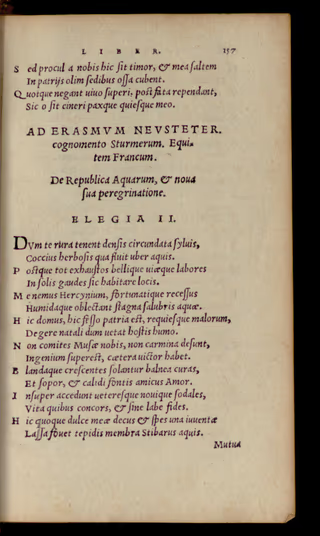
While the countryside surrounded by thick woods holds you,
where the abundant Kocher flows with its grassy waters.
And after so many exhausting labors of both war and travel
you rejoice thus to dwell in solitary places.
The Hercynian forest delights me, and its fortunate retreats,
and the damp pools of healing water.
Here is my home, here is a fatherland for a weary man, and a rest from misfortunes,
while the enemy forbids me to live on my native soil.
The Muses are not lacking to us as companions, nor are songs,
talent survives, the victor has the rest.
And the pleasant baths soothe my growing cares,
and sleep, and Love, the friend of the warm spring.
Moreover, both old and new companions join me,
whose lives are harmonious, and whose loyalty is without flaw.
Here also the sweet glory and sole hope of my youth,
Stibarus, soothes his weary limbs in the warm waters.
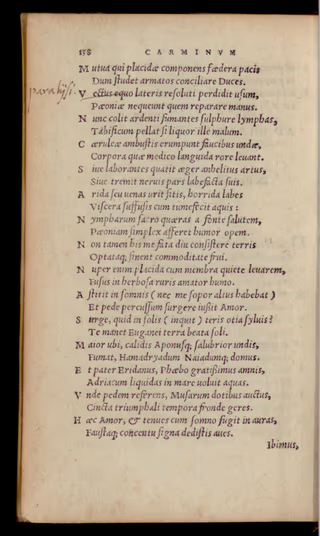
Who, arranging mutual treaties of gentle peace
While he strives to reconcile armed Dukes,
Riding on a horse, lost the use of his paralyzed side,
Which Paeonian hands cannot restore.
Now he frequents the waters smoking with burning sulfur,
If that liquid might drive out the wasting disease.
Dark blue waves burst forth from scorched jaws,
Which relieve languid bodies with their healing dew.
Whether sick panting shakes the laboring limbs,
Or a weakened part trembles in its sinews.
Or whether dry thirst burns the veins, when a dreadful affliction
Has swollen the vitals with suffused waters:
You should seek health from the sacred spring of the Nymphs,
The simple fluid will bring Paeonian aid.
However, the Fates will not allow me to stay long in these lands
And to enjoy the desired benefit.
For recently, when I was resting my limbs in peaceful quiet,
Stretched out on the grassy soil, a lover of the countryside,
Love stood by me in my sleep (nor did deep slumber hold me)
And, striking me with his foot, ordered me to rise.
"Rise, why," he said, "do you waste your leisure in lonely woods?
The blessed land of the Euganean soil awaits you.
Where Aponus, greater and more healthful with its warm waters,
Smokes, the home of the Hamadryads and Naiads.
And father Eridanus, the river most pleasing to Phoebus,
Rolls his clear waters into the Adriatic sea.
Returning from there, enriched by the gifts of the Muses,
You will wear your temples bound with a triumphal wreath."
Love spoke these words, and fled with sleep into the thin air,
And you, O birds, gave favorable signs with your song.
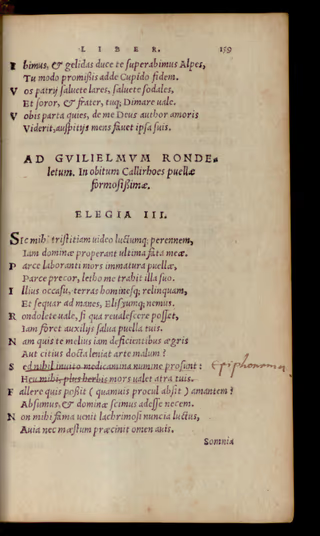
We shall go, and with you as our guide, cross the freezing Alps,
only you, Cupid, add faith to your promises.
Farewell, ancestral household gods; farewell, companions,
and sister, and brother, and you, Dimarus, farewell.
For you rest is secured; concerning me, let the God, author of love,
see to it; my mind itself favors its own auspices.
DVm te rura tenent denſis circundata ſyluis,
Coccius herboſis qua fluit uber aquis.
Poſtque tot exhauſtos bellique uiæque labores
In ſolis gaudes ſic habitare locis.
Me nemus Hercynium, fortunatique receſſus
Humidaque oblectant ſtagna ſalubris aquæ.
Hic domus, hic feſſo patria eſt, requieſque malorum,
Degere natali dum uetat hoſtis humo.
Non comites Muſæ nobis, non carmina deſunt,
Ingenium ſupereſt, cætera uictor habet.
Blandaque creſcentes ſolantur balnea curas,
Et ſopor, & calidi fontis amicus Amor.
Inſuper accedunt uetereſque nouique ſodales,
Vita quibus concors, & ſine labe fides.
Hic quoque dulce meæ decus & ſpes una iuuentæ
Laſſa fouet tepidis membra Stibarus aquis.
M utua qui placidæ componens fœdera pacis
Dum ſtudet armatos conciliare Duces.
V ectus equo lateris reſoluti perdidit uſum,
Pœoniæ nequeunt quem reparare manus.
N unc colit ardenti fumantes ſulphure lymphas,
Tabificum pellat ſi liquor ille malum.
C æruleæ ambuſtis erumpunt faucibus undæ,
Corpora quæ medico languida rore leuant.
S iue laborantes quatit æger anhelitus artus,
Siue tremit neruis pars labefacta ſuis.
A rida ſeu uenas urit ſitis, horrida labes
Viſcera ſuffuſis cum tumefecit aquis :
N ympharum ſacro quæras a fonte ſalutem,
Pœoniam ſimplex afferet humor opem.
N on tamen his me fata diu conſiſtere terris
Optataq; ſinent commoditate frui.
N uper enim placida cum membra quiete leuarem,
Fuſus in herboſa ruris amator humo.
A ſtitit in ſomnis ( nec me ſopor altus habebat )
Et pede percuſſum ſurgere iuſsit Amor.
S urge, quid in ſolis ( inquit ) teris otia ſyluis?
Te manet Euganei terra beata ſoli.
M aior ubi, calidis Aponuſq; ſalubrior undis,
Fumat, Hamadryadum Naiadumq; domus.
E t pater Eridanus, Phœbo gratiſsimus amnis,
Adriacum liquidas in mare uoluit aquas.
V nde pedem referens, Muſarum dotibus auctus,
Cincta triumphali tempora fronde geres.
H æc Amor, & tenues cum ſomno fugit in auras,
Fauſtaq; concentu ſigna dediſtis aues.
Ibimus, & gelidas duce te ſuperabimus Alpes,
Tu modo promiſsis adde Cupido fidem.
Vos patrij ſaluete lares, ſaluete ſodales,
Et ſoror, & frater, tuq; Dimare uale.
Vobis parta quies, de me Deus author amoris
Viderit, auſpicijs mens fauet ipſa ſuis.