Hover or tap a word to see its match.
Best Lucanus and you, my Georgius,
Who sing more charming verses
In the meter of the Greek and Latin tongue.
Those noises, if it pleases, of the restless city
Let us leave behind, and as we are accustomed,
Let us stroll in the pleasant green spaces
By the stream of the overflowing Elbe.
For now our weary limbs are refreshed
By the more serene temper of the sky,
And at the same time by a gentle walk.
Now charming birds beneath the woodland shades
Soothe the air with their songs,
And the earth, watered by pleasing streams, brings forth
Flowers in the multi-colored grass,
Which the mild breeze cherishes, while Favonius
Breathes gently on serene days.
O most pleasing solitude of the country,
O green woods, hail nymphs
And springs and fertile little fields.
After fickle Claudia left me,
Breaking the loins now of three hundred at once,
You are the pleasure of my humble leisure,
And the rest from my labor.
Here envy is not present, nor evil cares
Or mad love and the thirst for possessing,
Nor the varying chances of business affairs.
The day passes securely, and deep sleep
Bedews my soft rest through whole nights.
O truly born under a star three times and more
Benign, he who, known to himself,
As a companion to the choirs of the goddess nymphs,
Passes his time so peacefully, and sees the smoke
While it leaps black from his ancestral roof.
This is the kind of more blessed life,
Excellent Lucanus, and you, my Georgius.
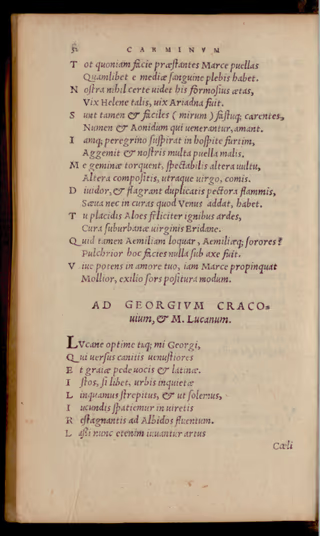
LVcane optime tuq; mi Georgi,
Qui uerſus canitis uenuſtiores
Et graiæ pede uocis & latinæ.
Iſtos, ſi libet, urbis inquietæ
Linquamus ſtrepitus, & ut ſolemus,
Iucundis ſpatiemur in uiretis
Reſtagnantis ad Albidos fluentum.
Laſsi nunc etenim iuuantur artus
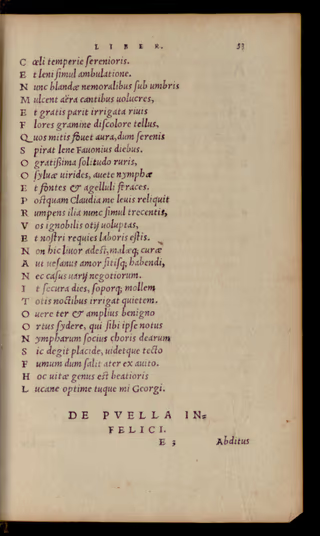
C æli temperie ſerenioris.
E t leni ſimul ambulatione.
N unc blandæ nemoralibus ſub umbris
M ulcent aëra cantibus uolucres,
E t gratis parit irrigata riuis
F lores gramine diſcolore tellus,
Q uos mitis fouet aura, dum ſerenis
S pirat lene Fauonius diebus.
O gratißima ſolitudo ruris,
O ſyluæ uirides, auete nymphæ
E t fontes & agelluli feraces.
P oſtquam Claudia me leuis reliquit
R umpens ilia nunc ſimul trecentis,
V os ignobilis otij uoluptas,
E t noſtri requies laboris eſtis.
N on hic liuor adeſt, malæq; curæ
A ut ueſanus amor ſitiſq; habendi,
N ec caſus uarij negotiorum.
I t ſecura dies, ſoporq; mollem
T otis noctibus irrigat quietem.
O uere ter & amplius benigno
O rtus ſydere, qui ſibi ipſe notus
N ympharum ſocius choris dearum
S ic degit placide, uidetque tecto
F umum dum ſalit ater ex auito.
H oc uitæ genus eſt beatioris
L ucane optime tuque mi Georgi.