Hover or tap a word to see its match.
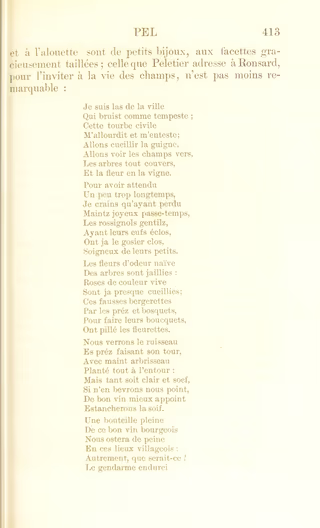
I am weary of the city
Which roars like a tempest;
This civic rabble
Weighs me down and clouds my head;
Let us go gather the wild cherry,
Let us go see the green fields,
The trees all covered,
And the blossom on the vine.
For having waited
A little too long,
I fear that having lost
Many a joyous pastime,
The gentle nightingales,
Having hatched their eggs,
Already have their throats closed,
Caring for their young.
The flowers of natural scent
Have sprung from the trees:
Roses of vivid color
Are already almost gathered;
These false shepherdesses
Through the meadows and groves,
To make their bouquets,
Have plundered the little flowers.
We shall see the brook
Winding through the meadows,
With many a shrub
Planted all around:
But however clear and sweet it may be,
We shall drink none of it,
With good wine better suited
We shall quench our thirst.
A full bottle
Of this good bourgeois wine
Will take away our sorrows
In these rustic parts:
Otherwise, what would it be?
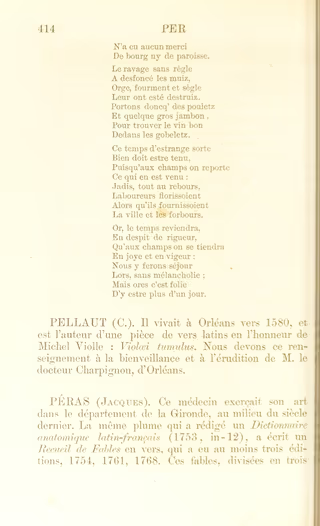
The hardened man-at-arms
Has had no mercy
On borough or on parish.
The unruly ravaging
Has staved in the casks,
Barley, wheat, and rye
Have been destroyed for them.
Let us therefore bring chickens
And some thick ham,
To find the wine good
Within the goblets.
This time of a strange sort
Must indeed be noted,
Since to the fields we carry back
What has come from them:
Formerly, quite the reverse,
Plowmen flourished
When they supplied
The city and the suburbs.
Now, the time will return,
Despite the hardship,
When in the fields we will stay
In joy and in vigor:
We will sojourn there
Then, without melancholy;
But now it is madness
To be there more than a day.
Je suis las de la ville
Qui bruist comme tempeste ;
Cette tourbe civile
M'allourdit et m'enteste;
Allons cueillir la guigne,
Allons voir les champs vers,
Les arbres tout couvers,
Et la fleur en la vigne.
Pour avoir attendu
Un peu trop longtemps,
Je crains qu'ayant perdu
Maintz joyeux passe-temps,
Les rossignols gentilz,
Ayant leurs eufs éclos,
Ont ja le gosier clos,
Soigneux de leurs petits.
Les fleurs d'odeur naïve
Des arbres sont jaillies :
Roses de couleur vive
Sont ja presque cueillies;
Ces fausses bergerettes
Par les préz et bosquets,
Pour faire leurs boucquets,
Ont pillé les fleurettes.
Nous verrons le ruisseau
Es préz faisant son tour,
Avec maint arbrisseau
Planté tout à l'entour :
Mais tant soit clair et soef,
Si n'en bevrons nous point,
De bon vin mieux appoint
Estancherons la soif.
Une bouteille pleine
De ce bon vin bourgeois
Nous ostera de peine
En ces lieux villageois :
Autrement, que serait-ce ?
Le gendarme endurci
N'a eu aucun merci
De bourg ny de paroisse.
Le ravage sans règle
A desfoncé les muiz,
Orge, fourment et sègle
Leur ont esté destruiz.
Portons doncq' des pouletz
Et quelque gros jambon,
Pour trouver le vin bon
Dedans les gobeletz.
Ce temps d'estrange sorte
Bien doit estre tenu,
Puisqu'aux champs on reporte
Ce qui en est venu :
Jadis, tout au rebours,
Laboureurs florissoient
Alors qu'ils fournissoient
La ville et les forbours.
Or, le temps reviendra,
En despit de rigueur,
Qu'aux champs on se tiendra
En joye et en vigeur :
Nous y ferons séjour
Lors, sans mélancholie ;
Mais ores c'est folie
D'y estre plus d'un jour.