Hover or tap a word to see its match.
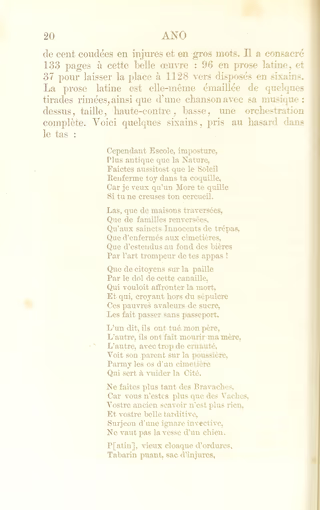
Meanwhile School, imposture,
More ancient than Nature,
Created as soon as the Sun
Shut yourself in your shell,
For I want a Moor to strike you down
If you do not dig your coffin.
Alas, how many houses afflicted,
How many families overturned,
How many deaths at the Holy Innocents,
How many locked in the cemeteries,
How many stretched out at the bottom of coffins
By the deceitful art of your charms!
How many citizens on the straw
Through the fraud of this scoundrel,
Who wanted to confront death,
And who, believing out of the sepulcher
These poor sugar-swallowers,
Makes them pass on without a passport.
One says, they have killed my father,
Another, they have caused the death of my mother,
Another, with too much cruelty,
Sees his relative in the dust,
Among the bones of a cemetery
That serves to empty the City.
Do not play the braggarts so much anymore,
For you are now nothing but Cows,
Your ancient knowledge is no longer anything,
And your fine latecomer,
Offshoot of an ignorant invective,
Is not worth a dog's fart.
P[atin], old cloaca of filth,
Stinking Tabarin, sack of insults,
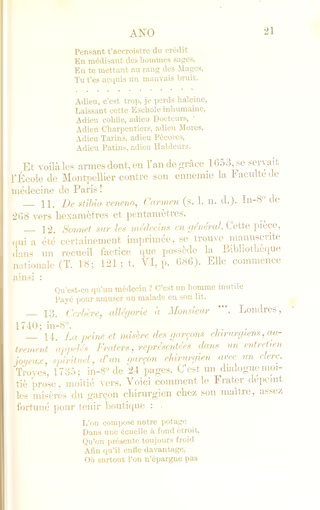
Thinking to increase your credit
By slandering wise men,
By placing yourself in the ranks of the Magi,
You have acquired a bad reputation.
Farewell, it is too much, I lose my breath,
Leaving this inhuman School,
Farewell rabble, farewell Doctors,
Farewell Charpentiers, farewell Mores,
Farewell Tarins, farewell Pécores,
Farewell Patins, farewell Braggarts.
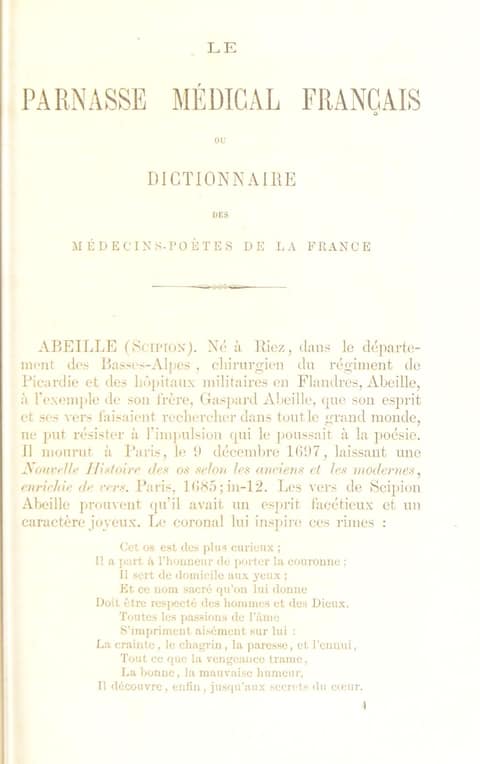
Cependant Escole, imposture,
Plus antique que la Nature,
Faictes aussitost que le Soleil
Renferme toy dans ta coquille,
Car je veux qu'un More te quille
Si tu ne creuses ton cercueil.
Las, que de maisons traversées,
Que de familles renversées,
Qu'aux saincts Innocents de trépas,
Que d'enfermés aux cimetières,
Que d'estendus au fond des bières
Par l'art trompeur de tes appas !
Que de citoyens sur la paille
Par le dol de cette canaille,
Qui vouloit affronter la mort,
Et qui, croyant hors du sépulcre
Ces pauvres avaleurs de sucre,
Les fait passer sans passeport.
L'un dit, ils ont tué mon père,
L'autre, ils ont fait mourir ma mère,
L'autre, avec trop de cruauté,
Voit son parent sur la poussière,
Parmy les os d'un cimetière
Qui sert à vuider la Cité.
Ne faites plus tant des Bravaches,
Car vous n'estes plus que des Vaches,
Vostre ancien scavoir n'est plus rien,
Et vostre belle tarditive,
Surjeon d'une ignare invective,
Ne vaut pas la vesse d'un chien.
P[atin], vieux cloaque d'ordures,
Tabarin puant, sac d'injures,
Pensant t'accroistre du crédit
En médisant des hommes sages,
En te mettant au rang des Mages,
Tu t'es acquis un mauvais bruit.
Adieu, c'est trop, je perds haleine,
Laissant cette Eschole inhumaine,
Adieu cohüe, adieu Docteurs,
Adieu Charpentiers, adieu Mores,
Adieu Tarins, adieu Pécores,
Adieu Patins, adieu Hableurs.