Hover or tap a word to see its match.
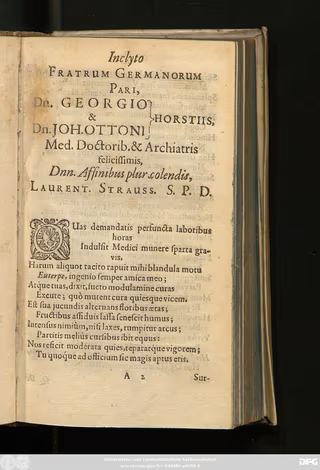
Those hours which, after I had discharged the tasks assigned to me,
the serious burden of a physician's office allowed,
A few of these gentle Euterpe, moving silently,
snatched from me, always a friend to my talent;
And she said: Shake off your cares with your accustomed
melody, so that care and rest may exchange their turn.
Pleasant flowers have their season by alternation;
the weary earth grows old from unbroken crops;
A bow drawn too tightly, unless you slacken it, breaks;
a horse will travel better by divided courses.
Moderate rest refreshes us and restores our vigor;
you too will thus be better fitted for your duty.
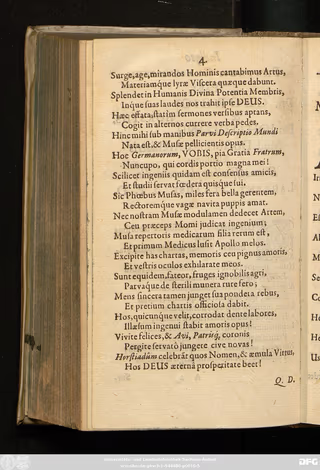
Rise, come, we shall sing of the wondrous Limbs of Man,
And each of the Viscera will provide material for the lyre.
Divine Power shines in Human Limbs,
And GOD himself draws us into his own praises.
Having spoken these words, immediately adapting discourses to verses,
She compels the words to run into alternating feet.
Hence beneath my hands the Description of the Little World
Was born, and the work of the alluring Muse.
This I dedicate TO YOU, O pious Grace of German Brothers,
Who are a great part of my heart!
Evidently there is a certain harmony among friendly minds,
And each preserves the pacts of his own study.
Thus Phoebus loves the Muses, the soldier loves the one waging fierce wars,
And the sailor loves the helmsman of the wandering ship.
Nor does the melody of the Muse disgrace our Art,
As the rash mind of Momus judges;
The Muse is the daughter of the discoverer of medical matters,
And Apollo the Physician played the first melody.
Receive these papers, as a pledge of mindful love,
And gladden my eyes with yours.
They are indeed, I confess, the fruits of an ignoble field,
And I bring small gifts from a barren countryside;
A sincere mind, however, will add its own weight to things,
And, dutiful, will give value to the papers.
Whoever wishes, let him gnaw at these labors with his tooth,
The work of genuine love will stand unharmed!
Live happily, and to the crowns of your Grandfather and Father
Proceed to join new ones by saving a citizen!
You whom the Name of the Horstiads, and emulous Virtue, celebrates,
May GOD bless you with eternal prosperity!
QUas demandatis perfuncta laboribus
horas
Indulſit Medici munere ſparta gra-
vis,
Harum aliquot tacito rapuit mihi blandula motu
Euterpe, ingenio ſemper amica meo;
Atq́ue tuas, dixit, ſueto modulamine curas
Excute; quò mutent cura quiesque vicem.
Eſt ſua jucundis alternans floribus ætas;
Fructibus aſſiduis laſſa ſeneſcit humus;
Intenſus nimiùm, niſi laxes, rumpitur arcus;
Partitis meliùs curſibus ibit equus:
Nos reficit moderata quies, reparatq́ue vigorem;
Tu quoq́ue ad officium ſic magis aptus eris.
Surge, age, mirandos Hominis cantabimus Artus,
Materiamq́ue lyræ Viſcera quæque dabunt.
Splendet in Humanis Divina Potentia Membris,
Inq́ue ſuas laudes nos trahit ipſe DEUS.
Hæc effata, ſtatìm ſermones verſibus aptans,
Cogit in alternos currere verba pedes.
Hinc mihi ſub manibus Parvi Deſcriptio Mundi
Nata eſt, & Muſæ pellicientis opus.
Hoc Germanorum, VOBIS, pia Gratia Fratrum,
Nuncupo, qui cordis portio magna mei!
Scilicet ingeniis quidam eſt conſenſus amicis,
Et ſtudii ſervat fœdera quisq́ue ſui.
Sic Phœbus Muſas, miles fera bella gerentem,
Rectoremq́ue vagæ navita puppis amat.
Nec noſtram Muſæ modulamen dedecet Artem,
Ceu præceps Momi judicat ingenium;
Muſa repertoris medicarum filia rerum eſt,
Et primum Medicus luſit Apollo melos.
Excipite has chartas, memoris ceu pignus amoris,
Et veſtris oculos exhilarate meos.
Sunt equidem, fateor, fruges ignobilis agri,
Parvaq́ue de ſterili munera rure fero;
Mens ſincera tamen junget ſua pondera rebus,
Et pretium chartis officioſa dabit.
Hos, quicunq́ue velit, corrodat dente labores,
Illæſum ingenui ſtabit amoris opus!
Vivite felices, & Avi, Patrisq́, coronis
Pergite ſervatô jungere cive novas!
Horſtiadûm celebrát quos Nomen, & æmula Virtus,
Hos DEUS æternâ proſperitate beet!