Hover or tap a word to see its match.
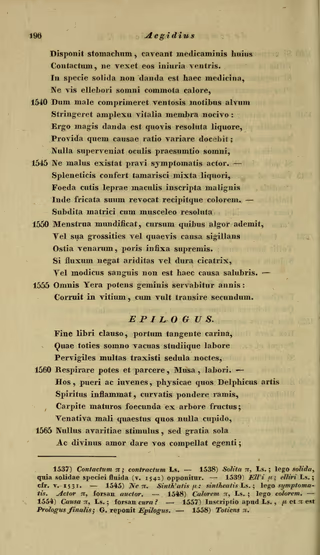
The end of the book being closed, the keel touching the port,
You who so many times, empty of sleep, by the labor of study
Have sedulously dragged out many wakeful nights,
You can breathe, O Muse, and spare your labor. —
Boys and youths, whom the Delphic spirit of the physical art
Inflames, pluck these mature fruits
From the fecund tree, its branches bent by the weight;
Which let no hunting desire for evil gain,
No stimulus of avarice, but grace alone
And divine love compel you to give to the needy;
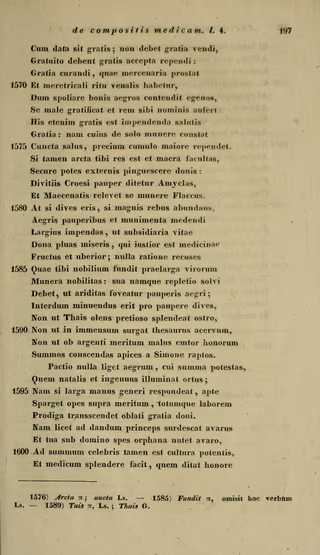
Since it was given for free; grace ought not to be sold,
Things received gratuitously ought to be repaid for free:
The grace of healing, which prostitutes itself for hire
And is held for sale in the manner of a harlot,
While it strives to plunder needy patients of their goods,
Renders itself ungracious and strips itself of the reality of its name:
For to these men the grace of health must be bestowed
For free: for He, upon whose sole gift
All health depends, will repay the price with a greater heap.
If, however, your circumstances are tight and your means meager,
You may safely grow fat on external gifts:
Let the poor Amyclas be enriched by the wealth of Croesus,
And let Flaccus relieve himself by the gift of Maecenas.
But if you are rich, if abounding in great means,
You should more generously bestow the protections of healing
Also upon the sick poor, so that you may rain down
The subsidiary gifts of life upon the wretched, which is the more just
And richer fruit of medicine; by no means should you refuse
The very bountiful gifts of noble men which
Nobility pours out for you: for its fullness ought to be
Released, so that the dryness of the sick poor man may be nourished;
Sometimes the rich man will have to be diminished for the sake of the poor man,
Not so that reeking Thais may shine in precious purple,
Not so that your treasure may rise into an immense heap,
Not so that, for the merit of silver, as a wicked buyer of honors,
You may ascend to the highest peaks snatched by Simon.
Let no contract bind the sick man who has supreme power,
Whom a noble and freeborn birth illuminates;
For if his generous hand corresponds to his lineage, he will fittingly
Scatter wealth beyond your merit, and the lavish grace
Of the offered gift will surpass all your labor.
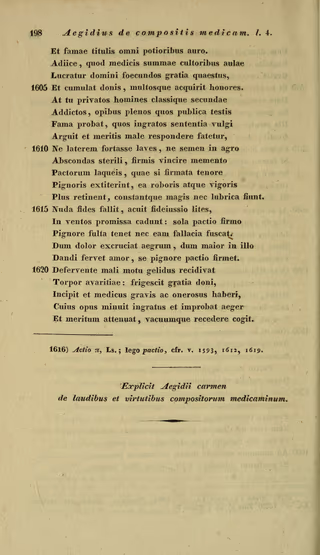
For although a greedy prince may turn a deaf ear to giving
And your orphaned hope may falter under a greedy lord,
Nevertheless the cultivation of a powerful man is highly celebrated,
And makes the physician shine, whom he enriches with honor
And with titles of fame better than all gold.
Add to this, that for physicians who cultivate the highest court
The favor of the lord procures fruitful gains,
And heaps them with gifts, and acquires many honors.
But as for private men and those assigned to the second class,
Full of wealth, whom public fame as a witness
Proves, whom the opinion of the common people accuses
Of being ungrateful, and confesses that they respond poorly to merits,
Lest perhaps you wash a brick, lest you hide seed in a field
That is sterile, remember to bind them with the firm
Snares of contracts, which, if they stand confirmed by the tenor
Of a pledge, retain more of strength and vigor,
And stand more constant, nor do they become slippery.
Bare faith deceives, a suretyship sharpens disputes,
Promises fall to the winds: only a contract supported by a firm
Pledge holds fast, nor does deceit obscure it.
While pain torments the sick man, while a greater love
Of giving burns in him, let the contract confirm itself with a pledge.
When the motion of the illness cools down, there returns the cold
Torpor of avarice: the gratitude for the gift grows cold,
And the physician begins to be considered heavy and burdensome,
Whose work the ungrateful sick man diminishes and disapproves of
And attenuates his merit, and forces him to depart empty-handed.
Fine libri clauso, portum tangente carina,
Quae toties somno vacuas studiique labore
Pervigiles multas traxisti sedula noctes,
Respirare potes et parcere, Musa, labori. —
Hos, pueri ac iuvenes, physicae quos Delphicus artis
Spiritus inflammat, curvatis pondere ramis,
Carpite maturos foecunda ex arbore fructus;
Venativa mali quaestus quos nulla cupido,
Nullus avaritiae stimulus, sed gratia sola
Ac divinus amor dare vos compellat egenti;
Cum data sit gratis; non debet gratia vendi,
Gratuito debent gratis accepta rependi:
Gratia curandi, quae mercenaria prostat
Et meretricali ritu venalis habetur,
Dum spoliare bonis aegros contendit egenos,
Se male gratificat et rem sibi nominis aufert:
His etenim gratis est impendenda salutis
Gratia: nam cuius de solo munere constat
Cuncta salus, precium cumulo maiore rependet.
Si tamen arcta tibi res est et macra facultas,
Secure potes externis pinguescere donis:
Divitiis Croesi pauper ditetur Amyclas,
Et Maecenatis relevet se munere Flaccus.
At si dives eris, si magnis rebus abundans,
Aegris pauperibus et munimenta medendi
Largius impendas, ut subsidiaria vitae
Dona pluas miseris, qui iustior est medicinae
Fructus et uberior; nulla ratione recuses
Quae tibi nobilium fundit praelarga virorum
Munera nobilitas: sua namque repletio solvi
Debet, ut ariditas foveatur pauperis aegri;
Interdum minuendus erit pro paupere dives,
Non ut Thais olens pretioso splendeat ostro,
Non ut in immensum surgat thesaurus acervum,
Non ut ob argenti meritum malus emtor honorum
Summos conscendas apices a Simone raptos.
Pactio nulla liget aegrum, cui summa potestas,
Quem natalis et ingenuus illuminat ortus;
Nam si larga manus generi respondeat, apte
Sparget opes supra meritum, totumque laborem
Prodiga transscendet oblati gratia doni.
Nam licet ad dandum princeps surdescat avarus
Et tua sub domino spes orphana nutet avaro,
Ad summum celebris tamen est cultura potentis,
Et medicum splendere facit, quem ditat honore
Et famae titulis omni potioribus auro.
Adiice, quod medicis summae cultoribus aulae
Lucratur domini foecundos gratia quaestus,
Et cumulat donis, multosque acquirit honores.
At tu privatos homines classique secundae
Addictos, opibus plenos quos publica testis
Fama probat, quos ingratos sententia vulgi
Arguit et meritis male respondere fatetur,
Ne laterem fortasse laves, ne semen in agro
Abscondas sterili, firmis vincire memento
Pactorum laqueis, quae si firmata tenore
Pignoris extiterint, ea roboris atque vigoris
Plus retinent, constantque magis nec lubrica fiunt.
Nuda fides fallit, acuit fideiussio lites,
In ventos promissa cadunt: sola pactio firmo
Pignore fulta tenet nec eam fallacia fuscat.
Dum dolor excruciat aegrum, dum maior in illo
Dandi fervet amor, se pignore pactio firmet.
Defervente mali motu gelidus recidivat
Torpor avaritiae: frigescit gratia doni,
Incipit et medicus gravis ac onerosus haberi,
Cuius opus minuit ingratus et improbat aeger
Et meritum attenuat, vacuumque recedere cogit.