Hover or tap a word to see its match.
Run, Pierides, renew the path begun
on the right track, let no delay retard you now,
from completing the journey begun, it is a shame to multiply
beginnings, and to impose an end on nothing.
If, since you are on foot, the way seems hard
and perhaps a very hard and rough pebble burns
your tender feet, having slipped through the hollows of the sandal,
to which the gap of a broken joint gave entrance:
so that rest mixed with labor may mitigate the pain,
so that night interrupted by serenity may please better,
so that laughter may intersperse weeping, leisure care,
joys sadness, splendor the shadow of darkness,
who may refresh the weary, who with a kindly mind
may receive you, repair exhaustion, make good losses,
shower you with the fruitful rain of gentle favor:
let no shame prevent you from approaching the abode of doctor
Renaud, whom long practice
and old experience have made more fruitful,
who [produces] not tasteless [fruits], who in the manner of a young plant
He brings forth no sour fruits, but those that have been well ripened
By the constant labor of study and long meditation;
He who, long an old inhabitant of Montpellier
And a most celebrated doctor in the medical art,
Held the rights of monarchy, but the nourishing spirit
Has now chosen him: heavenly grace arisen from the abodes above
Has seasoned his converted mind,
Has drenched him with its dew, who, considering the joys of the world,
Its gains, its pleasures, who considering its riches and honors
As the smoke of a mist and the likeness of frost,
Having set aside vain things, with Hippocrates left behind,
A soldier of justice, a severe judge of honesty,
Flies to Christ, who is the fount and origin of salvation,
True rest for the fallen, who is the port and anchor of life,
Who is the ship, the fare, the carrier, the guide, the path, the shore,
The Leader of the Catholic host, and the prize of triumph.
This man, bearing upon himself the banners of the crucified Lord,
Mortifies himself and takes up the cross; from a seer he becomes a prophet,
And from a physician he becomes a new Apostle: and of medicine,
Although he previously stood as a maker and a great professor,
He expresses a new Luke in himself, and portrays Cosmas,
And he carefully bestows true little gifts upon the sick poor for free,
And not only does he heal diseased bodies,
But he cures the diseases and wounds of the mind.
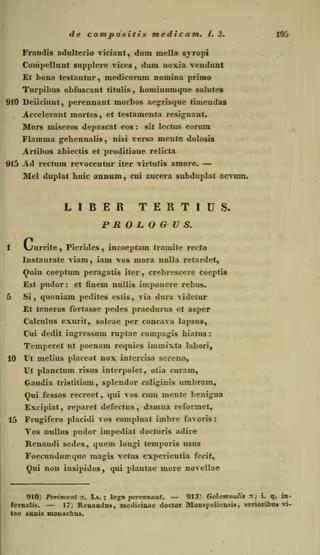
Currite, Pierides, incoeptam tramite recto
Instaurate viam, iam vos mora nulla retardet,
Quin coeptum peragatis iter, crebrescere coeptis
Est pudor: et finem nullis imponere rebus.
Si, quoniam pedites estis, via dura videtur
Et teneros fortasse pedes praedurus et asper
Calculus exurit, soleae per concava lapsus,
Cui dedit ingressum ruptae compagis hiatus:
Temperet ut poenam requies immixta labori,
Ut melius placeat nox intercisa sereno,
Ut planctum risus interpolet, otia curam,
Gaudia tristitiam, splendor caliginis umbram,
Qui fessos recreet, qui vos cum mente benigna
Excipiat, reparet defectus, damna reformet,
Frugifero placidi vos compluat imbre favoris:
Vos nullus pudor impediat doctoris adire
Renaudi sedes, quem longi temporis usus
Foecundumque magis vetus experientia fecit,
Qui non insipidos, qui plantae more novellae
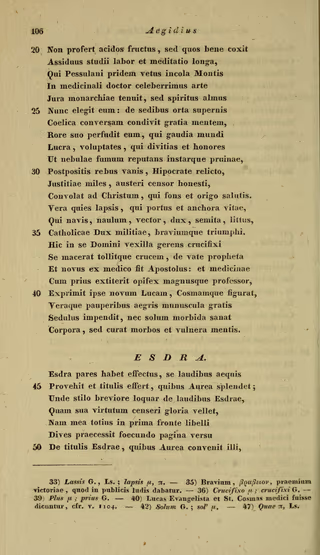
Non profert acidos fructus, sed quos bene coxit
Assiduus studii labor et meditatio longa,
Qui Pessulani pridem vetus incola Montis
In medicinali doctor celeberrimus arte
Jura monarchiae tenuit, sed spiritus almus
Nunc elegit eum: de sedibus orta supernis
Coelica conversam condivit gratia mentem,
Rore suo perfudit eum, qui gaudia mundi
Lucra, voluptates, qui divitias et honores
Ut nebulae fumum reputans instarque pruinae,
Postpositis rebus vanis, Hipocrate relicto,
Justitiae miles, austeri censor honesti,
Convolat ad Christum, qui fons et origo salutis.
Vera quies lapsis, qui portus et anchora vitae,
Qui navis, naulum, vector, dux, semita, littus,
Catholicae Dux militiae, braviumque triumphi.
Hic in se Domini vexilla gerens crucifixi
Se macerat tollitque crucem, de vate propheta
Et novus ex medico fit Apostolus: et medicinae
Cum prius extiterit opifex magnusque professor,
Exprimit ipse novum Lucam, Cosmamque figurat,
Veraque pauperibus aegris munuscula gratis
Sedulus impendit, nec solum morbida sanat
Corpora, sed curat morbos et vulnera mentis.