Hover or tap a word to see its match.
Resounding the sweet melodies of the Thracian bard,
Touch the lyre, and run through the sounding strings with your fingers,
Having drunk from a generous libation of the Cirrhaean stream,
O Goddess, unroll and discuss the laws of Musandinus.
Darkened for a long time by a decrepit and long lethargy,
Those things which lie downtrodden, which now are worn away as cast-offs,
And scattered become cheap, published on common papers,
Having neither the radiance of eloquence, nor a certain form,
Gather together, arrange, renew, and prudently adorn.
Which the present age, delighted by new things, despises,
Review the ancient things dug up from the writings of the ancients:
Since the modern ear is nauseated by ancient songs,
Seeking pastoral delights and jests,
The old history, bound by numbers and meters,
Remember to adapt to measures so that it may sound better,
And compel the old woman to grow young with a new song,
And let the matron join the dances of the girls,
And let her move her modest foot, but not wantonly,
Nor let her break her steps with a pentameter gait.
So that the old and ancient Falernian wine may flourish better,
Pour it into new casks, and to the Salernitan people
Offer its wines committed to a new bowl.
Which, after she has approved them by taste and learned ear,
She will know were gathered in her own mountains:
But let her know the cup is mine; if the form of the artisan
Is approved, who, taking foreign material,
Fashions new faces in bronze, wood, or marble.
But because use and compliance are generally prepared
From one's own things, acquired by the hands of a servant,
And the master is sometimes able to become renowned
By the gifts of the servant: bear my gifts to the Salernitan philosophers,
Sent by their Aegidius; let them receive dishes fruitful of health
With a not disdainful lip,
Let them read the writings: it is an honor to the father when the heir profits:
Thus the master responds to the servant: thus by a fixed
And relative covenant the offspring is subject to the father:
The doctor is bound to the disciple by such a connection:
Thus they swear together and cling with friendly bonds,
Because a good progeny is the praise and glory of the father,
And a noble offspring proves a well-born parent:
The diligence of the servant makes the honor of the master fruitful,
The fame of the doctor shines forth by the title of the disciple:
The moon proves the rays of the sun: and the shadow confesses
Its body: the branch its trunk, and the grape its vine:
From the merit of the oil the value of the olive shines forth.
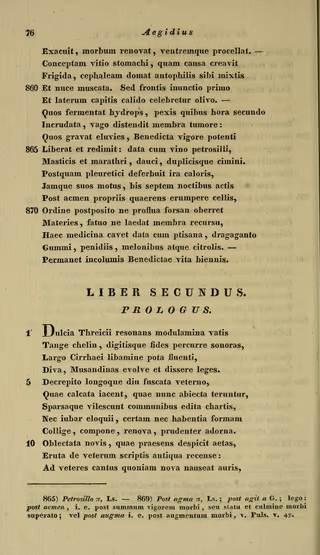
Dulcia Threicii resonans modulamina vatis
Tange chelin, digitisque fides percurre sonoras,
Largo Cirrhaei libamine pota fluenti,
Diva, Musandinas evolve et dissere leges.
Decrepito longoque diu fuscata veterno,
Quae calcata iacent, quae nunc abiecta teruntur,
Sparsaque vilescunt communibus edita chartis,
Nec iubar eloquii, certam nec habentia formam
Collige, compone, renova, prudenter adorna.
Oblectata novis, quae praesens despicit aetas,
Eruta de veterum scriptis antiqua recense:
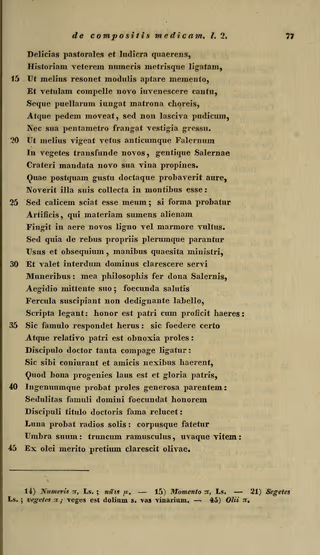
Ad veteres cantus quoniam nova nauseat auris,
Delicias pastorales et ludicra quaerens,
Historiam veterem numeris metrisque ligatam,
Ut melius resonet modulis aptare memento,
Et vetulam compelle novo iuvenescere cantu,
Seque puellarum iungat matrona choreis,
Atque pedem moveat, sed non lasciva pudicum,
Nec sua pentametro frangat vestigia gressu.
Ut melius vigeat vetus anticumque Falernum
In vegetes transfunde novos, gentique Salernae
Crateri mandata novo sua vina propines.
Quae postquam gustu doctaque probaverit aure,
Noverit illa suis collecta in montibus esse:
Sed calicem sciat esse meum; si forma probatur
Artificis, qui materiam sumens alienam
Fingit in aere novos ligno vel marmore vultus.
Sed quia de rebus propriis plerumque parantur
Usus et obsequium, manibus quaesita ministri,
Et valet interdum dominus clarescere servi
Muneribus: mea philosophis fer dona Salernis,
Aegidio mittente suo; foecunda salutis
Fercula suscipiant non dedignante labello,
Scripta legant: honor est patri cum proficit haeres:
Sic famulo respondet herus: sic foedere certo
Atque relativo patri est obnoxia proles:
Discipulo doctor tanta compage ligatur:
Sic sibi coniurant et amicis nexibus haerent,
Quod bona progenies laus est et gloria patris,
Ingenuumque probat proles generosa parentem:
Sedulitas famuli domini foecundat honorem
Discipuli titulo doctoris fama relucet:
Luna probat radios solis: corpusque fatetur
Umbra suum: truncum ramusculus, uvaque vitem:
Ex olei merito pretium clarescit olivae.