Hover or tap a word to see its match.
Part 1
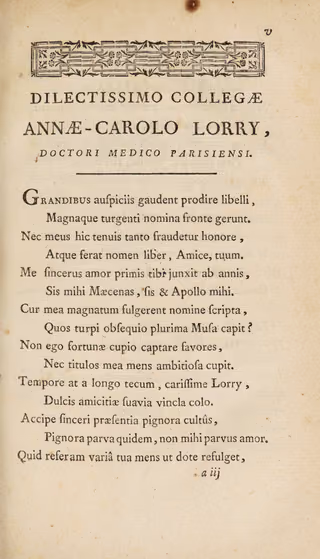
Little books rejoice to come forth under grand auspices,
And bear great names upon a swelling brow.
Let not this slender book of mine be cheated of so great an honor,
And let it bear your name, my Friend.
Sincere love has joined me to you from our earliest years;
Be a Maecenas to me, and be an Apollo to me.
Why should my writings shine with the name of grandees,
Whom many a Muse captivates with base flattery?
I do not desire to court the favors of fortune,
Nor does an ambitious mind in me desire titles.
But for a long time with you, dearest Lorry,
I have cherished the gentle bonds of sweet friendship.
Accept these present pledges of sincere devotion,
Small pledges indeed, though my love is not small.
Why should I recount how your mind shines with varied gifts,
GRANDIBUS auſpiciis gaudent prodire libelli,
Magnaque turgenti nomina fronte gerunt.
Nec meus hic tenuis tanto fraudetur honore,
Atque ferat nomen liber, Amice, tuum.
Me ſincerus amor primis tibi junxit ab annis,
Sis mihi Mæcenas, ſis & Apollo mihi.
Cur mea magnatum fulgerent nomine ſcripta,
Quos turpi obſequio plurima Muſa capit?
Non ego fortunæ cupio captare favores,
Nec titulos mea mens ambitioſa cupit.
Tempore at a longo tecum, cariſſime Lorry,
Dulcis amicitiæ ſuavia vincla colo.
Accipe ſinceri præſentia pignora cultûs,
Pignora parva quidem, non mihi parvus amor.
Quid referam variâ tua mens ut dote refulget,
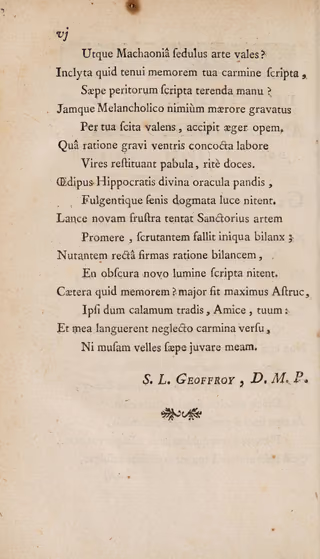
Part 2
And how you diligently prevail in the Machaonian art?
Why should I recount in slender verse your renowned writings,
Writings often to be thumbed by the hand of the learned?
And now the patient weighed down too much by melancholic grief,
Growing strong through your precepts, receives aid.
In what manner foods digested by the heavy labor of the belly
Restore strength, you rightly teach.
As an Oedipus, you unfold the divine oracles of Hippocrates,
And the doctrines of the old man shine with a resplendent light.
With his scale Sanctorius tries in vain to bring forth
A new art; the uneven balance deceives the inquirer;
With right reason you steady the wavering balance,
Behold, the obscure writings shine with a new light.
Why should I recount the rest? The greatest Astruc becomes greater,
While you, my Friend, lend him your pen:
And my songs would languish in neglected verse,
Were you not willing often to aid my Muse.
Étienne-Louis Geoffroy, Doctor of Medicine of Paris.
Utque Machaoniâ ſedulus arte vales?
Inclyta quid tenui memorem tua carmine ſcripta,
Sæpe peritorum ſcripta terenda manu?
Jamque Melancholico nimiùm mærore gravatus
Per tua ſcita valens, accipit æger opem.
Quâ ratione gravi ventris concocta labore
Vires reſtituant pabula, ritè doces.
Œdipus Hippocratis divina oracula pandis,
Fulgentique ſenis dogmata luce nitent.
Lance novam fruſtra tentat Sanctorius artem
Promere, ſcrutantem fallit iniqua bilanx;
Nutantem rectâ firmas ratione bilancem,
En obſcura novo lumine ſcripta nitent.
Cætera quid memorem? major fit maximus Aſtruc,
Ipſi dum calamum tradis, Amice, tuum:
Et mea languerent neglecto carmina verſu,
Ni muſam velles ſæpe juvare meam.