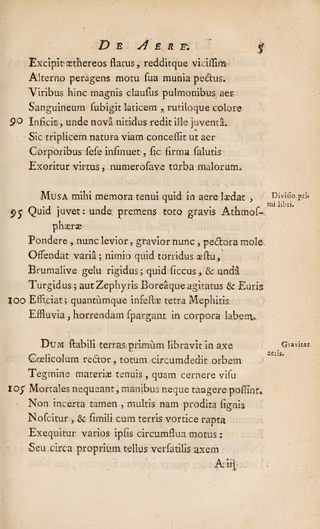
MUSA mihi memora tenui quid in aere lædat,

Poet
Étienne-Louis Geoffroy
Form
Not identifiable from book
Open the page in the book
The page this poem fills. Each opens in the Hygieine, sive ars sanitatem conservandi reader.

Hover or tap a word to see its match.

MUSE, recount to me what harms in the thin air,

what helps: whence, pressing with the whole weight of the heavy atmosphere,

now lighter, now heavier, it offends the chest

with its varying mass; what it effects when parched with excessive heat,

or stiff with wintry frost; what when dry, and swollen

with water; or agitated by Zephyrs and Boreas and Eurus;

and how much the foul effluvia of hostile mephitis

scatter a dreadful plague into bodies. Division of the first book.

MUSA mihi memora tenui quid in aere lædat,

Quid juvet: unde premens toto gravis Athmosphæræ

Pondere, nunc levior, gravior nunc, pectora mole

Offendat variâ; nimio quid torridus æstu,

Brumalive gelu rigidus; quid siccus, & undâ

Turgidus; aut Zephyris Boreâque agitatus & Euris

Efficiat; quantùmque infestæ tetra Mephitis

Effluvia, horrendam spargant in corpora labem. Divisio pri-
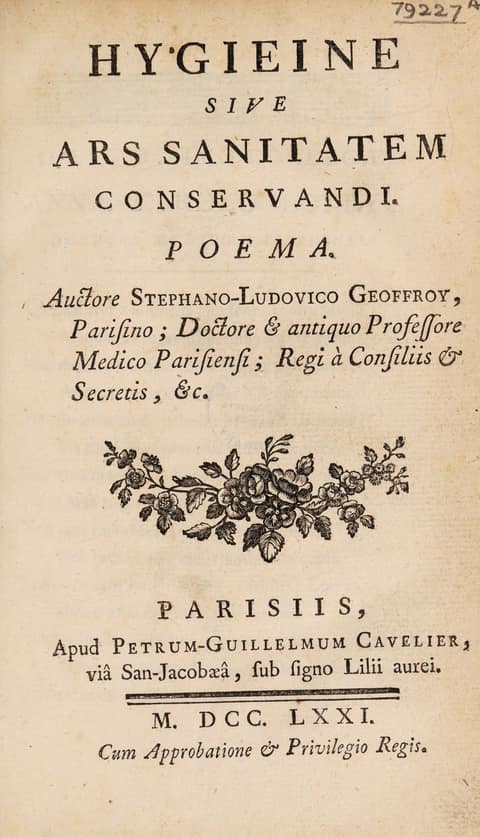
Title page of Hygieine, sive ars sanitatem conservandi
Title page of Hygieine, sive ars sanitatem conservandi , 1771

About this text

Provenance

This edition uses the Wellcome Collection copy, catalogue number b30508277. It starts at scan 6, after the front board, the marbled endpapers, a flyleaf with shelf marks and the digitization notice. The half-title is scan 7 and the title page is scan 9. Book One begins on scan 19, and the poem ends on scan 209. The last scans show blank leaves, the back endpapers and the back board.

Rights

The Wellcome Collection marks the digital images with the Public Domain Mark 1.0. Credit the Wellcome Collection.

Original scans: Wellcome Collection ( Public Domain Mark 1.0 ).

Historian’s note. This text records the medicine of its own time, and later evidence has replaced most of it. It is not medical advice. We read it as history, and we ask what, if anything, connects it to medicine today. More on how we read old medical books