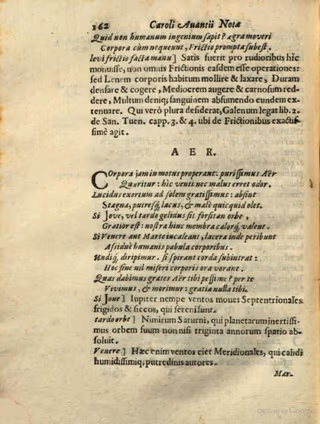
A E R.

Poet
Baptista Fiera
Form
Elegiac couplet
Open the page in the book
The page this poem fills. Each opens in the Coena, sive De cibariorum virtutibus reader.

Hover or tap a word to see its match.

Bodies now hasten into motions: the purest Air

is sought: let no foul odor of the wind wander here.

Bright toward the risen sun it is most pleasing: let stagnant pools

be absent, and putrid lakes, and whatever smells badly.

If perhaps it is cold by Jupiter, or by the slow orb,

it is more pleasing: hence our limbs and heat are strong.

If they grow warm by Venus or Mars, torn nourishments will thence

continually perish for human bodies.

We are torn apart from all sides. If they blow, it enters the hearts:

without this, the mouths of the wretched body devour nothing.

What thanks shall we give to you, worst Air? Through you

we live, and we die: no thanks to you.

COrpora jam in motus properant: puriſſimus Aër

Quæritur: hìc venti nec malus erret odor.

Lucidus exortum ad ſolem gratiſſimus: abſint

Stagna, putreſq́; lacus, & malè quicquid olet.

Si Jove, vel tardo gelidus ſit forſitan orbe,

Gratior eſt: noſtra hinc membra calorq́; valent.

Si Venere aut Marte incaleant, lacera inde peribunt

Aſsiduè humanis pabula corporibus.

Undiq́; diripimur. ſi ſpirant corda ſubintrat:

Hoc ſine nil miſeri corporis ora vorant.

Quas dabimus grates Aër tibi peſſime? per te

Vivimus, & morimur: gratia nulla tibi.
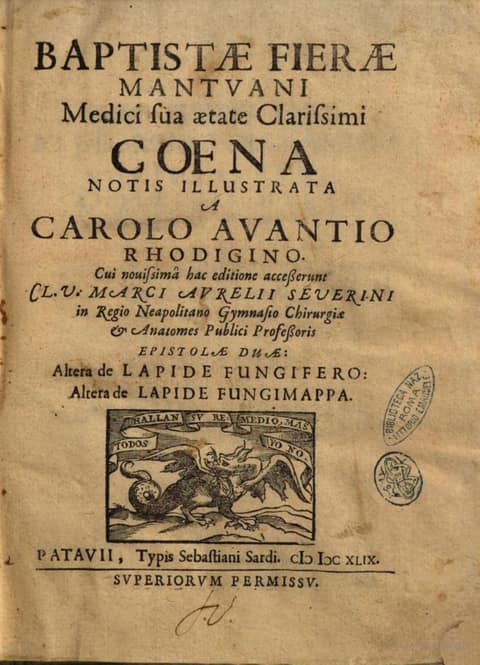
Title page of Coena, sive De cibariorum virtutibus
Title page of Coena, sive De cibariorum virtutibus , 1649

About this text

Provenance

This digital edition is derived from the Internet Archive copy of Battista Fiera's 1649 _Coena, sive De cibariorum virtutibus_, a Latin medical dinner poem with Carlo Avanzi's notes and related material.

Methodology

Each scan is treated as a page-level unit. The page image remains the authority for the edition. Local Kraken OCR used the Reichenau Latin early-print model as a reading aid, then Gemini generated scan-grounded Latin transcription and scholarly English translation from the images, the OCR aid, and the approved glossary. Word links connect the English translation to the Latin transcription and locations on the scans. 32 uncertain word-link decisions remain unlinked. Some links highlight only the text because the source word could not be located on the scan.

Rights

The Internet Archive metadata and IIIF manifest record the digital surrogate under the Creative Commons Public Domain Mark 1.0. Poet Doctor's presentation adds generated OCR, transcription, translation, navigation metadata, and editorial context.

Original scans: Internet Archive / Google Books ( Public Domain Mark 1.0 ).

Historian’s note. This text records the medicine of its own time, and later evidence has replaced most of it. It is not medical advice. We read it as history, and we ask what, if anything, connects it to medicine today. More on how we read old medical books