Hover or tap a word to see its match.
if a more humid temperament of the air joins heat
to itself, and the rains grow warm: why should I mention
that tainted bodies are dissolved by the blasts of the rainy south wind,
why that meats rot with mold, that nectareous draughts
of milk turn sour, and the pleasant gifts of Bacchus?
Yet the living mass itself is not exempt from putrefaction:
the mass of fluids boils, and, grown more acrid, expands its sulphurs,
and, with its bond broken, is dissolved and melts.
Hence the body wastes away with corruption, and fever with its malignant bite,
and pestilence consuming the languishing viscera
arises, and gangrene freezing the warm blood.
And at the same time, with filthy scabies and foul prurigo,
the beauty of the face is disfigured, the blood belches forth
acidities, and the skin, squalid with an obscene ulcer, oozes.
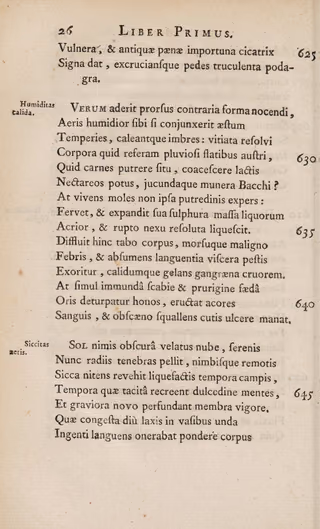
Aeris humidior sibi si conjunxerit æstum
Temperies, caleantque imbres: vitiata resolvi
Corpora quid referam pluviosi flatibus austri,
Quid carnes putrere situ, coacescere lactis
Nectareos potus, jucundaque munera Bacchi?
At vivens moles non ipsa putredinis expers:
Fervet, & expandit sua sulphura massa liquorum
Acrior, & rupto nexu resoluta liquescit.
Diffluit hinc tabo corpus, morsuque maligno
Febris, & absumens languentia viscera pestis
Exoritur, calidumque gelans gangræna cruorem.
At simul immundâ scabie & prurigine fædâ
Oris deturpatur honos, eructat acores
Sanguis, & obscæno squallens cutis ulcere manat.