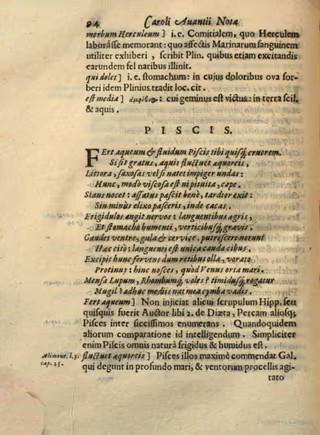
P I S C I S.

Poet
Baptista Fiera
Form
Elegiac couplet
Open the page in the book
The page this poem fills. Each opens in the Coena, sive De cibariorum virtutibus reader.

Hover or tap a word to see its match.

Every fish brings you a watery and fluid blood.

If it is to be pleasing, let it toss in the seawaters,

Whether it swims actively by the shores or in rocky waves:

Take this one, provided that your pituita is not viscous.

A standing one harms: roasted it nourishes well, and departs more slowly:

But if you feed rather on a boiled one, from that you defecate.

It constricts the somewhat chilly nerves: to languishing sick people,

And to a moist stomach, and to the heads it is heavy.

It rejoices in the belly, the gullet and the neck. These know how to

Putrefy quickly: for a languishing person the tail is the only food.

While the boiling pot receives this one from the nets, devour it

Immediately: hence you will know that Venus rose from the sea.

Will you desire the Wolf-fish and the Turbot for your table? And is the timid

Mullet requested? My boat still swims in the middle of the shallows.

FErt aqueum & fluidum Piſcis tibi quiſq; cruorem.

Si ſit gratus, aquis fluctuet æquoreis,

Littora , ſaxoſas vel ſi natet impiger undas :

Hunc, modò viſcoſa eſt ni pituita , cape.

Stans nocet : aſſatus paſcit benè, tardior exit :

Sin minùs elixo paſceris , inde cacas.

Frigidulos angit nervos : languentibus ægris ,

Et ſtomacho humenti, verticibuſq; gravis.

Gaudet ventre, gula & cervice . putreſcere norunt

Hæc citò : languenti eſt unica cauda cibus.

Excipit hunc fervens dum retibus olla , vorato

Protinus : hinc noſces, quòd Venus orta mari.

Menſa Lupum, Rhombumq; voles ? timiduſq; rogatur

Mugil ? adhuc mediis nat mea cymba vadis.
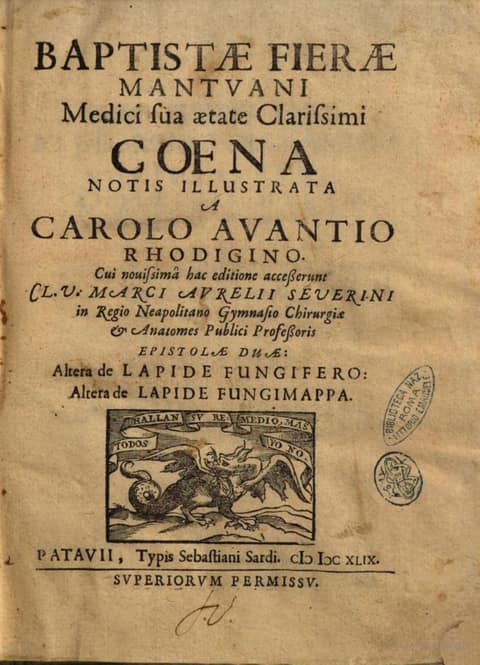
Title page of Coena, sive De cibariorum virtutibus
Title page of Coena, sive De cibariorum virtutibus , 1649

About this text

Provenance

This digital edition is derived from the Internet Archive copy of Battista Fiera's 1649 _Coena, sive De cibariorum virtutibus_, a Latin medical dinner poem with Carlo Avanzi's notes and related material.

Methodology

Each scan is treated as a page-level unit. The page image remains the authority for the edition. Local Kraken OCR used the Reichenau Latin early-print model as a reading aid, then Gemini generated scan-grounded Latin transcription and scholarly English translation from the images, the OCR aid, and the approved glossary. Word links connect the English translation to the Latin transcription and locations on the scans. 32 uncertain word-link decisions remain unlinked. Some links highlight only the text because the source word could not be located on the scan.

Rights

The Internet Archive metadata and IIIF manifest record the digital surrogate under the Creative Commons Public Domain Mark 1.0. Poet Doctor's presentation adds generated OCR, transcription, translation, navigation metadata, and editorial context.

Original scans: Internet Archive / Google Books ( Public Domain Mark 1.0 ).

Historian’s note. This text records the medicine of its own time, and later evidence has replaced most of it. It is not medical advice. We read it as history, and we ask what, if anything, connects it to medicine today. More on how we read old medical books