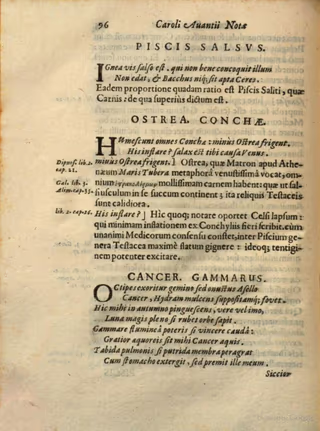
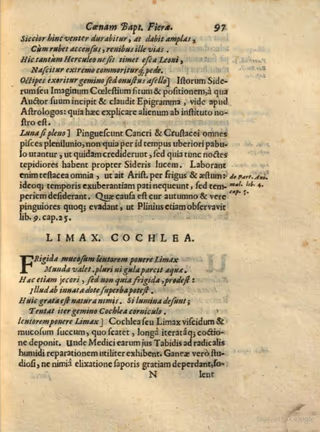
CANCER. GAMMARUS.

Poet
Baptista Fiera
Form
Elegiac couplet
Open the page in the book
The pages this poem fills. Each opens in the Coena, sive De cibariorum virtutibus reader.

Hover or tap a word to see its match.

The eight-footed Crab rises, but burdened with the twin Asellus,

Soothing the Hydra, and warms it placed beneath.

This one, growing fat for me in autumn, or in late spring,

Tastes better if the moon reddens with a full orb.

Lobster, if you can conquer with your river tail:

Let the Crab from the sea waters be more pleasing to me.

If it traverses the wasting, putrid limbs of the lung,

It wipes them clean along with the stomach, but it oppresses mine.

Hence the belly, becoming drier, will be hardened, but,

When he reddens, heated, he will provide wide pathways for the kidneys.

He only fears lest he become food for the Herculean Lion,

He rises and sets together at his outermost foot.

OCtipes exoritur gemino ſed onuſtus Aſello

Cancer, Hydram mulcens ſuppoſitamq; fovet.

Hic mihi in autumno pingueſcens, vere vel imo,

Luna magis pleno ſi rubet orbe ſapit.

Gammare flumineâ poteris ſi vincere caudâ :

Gratior æquoreis ſit mihi Cancer aquis.

Tabida pulmonis ſi putrida membra peragrat

Cum ſtomacho extergit, ſed premit ille meum.

*Siccior hinc venter durabitur, at dabit amplas,*

*Cùm rubet accenſus, renibus ille vias .*

*Hic tantùm Herculeo ne ſit timet eſca Leoni,*

*Naſcitur extremo commoriturq́; pede.*
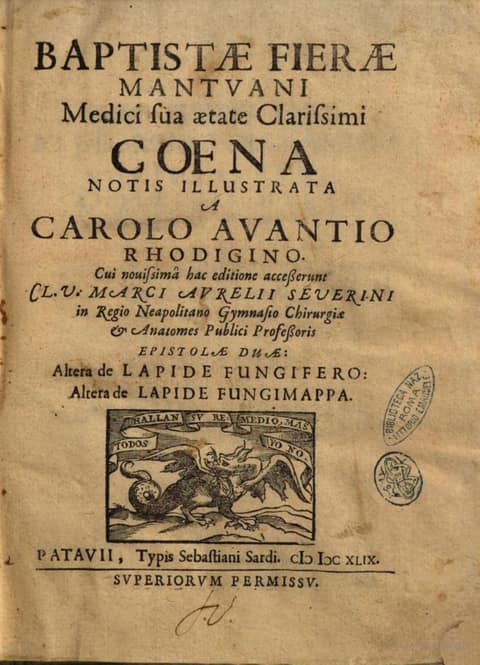
Title page of Coena, sive De cibariorum virtutibus
Title page of Coena, sive De cibariorum virtutibus , 1649

About this text

Provenance

This digital edition is derived from the Internet Archive copy of Battista Fiera's 1649 _Coena, sive De cibariorum virtutibus_, a Latin medical dinner poem with Carlo Avanzi's notes and related material.

Methodology

Each scan is treated as a page-level unit. The page image remains the authority for the edition. Local Kraken OCR used the Reichenau Latin early-print model as a reading aid, then Gemini generated scan-grounded Latin transcription and scholarly English translation from the images, the OCR aid, and the approved glossary. Word links connect the English translation to the Latin transcription and locations on the scans. 32 uncertain word-link decisions remain unlinked. Some links highlight only the text because the source word could not be located on the scan.

Rights

The Internet Archive metadata and IIIF manifest record the digital surrogate under the Creative Commons Public Domain Mark 1.0. Poet Doctor's presentation adds generated OCR, transcription, translation, navigation metadata, and editorial context.

Original scans: Internet Archive / Google Books ( Public Domain Mark 1.0 ).

Historian’s note. This text records the medicine of its own time, and later evidence has replaced most of it. It is not medical advice. We read it as history, and we ask what, if anything, connects it to medicine today. More on how we read old medical books