Hover or tap a word to see its match.
A splenetic swelling from black bile without fever
is cured by *Diacostum*, a useful aid for the disease,
drunk with wine in which tamarisk has been boiled;
if the compression of the spleen should block the narrow
approaches of the liver, so that by not allowing the bile to breathe
the liver becomes inflamed, a mixture of *Tryphera* will help. —
The winds which the cold injury of the belly strikes,
with which the fierce wickedness of hostile pain brawls,
it calms them and puts an end to every
complaint of an old offense, the dispute having been put to sleep,
—an administered dose of *Diacostum* with strong wine,
drawing valid vigor from nutmeg:
let a poultice be applied to the place, which is composed of tamarisk
with *musceleum* and *Diacostum*.
By chance a poor man, seeing himself more heavily burdened in this regard,
and himself less suited for such great expenses of things,
clamors against the physician and insults him with bitter words:
"You who set yourself up as an *artigenes* and a provider of health,
for whom *spillea* make an addition to a moderate stature,
and a spacious house makes augmentations:
You, whose fingers are radiant with jeweled gold
You confess that your fickle heart is made of various furs,
Your art serves the rich alone, who have ample means,
Whom the opulence of things draws into vain expenses,
And it provides the comforts of a desired life.
Your art, eagerly stretching its nets for riches,
Suggests the use of medicine to the rich alone.
While you recount mace, musk, nutmeg, balsams, nard,
Cloves, aloe wood, while [you recount] castor, myrrh,
While you enumerate various spices and many aromatics,
Which the Gangetic land produces under scorching suns,
You speak to emperors alone, whom nothing can delight
Unless it is expensive, and you exclude the barren needy.
Therefore poverty is a wretched thing and of an unjust lot,
Which not only the world rejects and profanes,
But the governing prudence of life deprives of its gifts,
And casts it away as vile, and leaves it barren. —
Fool, why do you sharpen your words with vain complaints?
What you cannot avoid, must be borne with an even mind:
Patience tames the hardship of a harsh lot:
A burden becomes heavier when it is borne on a rebellious neck:
You are pricked by the goads of envy if you seek to prick.
The law of envy is exceedingly just, because its author
Bears in his mind a cross for his vices and the penalty of his guilt,
As the judge of the punishment and the faithful avenger of the crime.
Measure yourself by your own bounds: poverty becomes very free
And safe when it is kept within its own limit:
He who stretches himself beyond the narrow edges of his cloak,
His short coverlet leaves the tips of his feet bare;
The ram does not contend with the ox for the honor of the forehead,
The *pinguina* tamarisk does not compete with the lofty plane-tree,
The boxwood not with the laurel, the bramble with the cedar, the seaweed with the privet:
The wild nard does not seek to shine in the garment of the rose.
The lesser star does not presume for itself the honor of the moon.
Provident nature restricts other things in a fixed
order, because she did not want them to overstep their proper laws;
In human affairs the rule of nature fails,
although the heavenly power of the rational soul
ought to bind human motions within fixed limits:
The irregular male, abandoning the active
rights of his sex, while he softens into passive acts,
becomes a woman, although the rib of a man produced her;
A solecistic woman breaks the joints of nature,
when she binds to herself a similar sex in grammatical order;
Touched by the love of ruling, a son aspires
to the death of his father and rebukes the sluggish years;
With the law of the marriage bed broken and forgetful of the nuptial torch,
a woman burns with adultery, who, prodigal of her shame,
becomes venal flesh consigned to a cheap market;
Poverty, not knowing how to be confined by modest limits,
while it oversteps itself, from quiet liberty
rashly exchanges for itself a servile lot.
But you, whom narrow means mutilate, whom they contract,
whom the apocope of poverty cuts down: why
do you strive to extend yourself, a fool, through a paragoge?
Hindering your advance, narrow circumstances at home
place firm barriers for you; since you are submerged in the depths,
you cannot bubble up further on the highest wave.
You will be able to rupture yourself, but not to extend yourself, if you
attempt things which you cannot bear: why therefore do you
pursue the physician with vain complaints, because he does not
set forth expensive spices for you, which the dark Indian brings?
Why do you presume for yourself the delights of the world bought
at precious costs? When it pours out for you for free the ample wealth
of a brief order, when the rich forest supplies without cost
the abundant gifts of restoring health.
Let the digression, spread out more than is proper, curb
its course, and let the page complete the begun praises
of *Diacostum* and run in its own path of treating:
Drunk with wine, into which the power of nard
has introduced itself, twisted through the force of fiery heat,
it draws out from a purulent body the old filth
which cold matter has massed together into one. —
It brings forth urine closed off by the barrier of strangury
and bound by a kidney condition, if you mix diuretics with it,
let it be given with wine and let its use be frequently observed. —
A doubled year gives it the laws of a firm state.
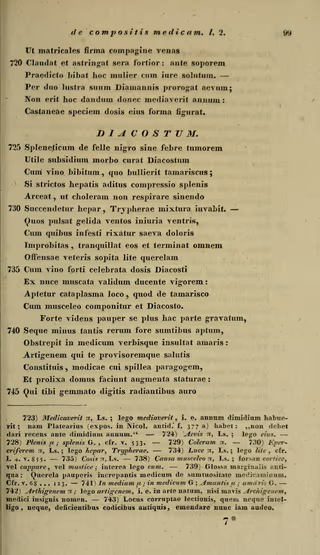
Spleneticum de felle nigro sine febre tumorem
Utile subsidium morbo curat Diacostum
Cum vino bibitum, quo bullierit tamariscus;
Si strictos hepatis aditus compressio splenis
Arceat, ut choleram non respirare sinendo
Succendetur hepar, Trypherae mixtura iuvabit. —
Quos pulsat gelida ventos iniuria ventris,
Cum quibus infesti rixatur saeva doloris
Improbitas, tranquillat eos et terminat omnem
Offensae veteris sopita lite querelam
Cum vino forti celebrata dosis Diacosti
Ex nuce muscata validum ducente vigorem:
Aptetur cataplasma loco, quod de tamarisco
Cum musceleo componitur et Diacosto.
Forte videns pauper se plus hac parte gravatum,
Seque minus tantis rerum fore sumtibus aptum,
Obstrepit in medicum verbisque insultat amaris:
Artigenem qui te provisoremque salutis
Constituis, modicae cui spillea paragogem,
Et prolixa domus faciunt augmenta staturae:
Qui tibi gemmato digitis radiantibus auro
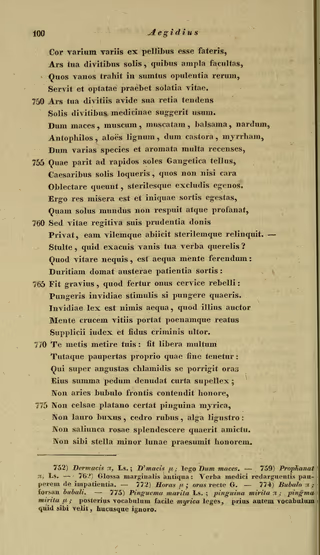
Cor varium variis ex pellibus esse fateris,
Ars tua divitibus solis, quibus ampla facultas,
Quos vanos trahit in sumtus opulentia rerum,
Servit et optatae praebet solatia vitae.
Ars tua divitiis avide sua retia tendens
Solis divitibus medicinae suggerit usum.
Dum maces, muscum, muscatam, balsama, nardum,
Antophilos, aloës lignum, dum castora, myrrham,
Dum varias species et aromata multa recenses,
Quae parit ad rapidos soles Gangetica tellus,
Caesaribus solis loqueris, quos non nisi cara
Oblectare queunt, sterilesque excludis egenos.
Ergo res misera est et iniquae sortis egestas,
Quam solus mundus non respuit atque profanat,
Sed vitae regitiva suis prudentia donis
Privat, eam vilemque abiicit sterilemque relinquit. —
Stulte, quid exacuis vanis tua verba querelis?
Quod vitare nequis, est aequa mente ferendum:
Duritiam domat austerae patientia sortis:
Fit gravius, quod fertur onus cervice rebelli:
Pungeris invidiae stimulis si pungere quaeris.
Invidiae lex est nimis aequa, quod illius auctor
Mente crucem vitiis portat poenamque reatus
Supplicii iudex et fidus criminis ultor.
Te metis metire tuis: fit libera multum
Tutaque paupertas proprio quae fine tenetur:
Qui super angustas chlamidis se porrigit oras
Eius summa pedum denudat curta supellex;
Non aries bubulo frontis contendit honore,
Non celsae platano certat pinguina myrica,
Non lauro buxus, cedro rubus, alga ligustro:
Non saliunca rosae splendescere quaerit amictu.
Non sibi stella minor lunae praesumit honorem.
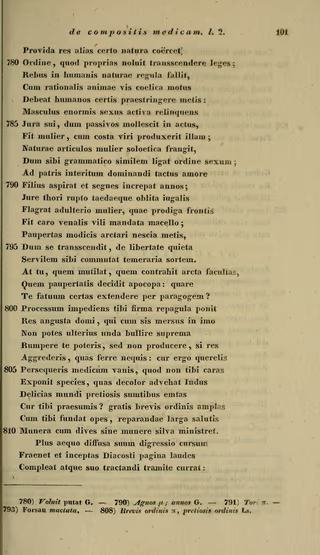
Provida res alias certo natura coërcet
Ordine, quod proprias noluit transscendere leges;
Rebus in humanis naturae regula fallit,
Cum rationalis animae vis coelica motus
Debeat humanos certis praestringere metis:
Masculus enormis sexus activa relinquens
Jura sui, dum passivos mollescit in actus,
Fit mulier, cum costa viri produxerit illam;
Naturae articulos mulier soloetica frangit,
Dum sibi grammatico similem ligat ordine sexum;
Ad patris interitum dominandi tactus amore
Filius aspirat et segnes increpat annos;
Jure thori rupto taedaeque oblita iugalis
Flagrat adulterio mulier, quae prodiga frontis
Fit caro venalis vili mandata macello;
Paupertas modicis arctari nescia metis,
Dum se transscendit, de libertate quieta
Servilem sibi commutat temeraria sortem.
At tu, quem mutilat, quem contrahit arcta facultas,
Quem paupertatis decidit apocopa: quare
Te fatuum certas extendere per paragogem?
Processum impediens tibi firma repagula ponit
Res angusta domi, qui cum sis mersus in imo
Non potes ulterius unda bullire suprema
Rumpere te poteris, sed non producere, si res
Aggrederis, quas ferre nequis: cur ergo querelis
Persequeris medicum vanis, quod non tibi caras
Exponit species, quas decolor advehat Indus
Delicias mundi pretiosis sumtibus emtas
Cur tibi praesumis? gratis brevis ordinis amplas
Cum tibi fundat opes, reparandae larga salutis
Munera cum dives sine munere silva ministret.
Plus aequo diffusa suum digressio cursum
Fraenet et inceptas Diacosti pagina laudes
Compleat atque suo tractandi tramite currat:
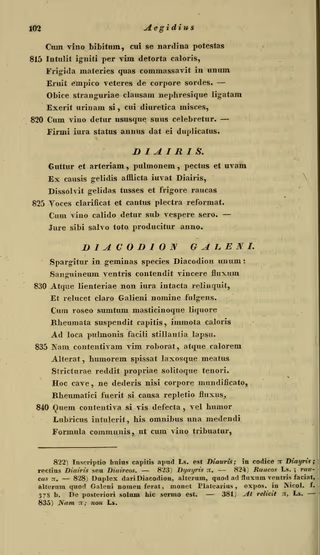
Cum vino bibitum, cui se nardina potestas
Intulit igniti per vim detorta caloris,
Frigida materies quas commassavit in unum
Eruit empico veteres de corpore sordes. —
Obice stranguriae clausam nephresique ligatam
Exerit urinam si, cui diuretica misces,
Cum vino detur ususque suus celebretur. —
Firmi iura status annus dat ei duplicatus.