Hover or tap a word to see its match.
*Diamargariton* refreshes the heart, and clears the mind:
It gladdens the sad: it furnishes remedies for phthisics:
It restores the consumed, whom *macronoxia* afflicts:
It cures cardiac affection: it banishes impurities from the heart:
It restores taste by sharpening the sluggish palate,
And gives to foods the seasonings of its proper flavor:
Those whom *anathymiasis* and smoky *pexis* afflict,
It recalls to their accustomed habit, and bestows vigor.
It refreshes a weak heart, bound by icy torpor,
Thickened by cold, burdened by a dark cloud,
If a powder is mixed into it, which the crushed
Bony hardness taken from the heart of a stag supplies;
This is the rule of weight: an ounce takes half a drachma;
Before food in the morning let this dose visit the sick heart,
And let a drink of fragrant wine be a companion to this.
Do not give it, if the suffering is the daughter of a hot cause.
Let this also be drunk with wine on an empty stomach,
By one whose stomach a cold *crasis* forces to become raw:
Let a piece of aloe wood linger with basilicon
During the nighttime in pure and strong Falernian wine,
If this wine is drunk in the morning with *Diamargariton*
It relieves weak *pexis*, which coldness casts down.
If the means are more abundant, if the supply of goods is full,
The hand generous, the purse pregnant, if the chest should shine
With gold, or gleam with silver, if the spacious house
Should swarm with the compliance of clients, if the voluptuous,
Overly wanton hunger of a powerful man should labor to despoil
The elements of their riches, if summer purple
Should envelop his body, if gold should flash on his fingers,
If jeweled vessels should offer choice unmixed wine,
If a great mind adapts itself to great riches,
Here let medicine make its hand heavy: let it exact
Burdensome expenses: here it ought to cross established boundaries,
Let him crush gems, grind gold, mix ambergris,
let him not hesitate to apply balsams for their proper conditions;
let the wood of aloe sweat in boiling unmixed wine and to it,
by destroying itself, let it impart and entrust its vigor.
Wealth compensates for the expense, the care of health,
and this too, that the guardianship of one's own life is being managed.
For when he takes a dram of the liquid of gold for the night,
and nature has to interpose her parts,
so that she may strengthen, refresh, and relieve herself when failing,
let *Diamargariton* with wine, in which the wood of aloe
has endured the burning heats, be given to a stomach suffering
a cold dyscrasia, and the dangers of cold digestion. —
What will Codrus do, what the scanty furniture of Codrus?
Whose empty belly with plebeian mash
is not sufficiently filled, his purse suffering a spasm,
whose wealth is sophistries depicted on modest papers,
Is it that because affairs at home are narrow, because scanty resources
and meager spending cannot attain these luxuries,
and forbids the movements of the mind to break out into the forbidden,
bare health shall lie prostrate without support?
Or because spices are lacking and aromatics are absent,
does your health act the Codrus, O Codrus, does the cast-down
integrity of your body weaken, because the splendid presence
of Maurus, spectacular with much gold, does not refresh you?
Far be it, that sober and clean poverty should lay snares
for nature, which, beset by certain bounds,
does not seek to cross the limits prescribed to it.
Poverty is to itself a medicine bought for three small coins,
which the bean of Pythagoras, seasoned with a little lard,
and coarse cabbage nourishes, for whom bread made from bran-mash
and received in a greedy belly
scrapes and files away the gross humors from the body.
It tastes better and refreshes, nourishes, strengthens and increases more,
it assimilates itself more to the limbs, it inserts itself
more firmly into them, the food seasoned with the greedy flavor of hunger.
What way of curing diseases, what reliable cause
Is a sure remedy for evils, if not the sober rule
Of a frugal life, mostly suited to private tables?
More does water, more does a meager diet under a poor roof
Confer of strength and life, than the hall of Caesar,
Cups of nectar, than the wines of the Falernian vine,
Than the flesh of wild beasts obtained by the labor of barking hounds,
Savory salmons, turbots and blushing trouts
Among royal feasts, and thick bowls.
In these the luxuriating gullet and the obese belly languish.
Taken with wine after meals, *Diamargariton*
Subdues the loathings arisen from cold humors:
But it controls those born from a defect of the spirits
Before food: contracted from a dyscrasia of heat,
It does not repress harmful things, but forces them to boil more. —
Placed under the tongue, it resolves the viscous rheums
Of an asthmatic chest: it restores the phthisical without fever
When taken with ptisan, to which cold seeds,
Long steeped, have commended a pure liquor.
This dose cleanses away corrupted blood, and reforms the flesh,
It binds the distant edges of an ulcer with intervening flesh. —
It restores and repairs those having suffered the chronic crises
Of a long-lasting disease, with clear Falernian accompanying it,
Whose fragrance surpasses aromatic odors,
And whose winy flavor, refreshing the taste,
Should be excluded from all astringency: its color a rival of pure gold,
Its substance subtle, its form clear,
On which a mixture of rosy liquor imposes a bridle. —
Those whom a severe fainting-fit agitates, depriving the limbs
Of sensory vigor, too much a rival of cold death,
Closing the vital pores with a rheumatic obstruction,
Or obscuring the pure ray of life, and the lamp of the heart,
With the dense shadow of blind darkness:
*Diamargariton* cures these things when the disease is ceasing.
Nothing should be given on the day, let oral medicines cease,
When the disease makes its attacks in the body:
Let the face rise suffused with rose liquor:
Let basil, mint, violets, rose, myrtle not cease
to yield pleasant fumes to the patient's nostrils:
Let pillows full of roses be placed under the head:
Let a sponge, having drunk the tepid moisture of strong vinegar,
strengthen the weak chest when placed upon it;
Let moderate friction visit the extreme parts:
Let a cloth steeped in water wrap the precordia,
So that the wandering blood, thrust back by the barrier of cold,
seeking the interior, may afford solace to the heart.
Let a lamp fed with thick oil and suddenly extinguished
burden and sadden the smell with a horrible odor,
so that the sensory faculty, moved by a sneeze,
may awaken the animal spirit buried in the cells of the brain.
A woman who, by the compelling complaint of the womb,
is seized into the rapture of ecstasy, should receive the so-often mentioned
*Diamargariton* in the pudendal region,
which is the seat of Venus, the forge of Vulcan, the door of birth,
where wanton pleasure, absorbing a human being,
is wont to boil down: where the just wrath of lust
is broken and, which at first was fervid, at the end grows tepid:
She who had been prodigal with gifts, who was flowing with agreements
and full of promises, languid with a relaxed nerve
freezes with avarice: after the ardor has boiled away
love ceases, affection falls, and the pleasure of giving:
Fever departs when sanies is formed, and with the tumor ruptured
tension is relaxed, and the wrath of heat is dissolved:
Reason, which at first had been absorbed by the lust of the flesh,
condemns the work: but afterwards, with a rising storm,
a relapsing hunger of the flesh occurs, and bulimia grows. —
This *Diamargariton* and the *Dianthos* conforming to it
maintain their rights unimpaired for two years.
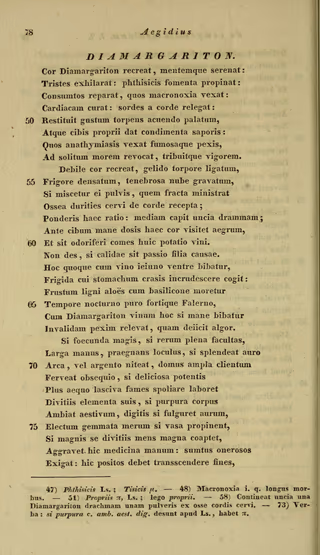
Cor Diamargariton recreat, mentemque serenat:
Tristes exhilarat: phthisicis fomenta propinat:
Consumtos reparat, quos macronoxia vexat:
Cardiacam curat: sordes a corde relegat:
Restituit gustum torpens acuendo palatum,
Atque cibis proprii dat condimenta saporis:
Quos anathymiasis vexat fumosaque pexis,
Ad solitum morem revocat, tribuitque vigorem.
Debile cor recreat, gelido torpore ligatum,
Frigore densatum, tenebrosa nube gravatum,
Si miscetur ei pulvis, quem fracta ministrat
Ossea durities cervi de corde recepta;
Ponderis haec ratio: mediam capit uncia drammam;
Ante cibum mane dosis haec cor visitet aegrum,
Et sit odoriferi comes huic potatio vini.
Non des, si calidae sit passio filia causae.
Hoc quoque cum vino ieiuno ventre bibatur,
Frigida cui stomachum crasis incrudescere cogit:
Frustum ligni aloës cum basilicone moretur
Tempore nocturno puro fortique Falerno,
Cum Diamargariton vinum hoc si mane bibatur
Invalidam pexim relevat, quam deiicit algor.
Si foecunda magis, si rerum plena facultas,
Larga manus, praegnans loculus, si splendeat auro
Arca, vel argento niteat, domus ampla clientum
Ferveat obsequio, si deliciosa potentis
Plus aequo lasciva fames spoliare laboret
Divitiis elementa suis, si purpura corpus
Ambiat aestivum, digitis si fulguret aurum,
Electum gemmata merum si vasa propinent,
Si magnis se divitiis mens magna coaptet,
Aggravet hic medicina manum: sumtus onerosos
Exigat: hic positos debet transscendere fines,
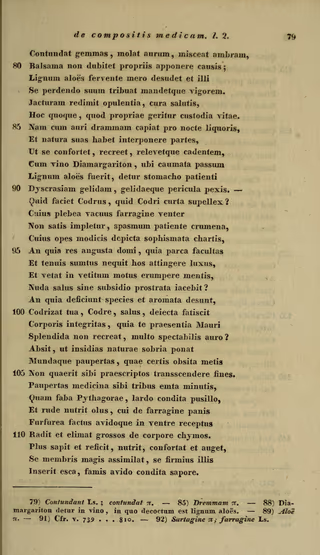
Contundat gemmas, molat aurum, misceat ambram,
Balsama non dubitet propriis apponere causis;
Lignum aloës fervente mero desudet et illi
Se perdendo suum tribuat mandetque vigorem.
Iacturam redimit opulentia, cura salutis,
Hoc quoque, quod propriae geritur custodia vitae.
Nam cum auri drammam capiat pro nocte liquoris,
Et natura suas habet interponere partes,
Ut se confortet, recreet, relevetque cadentem,
Cum vino *Diamargariton*, ubi caumata passum
Lignum aloës fuerit, detur stomacho patienti
Dyscrasiam gelidam, gelidaeque pericula pexis. —
Quid faciet Codrus, quid Codri curta supellex?
Cuius plebea vacuus farragine venter
Non satis impletur, spasmum patiente crumena,
Cuius opes modicis depicta sophismata chartis,
An quia res angusta domi, quia parca facultas
Et tenuis sumtus nequit hos attingere luxus,
Et vetat in vetitum motus erumpere mentis,
Nuda salus sine subsidio prostrata iacebit?
An quia deficiunt species et aromata desunt,
Codrizat tua, Codre, salus, deiecta fatiscit
Corporis integritas, quia te praesentia Mauri
Splendida non recreat, multo spectabilis auro?
Absit, ut insidias naturae sobria ponat
Mundaque paupertas, quae certis obsita metis
Non quaerit sibi praescriptos transscendere fines.
Paupertas medicina sibi tribus emta minutis,
Quam faba Pythagorae, lardo condita pusillo,
Et rude nutrit olus, cui de farragine panis
Furfurea factus avidoque in ventre receptus
Radit et elimat grossos de corpore chymos.
Plus sapit et reficit, nutrit, confortat et auget,
Se membris magis assimilat, se firmius illis
Inserit esca, famis avido condita sapore.
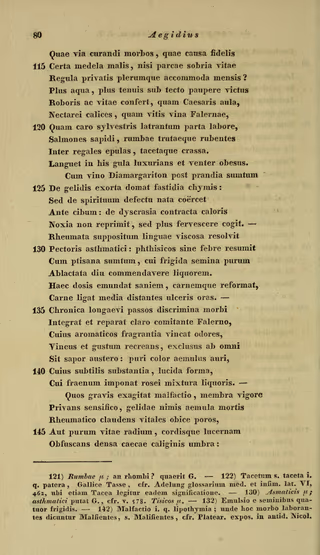
Quae via curandi morbos, quae causa fidelis
Certa medela malis, nisi parcae sobria vitae
Regula privatis plerumque accommoda mensis?
Plus aqua, plus tenuis sub tecto paupere victus
Roboris ac vitae confert, quam Caesaris aula,
Nectarei calices, quam vitis vina Falernae,
Quam caro sylvestris latrantum parta labore,
Salmones sapidi, rumbae trutaeque rubentes
Inter regales epulas, tacetaque crassa.
Languet in his gula luxurians et venter obesus.
Cum vino Diamargariton post prandia sumtum
De gelidis exorta domat fastidia chymis:
Sed de spirituum defectu nata coërcet
Ante cibum: de dyscrasia contracta caloris
Noxia non reprimit, sed plus fervescere cogit. —
Rheumata suppositum linguae viscosa resolvit
Pectoris asthmatici: phthisicos sine febre resumit
Cum ptisana sumtum, cui frigida semina purum
Ablactata diu commendavere liquorem.
Haec dosis emundat saniem, carnemque reformat,
Carne ligat media distantes ulceris oras. —
Chronica longaevi passos discrimina morbi
Integrat et reparat claro comitante Falerno,
Cuius aromaticos fragrantia vincat odores,
Vineus et gustum recreans, exclusus ab omni
Sit sapor austero: puri color aemulus auri,
Cuius subtilis substantia, lucida forma,
Cui fraenum imponat rosei mixtura liquoris. —
Quos gravis exagitat malfactio, membra vigore
Privans sensifico, gelidae nimis aemula mortis
Rheumatico claudens vitales obice poros,
Aut purum vitae radium, cordisque lucernam
Obfuscans densa caecae caliginis umbra:
His *Diamargariton*, morbo cessante, medetur.
Die nihil dandum est, oris medicamina cessent,
Quando suos agit insultus in corpore morbus:
Exsurgat facies roseo perfusa liquore:
Basilicon, mentha, violae, rosa, myrtus amoenos
Naribus aegroti non cessent reddere fumos:
Plena rosis capiti se cervicalia subdant:
Quae tepidum biberit humorem fortis aceti,
Roboret invalidum superaddita spongia pectus,
Visitet extremas moderata fricatio partes:
Involvat perfusus aqua praecordia pannus,
Ut vagus algoris retrusus ab obice sanguis
Interiora petens tribuat solatia cordi.
Pingui pasta oleo subitoque extincta lucerna
Olfactum horribili gravet et contristet odore,
Sensilis ut virtus sternuto mota, sepultam
In cerebri cellis animalem suscitet auram,
Foemina matricis quae compellente querela
Exstasis in raptum rapitur, totiens memoratum
Suscipiat *Diamargariton* regione pudenda,
Quae Veneris sedes, Vulcani fabrica, partus
Janua, qua sorbens hominem lasciva voluptas
Defervere solet: ubi iusta libidinis ira
Frangitur et, primo quae fervida, fine tepescit:
Prodiga quae donis fuerat, quae proflua pactis
Plenaque pollicitis, detenso languida nervo
Alget avaritia: postquam deferbuit ardor
Cessat amor, cadit affectus, dandique voluptas:
Febris abit facta sanie, ruptoque tumore
Tensio laxatur, et solvitur ira caloris:
Quae primo fuerat absorpta libidine carnis,
Damnat opus ratio: sed post, surgente procella
Fit carnis recidiva fames, crescitque bolismus. —
Illibata tenent annis sua iura duobus
Hoc Diamargariton et ei conforme Dianthos.