Hover or tap a word to see its match.
*Dianthos* aids and restores those afflicted by fevers,
tormented for a long time by languor, fugitives from disease.
It rouses weak pexis, strengthens orexis:
It benefits the cardiac, the sorrowful, and the emaciated:
It strengthens the weak, in whom the force of heat is small,
who, clinging to a plank, bare without the garment of vigor,
moved by the gentle breath of moderate virtue,
have already escaped the Charybdis of disease, their ship having been broken.
In what causes it may be expedient, what species of debility
it subverts, there is need for an investigation of the truth;
Heat, coldness, enphraxis, cold humor,
and a defect of spirits causes this: if heat [causes] it
or if a defect of spirits, no grace of *Dianthos*
will come to help: if an enphraxis closing off the ways
denies the spirits return through the limbs
and debilitates the limbs, take it with pure Falernian wine,
to which chosen diuretics have given their powers:
If a cold humor, an ally of cold dyscrasia,
disposes the body to be weak and fatigues it with a flux,
it shall be given with wine, in which mastic,
olibanum, clove, and cinnamon have suffered fires:
If the former cause remains and a looseness of the belly is absent,
let only nutmeg give its vigor to the wine:
Coldness lacking humor, after the gifts of *Dianthos*,
demands that libations of pure wine be offered.
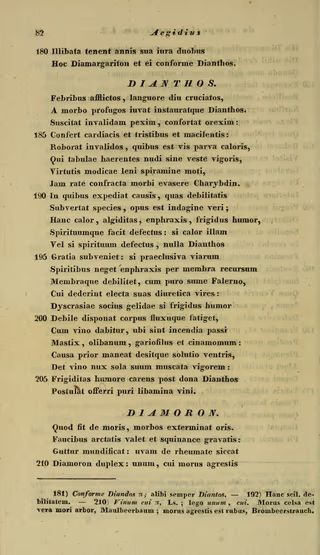
Febribus afflictos, languore diu cruciatos,
A morbo profugos iuvat instauratque Dianthos.
Suscitat invalidam pexim, confortat orexim:
Confert cardiacis et tristibus et macilentis:
Roborat invalidos, quibus est vis parva caloris,
Qui tabulae haerentes nudi sine veste vigoris,
Virtutis modicae leni spiramine moti,
Jam rate confracta morbi evasere Charybdin.
In quibus expediat causis, quas debilitatis
Subvertat species, opus est indagine veri;
Hanc calor, algiditas, enphraxis, frigidus humor,
Spirituumque facit defectus: si calor illam
Vel si spirituum defectus, nulla Dianthos
Gratia subveniet: si praeclusiva viarum
Spiritibus neget enphraxis per membra recursum
Membraque debilitet, cum puro sume Falerno,
Cui dederint electa suas diuretica vires:
Dyscrasiae socius gelidae si frigidus humor
Debile disponat corpus fluxuque fatiget,
Cum vino dabitur, ubi sint incendia passi
Mastix, olibanum, gariofilus et cinamomum:
Causa prior maneat desitque solutio ventris,
Det vino nux sola suum muscata vigorem:
Frigiditas humore carens post dona Dianthos
Postulat offerri puri libamina vini.