Hover or tap a word to see its match.
Lest I stir up bile (I who desire these poems to be free
From all bile), I shall approach the place of the Spleen.
The Spleen makes one laugh; to tell the truth by laughing
Is excellent. Often witty remarks foster many serious matters.
"Therefore, will that to which a turbid abundance of melancholic juice
Is attributed, refresh me with laughter?" you say.
It is so. The juice tinged with blackness that you fear,
None will go, my friend, to overturned homes.
This guest is entirely unknown, believe me, to the Spleen,
And we have other resources of this organ.
But that I may show these, first the fabric of the Spleen,
Which I have just uncovered, comes to be examined.
Its whole substance is cavernous, and it recalls muddy
And soft flesh in its mass and color.
Perhaps these things are in vain? No! Thus the heat presses more fiercely,
And the ample flesh more greatly imbibes the juices.
Nay, it even discharges them from a heavier vessel,
So that all things may finally proceed suitably.
But Nature has prepared a more sloping seat,
So that the Spleen itself might be closer to its source.
What source, what source do you tell me of? I will resolve the riddle:
I mean the splenic vessels which swell with blood;
Of which a vast number and plexus can be seen,
And which seek the interiors of the parenchyma.
A descending Artery supplies these vessels with a remarkable Branch;
Here the origin of the first source gushes forth.
But for the Veins it is enough, for the refluent wave of blood,
Before the Portal, to have soon gaped open with their little doors.
Furthermore, Fibres strengthen the rather soft Parenchyma,
And form pores with a curving knot.
Finally, silvery threads also send enclosed strength,
So that the arranged work may thus be animated.
Go now, and say the Spleen was made in vain,
To which Nature has given so many proofs of her work!
Remove it, if you please, from dogs; would no man
wish to be healthy without a spleen on such terms?
What does this Organ do? I see that you wish to ask,
and rightly so; for the question is not without dispute.
That the Spleen changes chyle into the dew of the blood,
you might indeed find men who have asserted this;
Hence they also said: that chyle is drawn by this organ,
but it is not granted to see any lacteal vessels here.
If any cream flows to it, it is entirely from the fountain of the blood,
nor can it be present except through the small vessels of the Heart.
Perhaps, you will say, the Spleen sucks milky draughts
from the Stomach? The convenient short vessel shows the way.
Thus the Ancients wished, as I said: nay, even among us
this matter could have deserved belief for a long time.
But fictitious communications made the belief doubtful,
with Nature rejecting such paths.
I know well enough that the consensus of the Body is urged here,
nor do I deny that the individual members conspire together;
Yet it does not follow from this that Nature obeys us,
and changes her vast work by an inverted order.
But, whither, they say, does the abundance of urine go,
which those using the hot springs are often wont to produce?
Does not the thirsty Spleen attract the fluid
from the neighboring belly? The nourishing Parent does not love detours.
Let it be so: but you would wrongly call that course a detour,
which the order of Nature has itself established for itself.
Truly! The swift descent of waters which occurs from the Stomach,
and the immediate ascent flowing through the white Vessels,
And the constant labor by which it proceeds to the Emulgentes,
do not much care to approach the channel of the Spleen.
Lest I detain you, let me now finally inquire into the true uses
Of this part, and its office.
All the viscera conspire in the labors of the Heart,
With each supplying its own assistance.
No less does the Spleen itself long to join as an ally,
And to prove the deeds of its devotion to its master.
Hence it receives the thick parts through its domestic vessels,
Which they commonly indicate by the word melancholy;
And soon it dissolves them, thins them, and unites them in turn,
So that they may become a welcome portion of new blood.
With the earthly dregs separated out, the mass exits purer,
And winds its way through the veins to the Liver:
The humor of the blood, carried down to the portal of the Liver,
Is cleansed further, and passes through the pressed filters.
Or here whatever abundance of Serum and Bile overflows at the same time,
Is compelled to go to its designated homes.
Thence it seeks again the Vena Cava by its accustomed path,
And the mass of the bloody fluid approaches the Heart.
And thus at last it returns the deposit with interest,
The Spleen bringing great benefits to the whole.
For when it cooks again the parts, in which a very great innate force
Of earth is present, it makes everything thrive;
But, when the dregs remain in the purple blood,
And the Spleen defrauds the viscera of its influence,
The native light perishes from the spirits, the limbs totter,
And man carries fear around night and day.
Thus the ancient School taught for a long time, and thus you know
That not a few Modern men have determined hitherto;
To whom I would not hesitate to subscribe in some part,
Provided someone is willing to add Salt with me,
And at the same time let the organ acknowledge that it transmits
This acid juice to the liver, without which the bile is sluggish.
The substance consisting of various cells hints at this,
And the many glands, which the organ of the spleen possesses:
Namely, an abundance of its own ferment swells here,
And the spleen everywhere lends allied hands to the liver;
And the work of the blood is pushed forward by a successful impulse,
When the exalted gall simultaneously urges the work on.
Why therefore does the younger generation not readily offer itself
To the ancients, so that it may assist them with new discoveries?
That it will be so, the best hope nourishes me with more than one sign,
Hence also, with Truth winning trust,
The spleen makes one laugh, I repeat: he happily approaches the Saturnian realms,
Who is on good terms with his own spleen!
Ne bilem moveam (qui carmina bile carere
Hæc omni cupio) Splenis adibo locum.
Splen ridere facit; ridendo dicere verum
Præſtat. Sæpè ſales ſeria multa fovent.
Ergò melancholici cui turbida copia ſucci
Debetur,riſu me recreabit? ais.
Sic eſt. quem metuis tinctum nigredine ſuccum,
Nullus ad everſos ibit,amice,lares.
Ignotus planè eſt hic hoſpes,crede,Lieni,
Suntq́ue aliæ nobis viſceris hujus opes.
Has ſed ut oſtendam,primùm tibi fabrica Splenis,
Quam modò detexi,conſpienda venit.
Tota cavernoſa eſt ſubſtantia,quævè lutoſam,
Ac mollem carnem mole, colore, refert.
Forſitan hæc fruſtrà? non! ſic calor acriùs inſtat,
Atq́ue magis ſuccos imbibit ampla caro.
Quin etiam graviore cadô dimittit eosdem,
Omnia quò tandem convenienter eant.
Sed magè declivem ſedem Natura paravit,
Quò propior fonti Splen foret ipſe ſuô.
Quem mihi,quem fontē narras? ænigma reſolvam:
Sanguine quæ turgent ſplenica vaſa puto;
Ingentem quorum numerum,plexumq́ue videre eſt,
Quævè parenchymatis interiora petunt.
Vaſa hæc deſcendens inſigni Arteria Ramô
Suggerit; hîc primi fontis origo ſcatet.
At Venis ſatis eſt,refluentem ſanguinis undam,
Portam ante,oſtiolis mox inhiaſſe ſuis.
Confirmant porrò ſat molle Parenchyma Fibræ,
Et nodô efformant ſe ſinuante poros.
Tandem etiam incluſum mittunt argentea robur
Fila,ut diſpoſitum ſic animetur opus.
I nunc,& fruſtrà factum dic eſſe Lienem,
Cui Natura operæ tot documenta dedit!
Exime, ſi placeat, canibus; ſine ſplene valere
Nullus homo tali conditione velit?
Hoc quid agat Viſcus? Video, te velle rogare,
Et meritò; nec enim quæſtio lite caret.
Sanguinis in rorem chylum mutare Lienem,
Invenias equidem, qui ſtatuêre, viros;
Hinc etiam dixêre: trahi hoc à viſcere chylum,
Lactea ſed nulla heîc cernere vaſa datur.
Sanguinis à fonte eſt, ſi quis cremor affluit, omnis,
Nec niſi per Cordis vaſcula adeſſe poteſt.
Fortè ex Ventriculô, dices, Splen lactea ſugit
Pocula? conveniens vas breve monſtrat iter.
Sic Veteres voluêre, ùt dixi: quin & apud nos
Hæcce diu potuit res meruiſſe fidem.
Sed dubiam fecêre fidem commercia ficta,
Naturâ tales rejiciente vias.
Corporis urgeri heîc conſenſum, ſat benè novi,
Nec, quòd conſpirent ſingula membra, nego;
Inde tamen non eſt, ut nos Natura ſequatur,
Inversôque ingens ordine mutet opus.
At, quorſum, dicunt, urinæ copia pergit,
Thermis utentes quam dare ſæpè ſolent?
Nonne Lien bibulus vicino ex ventre liquorem
Allicit? ambages haut amat alma Parens.
Eſto: ſed ambages curſum malè dixeris illum,
Quem Naturæ ordo condidit ipſe ſibi.
Næ! celer è Stomachô qui fit deſcenſus aquarum,
Aſcenſusque ſtatim Vaſa per alba fluens,
Et labor aſſiduus, quô pergit ad Emulgentes,
Non adeò curant Splenis adire vadum.
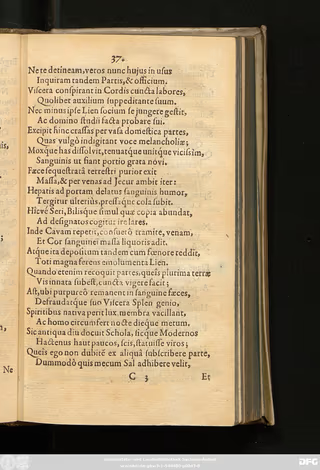
Ne te detineam, veros nunc hujus in uſus
Inquiram tandem Partis, & officium.
Viſcera conſpirant in Cordis cuncta labores,
Quolibet auxilium ſuppeditante ſuum.
Nec minus ipſe Lien ſocium ſe jungere geſtit,
Ac domino ſtudii facta probare ſui.
Excipit hinc craſſas per vaſa domeſtica partes,
Quas vulgò indigitant voce melancholiæ;
Moxq́ue has diſſolvit, tenuatq́ue unitq́ue viciſsìm,
Sanguinis ut fiant portio grata novi.
Fæce ſequeſtratâ terreſtri purior exit
Maſſa, & per venas ad Jecur ambit iter:
Hepatis ad portam delatus ſanguinis humor,
Tergitur ulteriùs, preſſaq́ue cola ſubit.
Hîcvé Seri, Bilísque ſimul quæ copia abundat,
Ad deſignatos cogitur ire lares.
Inde Cavam repetit, conſuetô tramite, venam,
Et Cor ſanguinei maſſa liquoris adit.
Atq́ue ita depoſitum tandem cum fœnore reddit,
Toti magna ferens emolumenta Lien.
Quando etenim recoquit partes, queîs plurima terræ
Vis innata ſubeſt, cuncta vigere facit;
Aſt, ubi purpureô remanent in ſanguine fæces,
Defraudatq́ue ſuo Viſcera Splen genio,
Spiritibus nativa perit lux, membra vacillant,
Ac homo circumfert nocte dieq́ue metum.
Sic antiqua diu docuit Schola, ſicq́ue Modernos
Hactenus haut paucos, ſcis, ſtatuiſſe viros;
Queîs ego non dubitẽ ex aliquâ ſubſcribere parte,
Dummodò quis mecum Sal adhibere velit,
Et ſimul hoc acidum Jecori transmittere ſuccum
Agnoſcat Viſcus, quo ſine Bilis hebet.
Innuit hoc variis conſtans ſubſtantia cellis,
Multaque, quæ Splenis, Glandia, viſcus habet:
Scilicet heîc proprii fermenti copia turget,
Et ſocias Jecori Splen dat ubique manus;
Sanguineusq́ue labor felici truditur actu,
Quando exaltatum Fel ſimul urget opus.
Quin ergò antiquis facilem ſe junior ætas
Præbet, ut inventis hos juvet ipſa novis?
Sic fore, non uno me ſpes alit optuma ſigno,
Hinc etiam, Vero conciliante fidem,
Splen ridere facit, repeto: Saturnia regna,
Cui benè cum proprio eſt Splene, beatus adit!