Hover or tap a word to see its match.
Thus far I have shown the excellent parts, which the first digestion requires,
with what brevity is permitted.
Now also, I shall tell what organs Hæmatosis demands,
and I will enumerate the uses of all of them for you.
It is a difficult labor, I confess, to enclose in meter
names which are less suited to our measures.
Nor is it surprising if by chance that grace is lacking in my words,
by which the love of Phœbus is won.
Outstanding doctrine will compensate for the duty of the song,
and the matter consolidated by new arguments.
Therefore let the Liver, a sufficiently noble Viscus, engage our cares,
and let us experience its various resources.
Look at it uncovered, and marvel at the Parenchyma, to which
no similar part is given in our body.
This part occupies the right belly under the Diaphragma,
and is the great glory of the hypochondriac house.
This surpasses the Spleen both in Hardness and in Mass,
which fear, and which gluttony are often accustomed to change.
Those who cleave the human liver, with Galen leading the way,
thrust upon nature lobes which she herself denies.
I admit a fissure, but the properly called bodies
of lobes, as in animals, I cannot perceive at all.
Behold, three ligaments suspend the various parts of the liver
by a strong connection, so that the burden may rest.
From what has been said, it is clear what its substance is,
and here you can perceive vessels of every kind.
The distinguished portal vein positions itself at the threshold,
to which the vena cava at the same time comes to be joined.
That the roots of these are joined by a silent effort
was an immovable dogma for quite a long time:
But the diligent Glisson persuaded the learned world
of something else, with sight winning belief.
Furthermore, the vein of the umbilicus follows, and the biliary
pore, and the small vessels accustomed to give lymph.
The vessels carrying back the vital juice, and the serum,
you have seen. It is enough. Do you wish to see more?
What care presses upon you? Tell me. Where, then, are the lacteal
vessels? you say. Show them. They are also worthy to be sung.
O good sir! Now in vain do you seek channels as if seen before;
rather, the dewy vessels carry water.
To the spring of the liver no part of the chyle
is carried anymore, nor was any ever carried there.
Once, indeed, the question was agitated by various battles:
where, in the end, might that lacteal path lead?
The goal had been the liver. The more learned world subscribed to this,
and Barthlinus himself gave his assent to it.
Nevertheless, Pecquet called this assent into doubt,
nor could he find such homes here,
Or soon he dared to show the Receptaclum more recently to the world,
And to call us back to a new source.
Truth, the most beautiful Daughter of Time, approached,
And it was like a light to the eyes of Barthlin.
"And look," she said, "you who are a true lover of ours,
The splendid vessels carry not milk, but lymph."
Therefore seeing this, the Man worthy of much honor agreed,
And showed the path of the Milk in a new stream;
And, what Pecquet first in the body of beasts,
He first offered to be seen in the human.
But our Muse has already sufficiently described most of these things before,
It remains that I sing also of the other vessels of the Liver.
An Artery of small bulk, and not large, an offspring
Of the Coeliac branch, seeks the lowest parts of the Liver.
For the organ is warm enough, and the blood is not filled
So completely with dregs; it desired such a work.
For otherwise everything would soon perish from excessive heat,
And the fabric of the house, set on fire, would be no more.
The hollow part has very few Nerves inserted into its membrane,
By which the animal force may be instilled.
Thus from what has been said, he will easily elicit what the Liver does,
To whom such things are usually a care, as is fitting.
Weigh each detail, and ponder the structure in your mind,
By which each canal assists the excellent work:
You will say, here the purification of the blood mass,
With Bile and Serum equally secreted, thrives.
This is the place where a vicarious cooking spontaneously boils,
And constantly extends its ministering hands.
Not at one time, nor the whole mass of blood,
Does it purge, but it continues its journey with a silent step.
And especially these dregs, with which the portal vein is filled,
It deposits, and the remnants of the place.
From here a part of the bile turns to the bladder, and,
Seeking the intestines, rushes where a gate is given.
But a part is driven towards the kidneys, through clear vessels, and finally
Pushed along the paths dedicated to serum.
This work the liver does! Depart, ancient settlers,
Here the mass of blood is not made, but washed.
Now therefore the more learned world gives funeral rites to the liver,
And at the same time the scepters of its empire and its hopes fall.
Learn, mortals, the mockeries of the slippery Goddess,
Nothing is perpetual, nor does it help to have deserved well.
Thus, he who yesterday drew a long furrow under the plowshare,
And dragged strong oxen under the curved yokes,
Today gives laws and rights to the great Latins,
Placing upon chariots the yokes taken from the oxen.
When it pleases Fate to play, the lowly are raised on high,
So that they may fall with a heavier crash.
Bodies are changed, and we will not be tomorrow what we have been and are;
All things flow in a variable course.
Recently the liver had been the renowned king of the blood-flowing world,
And gave laws in the whole body;
Now it sifts the acrid bile through small openings,
And, behold, it stretches out its conquered hands to the heart!
Do not trust too much in the doubtful favor of Fortune;
While Ambition swells, a strange lot falls.
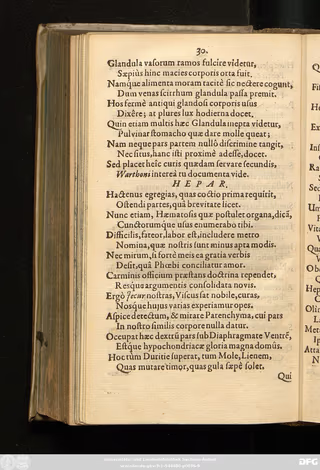
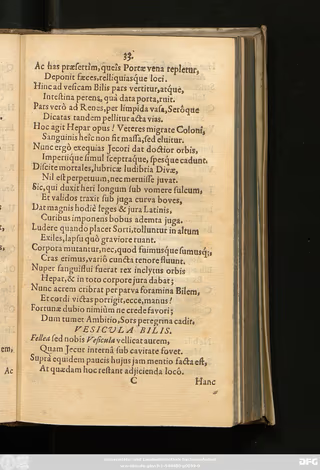
Hactenus egregias, quas coctio prima requirit,
Oſtendi partes, quâ brevitate licet.
Nunc etiam, Hæmatoſis quæ poſtulet organa, dicã,
Cunctorumq́ue uſus enumerabo tibi.
Difficilis, fateor, labor eſt, includere metro
Nomina, quæ noſtris ſunt minus apta modis.
Nec mirum, ſi fortè meis ea gratia verbis
Deſit, quâ Phœbi conciliatur amor.
Carminis officium præſtans doctrina rependet,
Resq́ue argumentis conſolidata novis.
Ergò Jecur noſtras, Viſcus ſat nobile, curas,
Nosq́ue hujus varias experiamur opes.
Aſpice detectum, & mirare Parenchyma, cui pars
In noſtro ſimilis corpore nulla datur.
Occupat hæc dextrũ pars ſub Diaphragmate Ventrẽ,
Eſtq́ue hypochondriacæ gloria magna domûs.
Hoc tùm Duritie ſuperat, tum Mole, Lienem,
Quas mutare timor, quas gula ſæpè ſolet.
Qui *Jecur* humanum findunt, præeunte *Galenô*,
Naturæ obtrudunt, quos negat ipſa, lobos.
Fiſſuram admitto, propriè ſed dicta loborum
Corpora, ùt in brutis, cernere nulla queo.
Hepatis, en, varias nexu tria vincula partes
Suſpendunt validô, quò requieſcat onus.
Ex dictis, hujus quæ ſit ſubſtantia conſtat,
Heîcque omnis generis cernere vaſa potes.
Inſignis Portæ ſe vena in limine ſiſtit,
Cui Cava vena ſimul jam ſocianda venit.
Radices harum tacitô conamine jungi,
Sat longô immotum tempore dogma fuit:
Sedulus aſt aliud docto *Gliſſonius* orbi
Perſuaſit, viſu conciliante fidem.
Umblîci porrò ſuccedit Vena, porusq́ue
Felleus, & Lympham vaſcula ſueta dare.
Vitalem ſuccum revehentia Vaſa, ſerumq́ue,
Vidiſti. Satis eſt. Cernere plura cupis?
Quæ te cura premit? mihi dic. Ubi lactea tandem
Vaſa? ais. oſtende hæc. ſunt quoq́ue digna cani.
O bone! jam fruſtrà quaſi viſos ante canales
Quæris; aquam potiùs rorida vaſa vehunt.
Hepatis ad ſcatebram non ampliùs ulla refertur
Chyli pars, unquam lata nec ulla fuit.
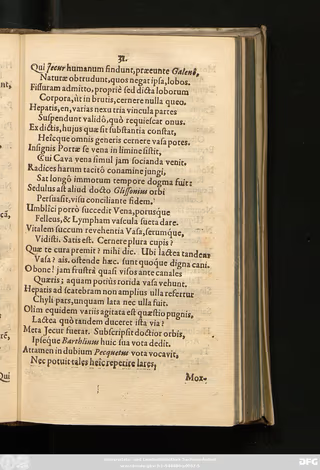
Olìm equidem variis agitata eſt quæſtio pugnis,
Lactea quò tandem duceret iſta via?
Meta *Jecur* fuerat. Subſcripſit doctior orbis,
Ipſéque *Barthlinus* huic ſua vota dedit.
Attamen in dubium *Pecquetus* vota vocavit,
Nec potuit tales heîc reperire lares,
Moxvé Receptaclum monſtrare recentius orbi
Auſus, & ad fontem nos revocare novum.
Temporis acceſſit pulcherrima Filia, Verum,
Et Barthlini oculis luminis inſtar erat.
Tuq́ue vide, dixit, noſtri es qui verus amator,
Non lac, ſed lympham ſplendida vaſa vehunt.
Annuit ergò videns, Vir multô dignus honore,
Oſtenditq́ue novô gurgite Lactis iter ;
Et, quæ Pecquetus brutorum in corpore primus,
Primus in humanô conſpicienda dedit.
Noſtra ſed antè ſatis deſcripſit pleraq́ue Muſa,
Reſtat ut & Jecoris cætera vaſa canam.
Exiguæ molis, nec multa Arteria, Rami
Cœliaci ſoboles, Hepatis ima petit.
Nempè ſatis calidum viſcus, neque fæce repletus
Uſque adeò ſanguis, tale volebat opus.
Namq́ue aliàs nimiô mox cuncta calore perirent,
Accenſæq́ue domus fabrica, nulla foret.
Membranæ inſertos perpaucos pars cava Nervos,
Queîs inſtilletur vis animalis, habet.
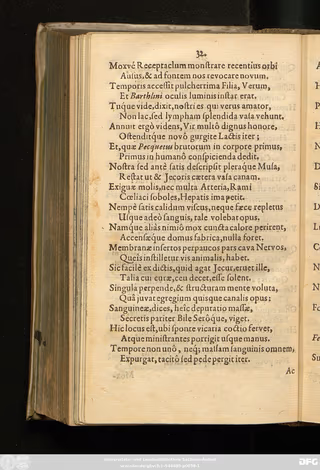
Sic facilè ex dictis, quid agat Jecur, eruet ille,
Talia cui curæ, ceu decet, eſſe ſolent.
Singula perpende, & ſtructuram mente voluta,
Quâ juvat egregium quisque canalis opus:
Sanguineæ, dices, heîc depuratio maſſæ,
Secretis pariter Bile Serôque, viget.
Hic locus eſt, ubi ſponte vicaria coctio fervet,
Atque miniſtrantes porrigit uſque manus.
Tempore non unô, neq́; maſſam ſanguinis omnem,
Expurgat, tacitô ſed pede pergit iter.
Ac has præſertìm, queîs Portæ vena repletur,
Deponit fæces, relliquiaśque loci.
Hinc ad veſicam Bilis pars vertitur, atquè,
Inteſtina petens, quà data porta, ruit.
Pars verò ad Renes, per limpida vaſa, Serôque
Dicatas tandem pellitur acta vias.
Hoc agit Hepar opus! Veteres migrate Coloni,
Sanguinis heîc non fit maſſa, ſed eluitur.
Nunc ergò exequias Jecori dat doctior orbis,
Imperiíque ſimul ſceptráque, ſpeśque cadunt.
Diſcite mortales, lubricæ ludibria Divæ,
Nil eſt perpetuum, nec meruiſſe juvat.
Sic, qui duxit heri longum ſub vomere ſulcum,
Et validos traxit ſub juga curva boves,
Dat magnis hodiè leges & jura Latinis,
Curibus imponens bobus ademta juga.
Ludere quando placet Sorti, tolluntur in altum
Exiles, lapſu quò graviore ruant.
Corpora mutantur, nec, quod fuimuśque ſumusq́;,
Cras erimus, variô cuncta tenore fluunt.
Nuper ſanguiflui fuerat rex inclytus orbis
Hepar, & in toto corpore jura dabat;
Nunc acrem cribrat per parva foramina Bilem,
Et cordi victas porrigit, ecce, manus!
Fortunæ dubio nimiùm ne crede favori;
Dum tumet Ambitio, Sors peregrina cadit.