Hover or tap a word to see its match.
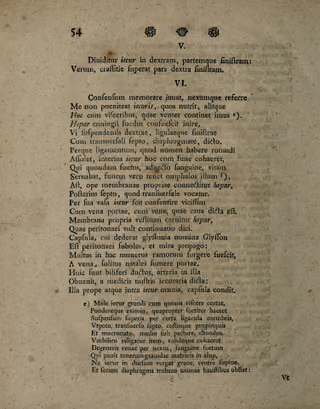
VI.
It is pleasing to recount the sympathy, and let it not repent me
To relate the connection of the liver—those ties which it nourishes and sustains—
With the viscera which the lowest belly contains e).
The liver is accustomed to enter into a bond of marriage,
By the force of the right and left suspensory ligament,
With the transverse septum, called the diaphragm.
And through the ligament which is accustomed to have the name
Of round, this liver coheres inwardly with the cord
Which once preserved the life of the fetus by conveying blood;
Indeed, the navel holds that cord f),
But, by the aid of its proper membrane, the liver is connected
Posteriorly to the septum which is called transverse.
Through its own vessels the liver knows how to sympathize in turn
With the portal vein, and with the vein which is called the vena cava.
The liver is seen clothed in its proper membrane,
Which wishes to be called a continuation of the peritoneum.
The capsule, to which Glisson had given the Glissonian name,
Is the offspring of the peritoneum, and its wondrous shoot:
A great number of branches is accustomed to arise in this,
Wont to take their origin from the portal vein.
To this belong the bile-bearing ducts; in it occurs the artery,
Called the hepatic by our physicians:
That capsule encloses all things near and within the liver.
Consensum memorare iuuat, nexumque referre
Me non poeniteat iecoris, quos nutrit, alitque
Hoc cum visceribus, quae venter continet imus e).
Hepar coniugii foedus consuescit inire,
Vi suspendentis dextrae, ligulaeque sinistrae
Cum transuersali septo, diaphragmate, dicto.
Perque ligamentum, quod nomen habere rotundi
Assolet, interius iecur hoc cum fune cohaeret,
Qui quondam foetus, aduecto sanguine, vitam
Seruabat, funem vero tenet omphalos illum f),
Ast, ope membranae propriae connectitur hepar,
Posterius septo, quod transuersale vocatur.
Per sua vasa iecur scit consentire vicissim
Cum vena portae, cum vena, quae caua dicta est.
Membrana propria vestitum cernitur hepar,
Quae peritonaei vult continuatio dici.
Capsula, cui dederat glyssonia nomina Glysson
Est peritonaei soboles, et mira propago:
Multus in hac numerus ramorum surgere suescit,
A vena, solitus natales sumere portae.
Huic sunt biliferi ductus, arteria in illa
Obuenit, a medicis nostris iecoraria dicta:
Illa prope atque intra iecur omnia, capsula condit.