Hover or tap a word to see its match.
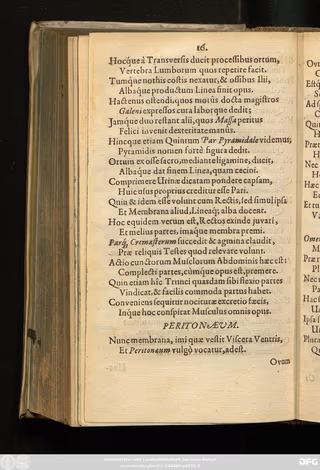
Now the membrane, which clothes the viscera of the lowest belly,
And is commonly called the Peritoneum, is present.
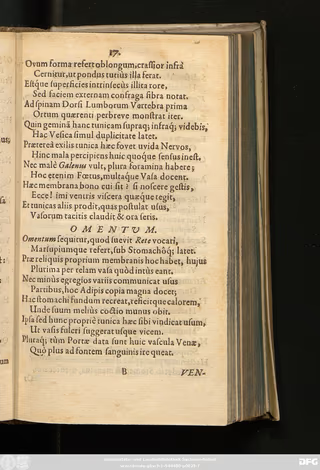
In shape it resembles an oblong egg; below it is seen
To be thicker, so that it may bear the weight more safely.
And its inner surface is moistened with dew,
But an uneven fibre marks its outer face.
At the spine of the back, the first vertebra of the loins
Shows a very short path to one seeking its origin.
Indeed, you will see this tunic is double both above and below;
By this doubling the Bladder is simultaneously concealed.
Furthermore, this thin, damp tunic nurtures the Nerves,
Hence, perceiving ills, it too possesses sensation.
Nor is Galen wrong in claiming it has many openings;
For the Fetus and the many Vessels prove this.
For what good is this membrane? If you desire to know,
Behold! it covers all the viscera of the lower belly,
And provides tunics for the others, as necessity requires,
And shuts the mouths of the vessels with silent locks.
Nunc membrana, imi quæ veſtit Viſcera Ventris,
Et Peritonæum vulgò vocatur, adeſt.
Ovum forma refert oblongum, craſſior infrà
Cernitur, ut pondus tutiùs illa ferat.
Eſtque ſuperficies intrinſecùs illita rore,
Sed faciem externam confraga fibra notat.
Ad ſpinam Dorſi Lumborum Vertebra prima
Ortum quærenti perbreve monſtrat iter.
Quin geminã hanc tunicam ſupraq; infràq; videbis,
Hac Veſica ſimul duplicitate latet.
Prætereà exilis tunica hæc fovet uvida Nervos,
Hinc mala percipiens huic quoque ſenſus ineſt.
Nec malè Galenus vult, plura foramina habere;
Hoc etenim Fœtus, multaque Vaſa docent.
Hæc membrana bono cui ſit ? ſi noſcere geſtis,
Ecce! imi ventris viſcera quæque tegit,
Et tunicas aliis prodit, quas poſtulat uſus,
Vaſorum tacitis claudit & ora ſeris.