Hover or tap a word to see its match.
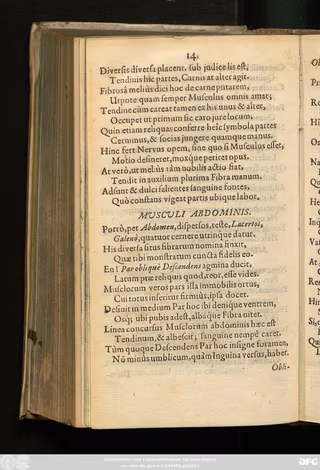
Furthermore, dispersed through the abdomen, as Galen bears witness,
It is granted to see four muscles on each side.
The situation of the fibres has fashioned different names for these,
All of which I faithfully proceed to point out to you.
Behold! The obliquely descending pair leads the troops,
Which you see, I suppose, to be broad beyond the rest.
That immobile part, to which the fleshy bulk is more firmly inserted,
Itself teaches the true origins of the muscles.
This pair finally ends there in the middle of the belly,
And where the pubic bone is present, and the white fibre shines.
This is the line of meeting of the tendons of the muscles of the abdomen,
And it grows white; for indeed it lacks blood.
Then too this descending pair has a notable hole,
No less towards the navel, than towards the groins.
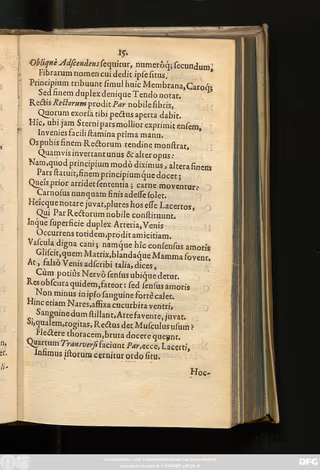
The Obliquely Ascending follows, and second in number,
to which the very position of the fibres has given its name.
A Membrane, and Flesh together give it its beginning;
but finally a double Tendon marks its end.
The noble Pair of the Straight [muscles] comes forth with straight fibres,
whose open beginnings the chest will give you.
Here, where the softer part of the Sternum already portrays a sword,
you will find the first threads with an easy hand.
The pubic bone shows the end of the Straight [muscles] with a tendon,
although one or another may invert the work:
For what we just called the beginning, the other party
determines as the end, and teaches the end as the beginning;
To them the former opinion appeals; they are set in motion by flesh:
a fleshy end is never wont to be present.
And here it is pleasing to note, that these are multiple muscles,
which constitute the noble Pair of the Straight [muscles].
And on the surface a double Artery, meeting
as many Veins, reveals a friendship.
Little vessels worthy to be sung; for here a consensus of love
swells, which the Womb, and the soothing Breast foster.
But, you will say, such things are falsely ascribed to the Veins,
since sensation is rather everywhere given by a Nerve.
An obscure matter indeed, I confess: but the sensation of love
perhaps burns no less in the blood itself.
Hence also, while the nostrils drip with blood, a cupping-glass
affixed to the belly helps, with Art favouring.
If you ask, what use the Straight Muscle provides?
Brutes can teach [us] to bend the thorax.
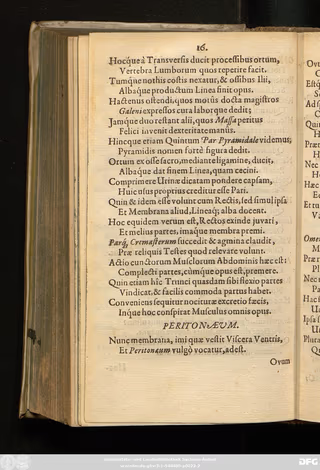
Behold, the Transverse muscles make the fourth Pair,
the lowest order of them is seen by position.
And this takes its origin from the transverse processes,
Which the vertebra of the loins allows one to find.
And then it is bound to the false ribs, and the bones of the ilium,
And the Linea Alba finishes the extended work.
Thus far I have shown the masters of motion,
Whom the learned care and labor of Galen provided, fully described;
And now two others remain, which the skilled Massa
Found with the happy dexterity of his hand.
And hence also we see the fifth pair, the Pyramidal;
Its shape perhaps gave it the name of a pyramid.
It draws its origin from the sacrum bone, by means of a mediating ligament,
And the Linea Alba, which I have sung of, gives it an end.
To compress by its weight the receptacle dedicated to urine,
Is believed to be the proper use for this pair.
Furthermore, they claim it is the same as the straight muscles, but at the same time both the
Membrane itself and the linea alba teach otherwise.
This indeed is true, that the straight muscles are assisted by it,
And the parts, and the lowest members, are better pressed.
And the pair of the Cremasters follows and closes the ranks,
Which they claim elevates the testicles above the rest.
The action of all the muscles of the abdomen is this:
To embrace the parts, and when there is need, to press them.
Moreover, here the bending of the trunk claims certain roles for itself,
And holds the advantages of an easy birth.
A fitting excretion of harmful feces follows,
And every muscle conspires in this work.
Porrò, per Abdomen, diſperſos, teſte, Lacertos,
Galenô, quatuor cernere utrinque datur.
His diverſa ſitus fibrarum nomina finxit,
Quæ tibi monſtratum cuncta fidelis eo.
En! Par obliquè Deſcendens agmina ducit,
Latum præ reliquis quod, reor, eſſe vides.
Muſclorum veros pars illa immobilis ortus,
Cui torus inſeritur firmiùs, ipſa docet.
Deſinit in medium Par hoc ibi denique ventrem,
Osq́; ubi pubis adeſt, albaq́ue Fibra nitet.
Linea concurſus Muſclorum abdominis hæc eſt
Tendinum, & albeſcit; ſanguine nempè caret.
Tùm quoque Deſcendens Par hoc inſigne foramen,
Nó minùs umblicum, quàm Inguina verſus, habet.
Obliquè Adſcendens ſequitur, numerôq́; ſecundum,
Fibrarum nomen cui dedit ipſe ſitus.
Principium tribuunt ſimul huic Membrana, Caroq́;
Sed finem duplex denique Tendo notat.
Rectis Rectorum prodit Par nobile fibris,
Quorum exorſa tibi pectus aperta dabit.
Hîc, ubi jam Sterni pars mollior exprimit enſem,
Invenies facili ſtamina prima manu.
Os pubis finem Rectorum tendine monſtrat,
Quamvis invertant unus & alter opus:
Nam, quod principium modò diximus, altera finem
Pars ſtatuit, finem principiumq́ue docet;
Queîs prior arridet ſententia; carne moventur:
Carnoſus nunquam finis adeſſe ſolet.
Heîcque notare juvat, plures hos eſſe Lacertos,
Qui Par Rectorum nobile conſtituunt.
Inq́ue ſuperficie duplex Arteria, Venis
Occurrens totidem, prodit amicitiam.
Vaſcula digna cani; namq́ue hîc conſenſus amoris
Gliſcit, quem Matrix, blandaq́ue Mamma fovent.
At, falsò Venis adſcribi talia, dices,
Cùm potiùs Nervô ſenſus ubiq́ue detur.
Res obſcura quidem, fateor: ſed ſenſus amoris
Non minus in ipſo ſanguine fortè calet.
Hinc etiam Nares, affixa cucurbita ventri,
Sanguine dum ſtillant, Arte favente, juvat.
Si, qualem, rogitas, Rectus det Muſculus uſum?
Flectere thoracem, bruta docere queunt.
Quartum Transverſi faciunt Par, ecce, Lacerti,
Infimus iſtorum cernitur ordo ſitu.
Hocq́ue à Transverſis ducit proceſſibus ortum,
Vertebra Lumborum quos reperire facit.
Tumq́ue nothis coſtis nexatur, & oſſibus Ilii,
Albaq́ue productum Linea finit opus.
Hactenus oſtendi, quos motûs docta magiſtros
Galeni expreſſos cura laborque dedit;
Jamq́ue duo reſtant alii, quos Maſſa peritus
Felici invenit dexteritate manûs.
Hincque etiam Quintum Par Pyramidale videmus;
Pyramidis nomen fortè figura dedit.
Ortum ex oſſe ſacro, mediante ligamine, ducit,
Albaq́ue dat finem Linea, quam cecini.
Comprimere Urinæ dicatam pondere capſam,
Huic uſus proprius creditur eſſe Pari.
Quin & idem eſſe volunt cum Rectis, ſed ſimul ipſa
Et Membrana aliud, Lineaq́; alba docent.
Hoc equidem verum eſt, Rectos exinde juvari,
Et meliùs partes, imaq́ue membra premi.
Parq́; Cremaſterum ſuccedit & agmina claudit,
Præ reliquis Teſtes quod relevare volunt.
Actio cunctorum Muſclorum Abdominis hæc eſt:
Complecti partes, cùmque opus eſt, premere.
Quin etiam hîc Trunci quasdam ſibi flexio partes
Vindicat, & facilis commoda partus habet.
Conveniens ſequitur nocituræ excretio fæcis,
Inq́ue hoc conſpirat Muſculus omnis opus.