Hover or tap a word to see its match.
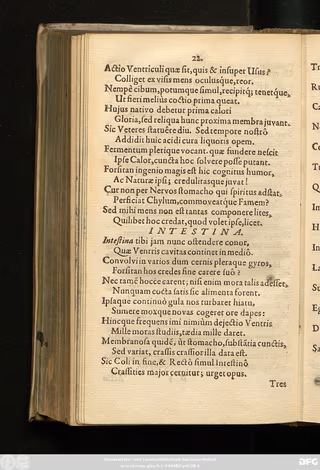
Now I attempt to show you the intestines,
Which the cavity of the belly contains in its midst.
While you see most of them coiled into various convolutions,
Perhaps you believe they lack their own purpose?
Yet they do not lack it; for if such a delay were not present,
The food would never be sufficiently digested.
And the gullet itself would continually trouble us with its gaping,
And would soon compel us to consume new meals by mouth:
And hence the too frequent voiding of the lower belly
Would cause a thousand interruptions to studies, and a thousand wearinesses.
A membranous substance, indeed, is given to all, as to the stomach,
But it varies, a thicker one is assigned to the thick ones.
Thus at the end of the colon, and likewise in the Rectum,
A greater thickness is seen; the work demands it.
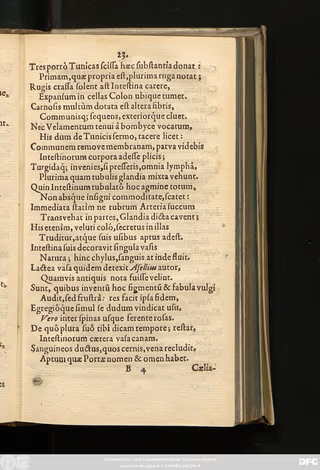
Furthermore, this cut substance yields three tunics:
Many a fold marks the first, which is the proper one;
But the thick intestines usually lack folds,
And the colon, expanded into cells, swells everywhere.
The second is richly endowed with fleshy fibers,
And the next is known as the common and outer one.
Nor is it permitted to be silent about the covering named from fine silk,
While there is discourse concerning these tunics:
Remove the common membrane, and you will see that small
Bodies are present in the folds of the intestines;
And you will find them all, if you press them, swollen with lymph,
Which very many glands mixed with little tubes convey.
Indeed, the whole intestine abounds with this tubular host,
Not without remarkable advantage:
Lest the artery straightway convey the red juice directly
Into the parts, the said glands take care;
For by these, as by a strainer, having been separated it is thrust
Into them, and is present fit for its uses.
Nature has adorned the individual intestines with their own vessels;
Hence flows the chyle, but from there the blood.
The author Asellius indeed discovered the lacteal vessels,
Although they would have it that they were known to the ancients.
There are those to whom this discovery is called a fiction and a fable of the crowd,
But in vain: the thing itself creates belief,
And at the same time it has long vindicated itself by its excellent use,
With truth ever bearing roses among the thorns.
Of which I shall tell you more at its proper time; it remains
That I sing of the other vessels of the intestines.
A vein reveals the sanguineous ducts, which you see,
Which has the fitting name and omen of the Porta.
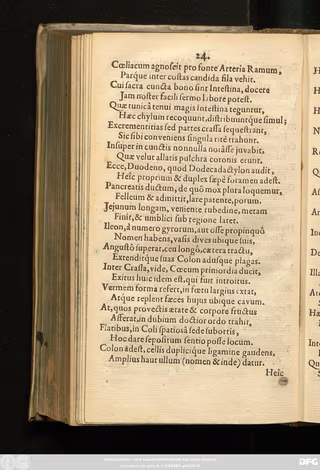
The Artery acknowledges the Celiac Branch as its source,
And the pair between the ribs carries white threads.
To what good all the Intestines are dedicated, to teach
Our discourse can now with easy effort.
Those Intestines which are covered by a thinner tunic,
These digest the chyle again, and simultaneously distribute it;
But the thick ones separate out the excrementitious parts,
Thus each duly draws what is suitable for itself.
Moreover, it will be helpful to have noted some things in all of them,
Which will be beautiful, like added crowns.
Behold, in the Duodenum, which is called the Dodecadactylon,
Here there is often a proper and double opening.
The duct of the Pancreas, of which we will soon speak more,
And the biliary pore it admits, with an open dwelling.
The Jejunum, as redness comes, its long boundary
Finishes, and lies hidden beneath the region of the umbilicus.
The Ileon, from the number of its coils, or from the nearby bone
Having its name, rich everywhere in its own vessels,
Surpasses the others in its narrow, as well as long, tract,
And extends its reaches all the way to the Colon.
Among the Thick, see, the Cæcum takes its beginnings,
The exit for this is the same as was the entrance.
In shape it resembles a worm, in the fetus it stands out more largely,
And feces fill its cavity everywhere.
But what fruits it brings to those advanced in age and body,
The more learned order draws into doubt.
For flatus, arisen in the spacious seat of the Colon,
I feel that this can provide a set-aside place.
The Colon is present, rejoicing in its cells and a double ligament,
None other is given that is wider (and from thence its name).
Here colic pain presses with remarkable torment,
And the distended enclosures sound with a heavy murmur.
In its beginnings, and above the opening of the cecum,
A sufficiently thick valve is seen further inside.
This prevents the constipation of a hard belly,
Or any force of excreting from bringing harm.
For otherwise, flatus and feces would be able to return,
And vomiting of dung could follow from there.
There remains what from the extended path of the rectum its name
Obtains; here, behold! a double sphincter is also present.
Or that which, impacted in the skin, is mostly called Cutaneous,
And occupies the outermost regions of the fundament;
But the other, joined to the parts of the sacred bone,
Being broader, has its name from there.
As a ring on the fingers, so it is drawn around the anus,
Lest the burden of the belly fall out also against our will.
And into its own seat, the anus which the lifting muscle
Has drawn apart, the sphincter draws from both sides.
Finally, mention must be made of the vessels, which a portion
Of the portal vein sends, or which of the vena cava:
That internal one indeed is transferred into the tunics themselves,
But the exterior one is scattered to the muscles of the anus.
And an artery associates itself with these veins; the lowest
Marrow of the spine has given sufficiently small nerves.
These are the things which it pleased to add to the remaining sayings,
So that the intestines would be more known to you.
Inteſtina tibi jam nunc oſtendere conor,
Quæ Ventris cavitas continet in mediô.
Convolvi in varios dum cernis pleraque gyros,
Forſitan hos credes fine carere ſuô?
Nec tamẽ hocce carent; niſi enim mora talis adeſſet,
Nunquam cocta ſatis ſic alimenta forent.
Ipſaque continuò gula nos turbaret hiatu,
Sumere moxque novas cogeret ore dapes:
Hincque frequens imi nimiùm dejectio Ventris
Mille moras ſtudiis, tædia mille daret.
Membranoſa quidẽ, ùt ſtomacho, ſubſtãtia cunctis,
Sed variat, craſſis craſſior illa data eſt.
Sic Coli in fine, & Rectô ſimul Inteſtinô
Craſſities major cernitur; urget opus.
Tres porrò Tunicas ſciſſa hæc ſubſtantia donat :
Primam, quæ propria eſt, plurima ruga notat ;
Rugis craſſa ſolent aſt Inteſtina carere,
Expanſum in cellas Colon ubique tumet.
Carnoſis multùm dotata eſt altera fibris,
Communisq́; ſequens, exteriorq́ue cluet.
Nec Velamentum tenui à bombyce vocatum,
His dum de Tunicis ſermo, tacere licet :
Communem remove membranam, parva videbis
Inteſtinorum corpora adeſſe plicis;
Turgidaq́; invenies, ſi preſſeris, omnia lymphâ,
Plurima quam tubulis glandia mixta vehunt.
Quin Inteſtinum tubulatô hoc agmine totum,
Non absq́ue inſigni commoditate, ſcatet :
Immediata ſtatim ne rubrum Arteria ſuccum
Transvehat in partes, Glandia dicta cavent;
His etenìm, veluti colô, ſecretus in illas
Truditur, atq́ue ſuis uſibus aptus adeſt.
Inteſtina ſuis decoravit ſingula vaſis
Natura ; hinc chylus, ſanguis at inde fluit.
Lactea vaſa quidem detexit Aſellius autor,
Quamvis antiquis nota fuiſſe velint.
Sunt, quibus inventū hoc figmentū & fabula vulgi
Audit, ſed fruſtrà: res facit ipſa fidem,
Egregiôque ſimul ſe dudum vindicat uſu,
Vero inter ſpinas uſque ferente roſas.
De quô plura ſuô tibi dicam tempore; reſtat,
Inteſtinorum cætera vaſa canam.
Sanguineos ductus, quos cernis, vena recludit,
Aptum quæ Portæ nomen & omen habet.
Cœliacum agnoſcit pro fonte Arteria Ramum,
Parq́ue inter coſtas candida fila vehit.
Cui ſacra cuncta bono ſint Inteſtina, docere
Jam noſter facili ſermo labore poteſt.
Quæ tunicâ tenui magis Inteſtina teguntur,
Hæc chylum recoquunt, diſtribuuntq́ue ſimul;
Excrementitias ſed partes craſſa ſequeſtrant,
Sic ſibi conveniens ſingula ritè trahunt.
Inſuper in cunctis nonnulla notâſſe juvabit,
Quæ velut allatis pulchra coronis erunt.
Ecce, Duodeno, quod Dodecadactylon audit,
Heîc proprium & duplex ſæpè foramen adeſt.
Pancreatis ductum, de quô mox plura loquemur,
Felleum & admittit, lare patente, porum.
Jejunum longam, veniente rubedine, metam
Finit, & umblici ſub regione latet.
Ileon, à numero gyrorum, aut oſſe propinquô
Nomen habens, vaſis dives ubique ſuis,
Anguſtô ſuperat, ceu longô, cætera tractu,
Extenditq́ue ſuas Colon aduſque plagas.
Inter Craſſa, vide, Cæcum primordia ducit,
Exitus huic idem eſt, qui fuit introitus.
Vermem forma refert, in fœtu largius extat,
Atq́ue replent fæces hujus ubique cavum.
At, quos provectis ætate & corpore fructus
Afferat, in dubium doctior ordo trahit.
Flatibus, in Coli ſpatiosâ ſede ſubortis,
Hoc dare ſepoſitum ſentio poſſe locum.
Colon adeſt, cellis dupliciq́ue ligamine gaudens,
Amplius haut ullum (nomen & inde) datur.
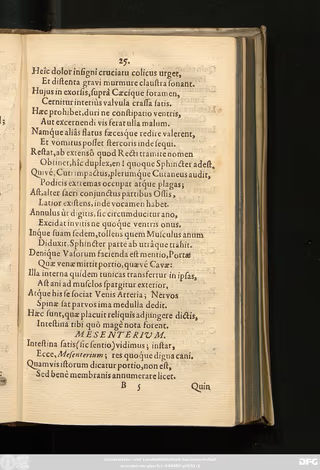
Heîc dolor inſigni cruciatu colicus urget,
Et diſtenta gravi murmure clauſtra ſonant.
Hujus in exorſis, ſuprà Cæcique foramen,
Cernitur interiùs valvula craſſa ſatis.
Hæc prohibet, duri ne conſtipatio ventris,
Aut excernendi vis ferat ulla malum.
Namq́ue aliâs flatus fæcesq́ue redire valerent,
Et vomitus poſſet ſtercoris inde ſequi.
Reſtat, ab extensô quod Recti tramite nomen
Obtinet, hîc duplex, en! quoque Sphincter adeſt.
Quivè, Cuti impactus, plerumq́ue Cutaneus audit,
Podicis extremas occupat atq́ue plagas;
Aſt, alter ſacri conjunctus partibus Oſſis,
Latior exiſtens, inde vocamen habet.
Annulus ùt digitis, ſic circumducitur ano,
Excidat invitis ne quoq́ue ventris onus.
Inq́ue ſuam ſedem, tollens quem Muſculus anum
Diduxit, Sphincter parte ab utrâque trahit.
Deniq́ue Vaſorum facienda eſt mentio, Portæ
Quæ venæ mittit portio, quævè Cavæ:
Illa interna quidem tunicas transfertur in ipſas,
Aſt ani ad muſclos ſpargitur exterior.
Atq́ue his ſe ſociat Venis Arteria; Nervos
Spinæ ſat parvos ima medulla dedit.
Hæc ſunt, quæ placuit reliquis adjungere dictis,
Inteſtina tibi quò magè nota forent.