Hover or tap a word to see its match.
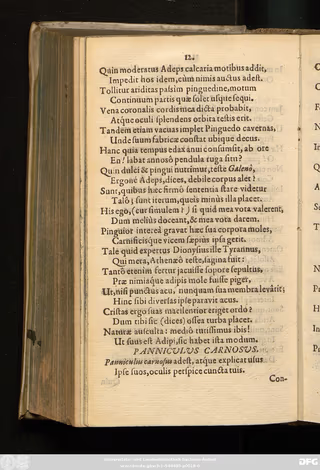
The panniculus carnosus is present, and itself explains its
Uses; examine everything with your own eyes.
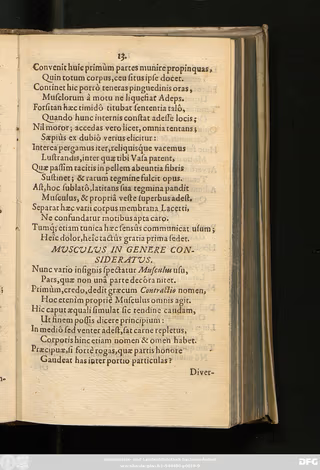
It is fitting for this first to fortify the nearby parts,
Indeed the whole body, as its very location teaches.
Furthermore, it confines the tender margins of the fat,
Lest the fat melt from the movement of the muscles.
Perhaps this opinion totters on a timid heel,
Since it is known to be present in internal places;
I make no objection; you may approach the truth, testing all things;
More often the truer thing is drawn out from doubt:
Meanwhile let us continue our journey, and devote time to the rest
That must be surveyed, among which the vessels lie open to you,
Which, passing here and there into the skin with silent fibers,
It supports; and props up the porous structure with a covering.
But, when this is removed, the hidden muscle spreads its coverings,
And is proudly present in its own garment.
This membrane separates the body of the various muscle,
Lest the flesh suited for movements be thrown into confusion.
And then also this tunic imparts the use of sensation;
Here pain, here the foremost grace of touch resides.
Panniculus carnoſus adeſt, atq́ue explicat uſus
Ipſe ſuos, oculis perſpice cuncta tuis.
Convenit huic primùm partes munire propinquas,
Quin totum corpus, ceu ſitus ipſe docet.
Continet hic porrò teneras pinguedinis oras,
Muſclorum à motu ne liquefiat Adeps.
Forſitan hæc timidô titubat ſententia talô,
Quando hunc internis conſtat adeſſe locis;
Nil moror; accedas vero licet, omnia tentans;
Sæpiùs ex dubiô verius elicitur :
Interea pergamus iter, reliquisq́ue vacemus
Luſtrandis, inter quæ tibi Vaſa patent,
Quæ paſſim tacitis in pellem abeuntia fibris
Suſtinet; & rarum tegmine fulcit opus.
Aſt, hoc ſublatô, latitans ſua tegmina pandit
Muſculus, & propriâ veſte ſuperbus adeſt.
Separat hæc varii corpus membrana Lacerti,
Ne confundatur motibus apta caro.
Tumq́; etiam tunica hæc ſensûs communicat uſum;
Heîc dolor, heîc tactûs gratia prima ſedet.