Hover or tap a word to see its match.
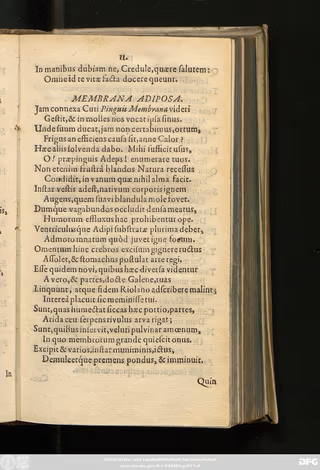
Now the Fat Membrane, connected to the Skin, longs to be seen,
and calls us itself into its soft folds.
We shall not dispute now whence it derives its origin,
whether cold is the efficient cause, or heat?
I shall give these matters to others to solve. It is enough for me
to enumerate your uses, O exceedingly rich Fat!
For not in vain did nourishing Nature build pleasant recesses,
she who does nothing in vain.
It is present like a garment, increasing the native fire of the body,
which it soothingly fosters with its pleasant mass.
And while, dense as it is, it closes off wandering passages,
the outflows of humors are prevented by this aid.
And the stomach owes very much to the underlying Fat,
because it assists the innate hearth with an applied fire.
Hence the omentum, when cut out, is wont to produce frequent belches,
and the stomach requires to be covered by art.
I know indeed that there are those to whom these things seem different
from the truth, and who abandon your side, learned Galen,
and prefer to assign their trust to Riolan;
meanwhile it has pleased me to remember you thus.
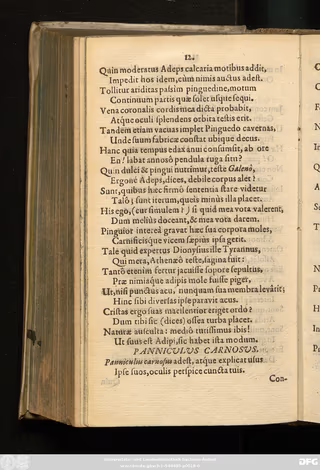
There are dry parts which this portion moistens,
just as a winding stream waters parched fields;
There are those it serves as a pleasant cushion,
upon which the great burden of the limbs rests.
It also receives various blows, like a fortification,
and softens the pressing weight, and lessens it.
But a moderate amount of fat adds spurs to movements,
The same hinders them, when it is present too greatly increased.
Dryness is removed everywhere by fat, which usually
Constantly follows the continuous movement of a part.
The coronal vein of the heart will prove my words,
And the shining orbit of the eye will be a witness.
Finally, fat also fills empty cavities,
Whence the structure's own beauty is evident everywhere.
Because devouring time has consumed this in an old woman, from her face
Behold! does a hanging wrinkle sag in age-old decay?
Furthermore, we are nourished by sweet and fatty things, with Galen as a witness,
Therefore, you will say, does fat nourish a weak body?
There are those to whom this opinion seems to stand on a firm
Footing; there are others again, to whom it is less pleasing.
To these I, (why should I pretend?) if my votes had any weight,
Would also give my votes, until they teach better.
Meanwhile, this fatter mass burdens its bodies,
And quite often plays the part of an executioner.
Such a thing was experienced by that tyrant Dionysius,
Who, as Athenaeus bears witness, was sheer fat:
For he is said to have lain buried in so deep a lethargy,
And to have been sluggish on account of the excessive mass of fat,
That, unless pricked with a needle, he would never have lifted his limbs;
Hence he procured various needles for himself.
Will the leaner rank therefore raise its crests?
While thus (you will say) the bony crowd pleases you.
Listen to Nature: you will go safest in the middle!
As fat has its own limit, so does that condition have its measure.
Jam connexa Cuti Pinguis Membrana videri
Geſtit, & in molles nos vocat ipſa ſinus.
Unde ſuum ducat, jam non certabimus, ortum,
Frigus an efficiens cauſa ſit, anne Calor?
Hæc aliis ſolvenda dabo. Mihi ſufficit uſus,
O! præpinguis Adeps! enumerare tuos.
Non etenim fruſtrà blandos Natura receſſus
Condidit, in vanum quæ nihil alma facit.
Inſtar veſtis adeſt, nativum corporis ignem
Augens, quem ſuavi blandula mole fovet.
Dumq́ue vagabundos occludit denſa meatus,
Humorum effluxus hac prohibentur ope.
Ventriculusq́ue Adipi ſubſtratæ plurima debet,
Admoto innatum quòd juvet igne focum.
Omentum hinc crebros exciſum gignere ructus
Aſſolet, & ſtomachus poſtulat arte tegi.
Eſſe quidem novi, quibus hæc diverſa videntur
A vero, & partes, docte Galene, tuas
Linquunt, atque fidem Riolano adſcribere malint;
Intereà placuit ſic meminiſſe tui.
Sunt, quas humectat ſiccas hæc portio, partes,
Arida ceu ſerpens rivulus arva rigat;
Sunt, quibus inſervit, veluti pulvinar amœnum,
In quo membrorum grande quieſcit onus.
Excipit & varios, inſtar muniminis, ictus,
Demulcetq́ue premens pondus, & imminuit.
Quin moderatus Adeps calcaria motibus addit,
Impedit hos idem, cùm nimis auctus adeſt.
Tollitur ariditas paſsìm pinguedine, motum
Continuum partis quæ ſolet uſque ſequi.
Vena coronalis cordis mea dicta probabit,
Atq́ue oculi ſplendens orbita teſtis erit.
Tandem etiam vacuas implet Pinguedo cavernas,
Unde ſuum fabricæ conſtat ubique decus.
Hanc quia tempus edax anui conſumſit, ab ore
En! labat annosô pendula ruga ſitu?
Quin dulci & pingui nutrimur, teſte Galenô,
Ergoné Adeps, dices, debile corpus alet?
Sunt, quibus hæc firmô ſententia ſtare videtur
Talô; ſunt iterum, queìs minùs illa placet.
His ego, (cur ſimulem?) ſi quid mea vota valerent,
Dum meliùs doceant, & mea vota darem.
Pinguior intereà gravat hæc ſua corpora moles,
Carnificisq́ue vicem ſæpiùs ipſa gerit.
Tale quid expertus Dionyſius ille Tyrannus,
Qui mera, Athenæô teſte, ſagina fuit:
Tantô etenìm fertur jacuiſſe ſopore ſepultus,
Præ nimiaq́ue adipis mole fuiſſe piger,
Ut, niſi punctus acu, nunquam ſua membra levârit;
Hinc ſibi diverſas ipſe paravit acus.
Criſtas ergo ſuas macilentior eriget ordó?
Dum tibi ſic (dices) oſſea turba placet.
Naturæ auſculta: mediô tutiſſimus ibis!
Ut ſuus eſt Adipi, ſic habet iſta modum.