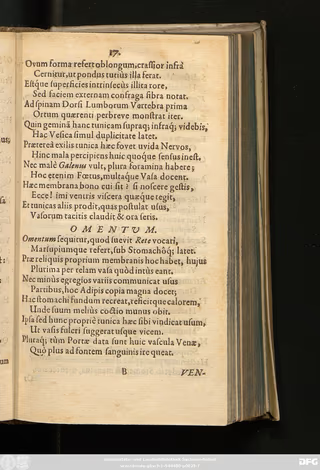
O M E N T U M.

Poet
Strauss
Form
Elegiac couplet
Open the page in the book
The page this poem fills. Each opens in the Mikrokosmographia Metrica, sive Humani Corporis Historia reader.

Hover or tap a word to see its match.

The Omentum follows, which is usually called the Net,

And it resembles a pouch, and lies hidden beneath the Stomach.

Compared to the other membranes it has this specific trait:

That very many vessels run inwardly through its web.

No less does it impart excellent uses to various

Parts; the great abundance of Fat demonstrates this;

With this it revives the bottom of the stomach, and restores its heat,

Whence digestion better performs its task.

But this tunic itself properly claims this function for itself:

That it may continually supply the role of a support for the vessels.

And then many small vessels of the Portal Vein are given to it,

So that more may be able to go to the fount of the blood.

Omentum ſequitur, quod ſuevit Rete vocari,

Marſupiumque refert, ſub Stomachôq; latet.

Præ reliquis proprium membranis hoc habet, hujus

Plurima per telam vaſa quòd intùs eant.

Nec minùs egregios variis communicat uſus

Partibus, hoc Adipis copia magna docet;

Hac ſtomachi fundum recreat, reficitque calorem,

Unde ſuum meliùs coctio munus obit.

Ipſa ſed hunc propriè tunica hæc ſibi vindicat uſum,

Ut vaſis fulcri ſuggerat uſque vicem.

Pluraq; tùm Portæ data ſunt huic vaſcula Venæ,

Quò plus ad fontem ſanguinis ire queat.
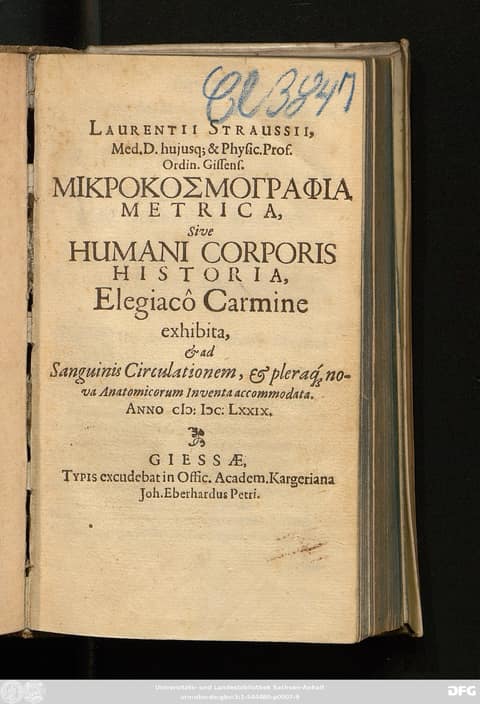
Title page of Mikrokosmographia Metrica, sive Humani Corporis Historia
Title page of Mikrokosmographia Metrica, sive Humani Corporis Historia , 1679

About this text

Provenance

This digital edition is derived from the Deutsche Digitale Bibliothek record for the Universitäts- und Landesbibliothek Sachsen-Anhalt digitization of Lorenz Strauss's 1679 _Mikrokosmographia Metrica, sive Humani Corporis Historia_.

Methodology

Each scan is treated as a page-level unit. The page image remains the authority for the edition. Local Kraken OCR used the Reichenau Latin early-print model as a reading aid, then Gemini generated scan-grounded Latin transcription and scholarly English translation from the images, the OCR aid, and the approved glossary. During review preparation, the title and dedication pages received a light editorial repair to translate Latin abbreviations that had been left in the English output. Word links connect the English translation to the Latin transcription and locations on the scans. Some links highlight only the text because the source word could not be located on the scan.

Rights

The source work is in the public domain by publication age, and the DDB/Halle metadata records the digital surrogate under the Creative Commons Public Domain Mark 1.0. Poet Doctor's presentation adds generated OCR, transcription, translation, navigation metadata, and editorial context.

Original scans: Deutsche Digitale Bibliothek / Universitäts- und Landesbibliothek Sachsen-Anhalt ( Public Domain Mark 1.0 ).

Historian’s note. This text records the medicine of its own time, and later evidence has replaced most of it. It is not medical advice. We read it as history, and we ask what, if anything, connects it to medicine today. More on how we read old medical books