Hover or tap a word to see its match.
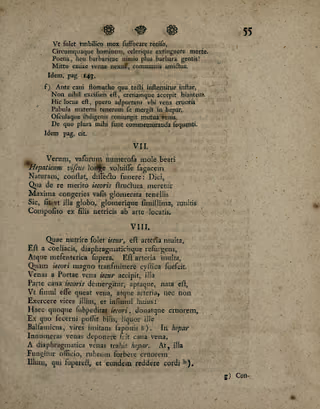
VIII.
That which usually nourishes the liver is a manifold artery,
Arising from the coeliac and diaphragmatic ones,
And the superior mesenteric. There is a manifold artery,
Which the cystic is accustomed to transmit to the great liver.
The liver receives veins from the portal vein; it
Is plunged into the hollow part of the liver, and is born fitted
So that it can be at once a vein and an artery, and also
Perform the offices of the former, and at the same time of the latter:
This also supplies and bestows blood upon the liver,
From which bile may be secreted, that balsamic
Liquor, imitating the powers of soap g). Into the liver
The vena cava knows how to deposit innumerable veins.
The liver draws veins from the diaphragmatic. Yet, that one
Performs the office of absorbing that red blood
Which remains, and returning the same to the heart h).
Quae nutrire solet iecur, est arteria multa,
Est a coeliacis, diaphragmaticisque resurgens,
Atque mesenterica supera. Est arteria multa,
Quam iecori magno transmittere cystica suescit.
Venas a Portae vena iecur accipit, illa
Parte caua iecoris demergitur, aptaque, nata est,
Vt simul esse queat vena, atque arteria, nec non
Exercere vices illius, et insimul huius:
Haec quoque subpeditat iecori, donatque cruorem,
Ex quo secerni possit bilis, liquor ille
Balsamicus, vires imitans saponis g). In hepar
Innumeras venas deponere scit caua vena.
A diaphragmatica venas trahit hepar. At, illa
Fungitur officio, rubeum sorbere cruorem
Illum, qui superest, et eundem reddere cordi h).