Hover or tap a word to see its match.
Part 1
IX.
Wisdom willed that nerves should not be lacking to the liver i).
That hepatic plexus of the intercostal
Nerve bestows many threads of nerves.
And the liver has vessels which convey bile, and many a
Gland holds them. It will be helpful not to be ignorant:
That these vessels conveying the juice of bile are
Canals, to which likewise fixed names are not lacking k),
The first is called the common bile duct,
Accustomed to join itself obliquely to the duodenum.
The cystic is the duct which enjoys the second place;
This comes from the gallbladder, and enters the canal
Called the common; finally, an acute
Angle insinuates, joins, and unites the duct
To the hepatic; many a gland of diverse kind,
Situated around the neck of the gallbladder, also
Fortifies it. The duct surnamed cystic has various
Recurved windings after the manner of serpents, and
The third is wont to be known under the name
Of the hepatic duct, which tends in a straight course from the liver
Towards the common one. That one disseminates frequent
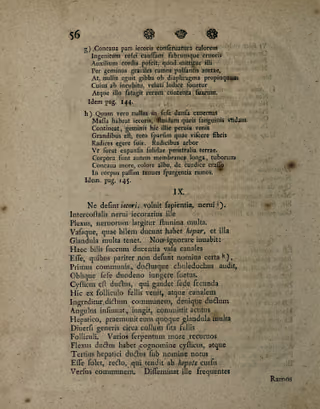
Ne deſint iecori, voluit ſapientia, nerui i).
Intercoſtalis nerui iecorarius ille
Plexus, neruorum largitur ſtamina multa.
Vaſaque, quae bilem ducunt habet hepar, et illa
Glandula multa tenet. Non ignorare iuuabit:
Haec bilis ſuccum ducentia vaſa canales
Eſſe, quibus pariter non deſunt nomina certa k),
Primus communis, ductusque choledochus audit,
Oblique ſeſe duodeno iungere ſuetus.
Cyſticus eſt ductus, qui gaudet ſede ſecunda
Hic ex folliculo fellis venit, atque canalem
Ingreditur dictum communem, denique ductum
Angulus inſinuat, iungit, committit acutus
Hepatico, praemunit eum quoque glandula multa
Diuerſi generis circa collum ſita fellis
Folliculi. Varios ſerpentum more recuruos
Flexus ductus habet cognomine cyſticus, atque
Tertius hepatici ductus ſub nomine notus
Eſſe ſolet, recto, qui tendit ab hepate curſu
Verſus communem. Diſſeminat ille frequentes
Part 2
branches through the viscus of the liver under the name of pores,
accustomed to lead the most slender streams of bile.
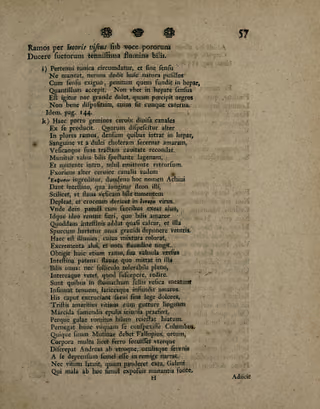
Ramos per iecoris viſcus ſub voce pororum
Ducere ſuetorum tenuiſſima flumina bilis.