Medicus poeta: Three Latin poems on medicine, with an essay on physician-poets
By Christian Tobias Ephraim Reinhard · Published 1762 · Latin with English translation · Wellcome Collection
Historian’s note. This text records the medicine of its own time, and later evidence has replaced most of it. It is not medical advice. We read it as history, and we ask what, if anything, connects it to medicine today.
Historian’s note. This text records the medicine of its own time, and later evidence has replaced most of it. It is not medical advice. We read it as history, and we ask what, if anything, connects it to medicine today. More on how we read old medical books
Medicus poeta
Three Latin poems on medicine, with an essay on physician-poets
By Christian Tobias Ephraim Reinhard, 1762. The edition has the page scans, the Latin text, and an English translation.
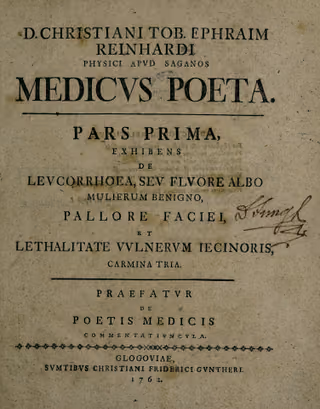
Christian Tobias Ephraim Reinhard, a physician at Sagan, published the first part of Medicus poeta at Glogau in 1762, at the expense of Christian Friedrich Günther. The title page lists three poems, on leucorrhoea, on pallor of the face and on the lethality of wounds of the liver, with a short essay on physician-poets before them. Reinhard, who signs himself “of Kamenz”, dedicates the book to Frederick Christian, Royal Prince of Poland, Duke of Saxony and heir to the electorate.
The essay names Haller, Hebenstreit, Triller and Tralles among the physician-poets of Reinhard’s own day. It cites his teacher Johann Heinrich Schulze for the claim that the first physicians were poets who treated disease with songs. Reinhard argues that poets and physicians both imitate nature and so can both foretell. His examples are Petrus Lotichius, who foretold the siege of Magdeburg in an elegy, and Girolamo Fracastoro, who foretold a plague at Trent.
Each poem has a separate title page and a short epigram. In the preface to the first poem, Reinhard says that his lines have only the form of verse and that he mixes the useful with the pleasant. Three short fables follow it. The poem on the liver is in numbered sections with notes. It starts from the Hippocratic aphorism that a pierced liver is fatal and ends by arguing that only a deep wound kills, while a light wound to the top or bottom of the liver need not.
Christian Tobias Ephraim Reinhard is listed with the physician-poets in this library.
| Date | Place | Work | Notes |
|---|---|---|---|
| Antiquity | Greece | Aphorisms By Hippocrates | The poem on the liver quotes the aphorism that a pierced liver is fatal (section VI, aphorism 18). Its last sections argue that the rule holds only for deep wounds. |
| 1762 | Glogau | Medicus poeta. Pars prima By Christian Tobias Ephraim Reinhard | Printed at the expense of Christian Friedrich Günther. The title page calls this the first part. |
Illustrations
13 illustrations. Each opens its page in the reader, zoomed to the picture.
-
-
-
-
A BRIEF ESSAY ON POET-PHYSICIANS. -
-
-
-

-

-
-
-
-
Poems
130 poems, sorted by title.
- §. XXXIIII.
- §. XXXV.
- §. XXXVI.
- §. XXXVII.
- §. XXXVIII.
- §. XXXVIIII.
- §. XXXXI.
- §. XXXXIII.
- §. XXXXIIII.
- AD LECTOREM RELIGIOSVM.
- AD LECTOREM.
- AD MOMUM.
- At, non pallores alienos esse, sciendum est,
- Corporis instituat moderatum femina motum:
- De pallore canam faciei, pallida Luna,
- DE PALLORE FACIEI CARMEN.
- EPIGRAMMA IN MEDICOS.
- EPIGRAMMA.
- EPIGRAMMA.
- Es, bibis, et dormis, bene digeris, ingeris, atque
- Femellae grauidae pallent, quia sanguis earum
- Haec sunt, quae volui de spurco dicere morbo,
- I.
- I. CANIS ET FELIS.
- II. ASINVS ET VVLPES.
- III.
- III. PASSER ET ALAVDA.
- IIII.
- IIII.
- Iste color pallens oritur, quia sanguinis humor
- IX.
- IX.
- LII.
- LIII.
- LIIII.
- LV.
- LVI.
- LVII.
- LVIII.
- LX.
- Multa vetant medici, ceu sanae noxia vitae;
- Pallorem fibrae rigidae, siccaeque creabunt,
- Prae se fert speciem fluor albus saepe catarrhi,
- PRAEFAMEN.
- PRINCEPS SVMME!
- Si lactans fuerit correpta fluore benigno,
- V.
- VI.
- VI.
- VII.
- VIII.
- VIII.
- VIII.
- VIIII.
- Vrinam crassam mingunt, multoque scatentem
- X.
- X.
- X.
- XI.
- XI.
- XII.
- XII.
- XIII.
- XIII.
- XIII.
- XIIII.
- XIV.
- XIV.
- XIX.
- XIX.
- XV.
- XV.
- XV.
- XVI.
- XVI.
- XVII.
- XVIII.
- XVIII.
- XVIII.
- XX.
- XX.
- XXI.
- XXI.
- XXII.
- XXII.
- XXII.
- XXIII.
- XXIII.
- XXIII.
- XXIIII.
- XXIV.
- XXIV.
- XXIX.
- XXV.
- XXV.
- XXV.
- XXVI.
- XXVI.
- XXVI.
- XXVII.
- XXVII.
- XXVII.
- XXVIII.
- XXVIII.
- XXVIII.
- XXVIIII.
- XXVIIII.
- XXX.
- XXX.
- XXX.
- XXXI.
- XXXI.
- XXXI.
- XXXII.
- XXXII.
- XXXII.
- XXXIII.
- XXXIII.
- XXXIII.
- XXXIV.
- XXXVI.
- XXXVI.
- XXXVII.
- XXXVIII.
- XXXXII.
- XXXXIII.
- XXXXIIII.
- XXXXIIII.
- XXXXV.
- XXXXVI.