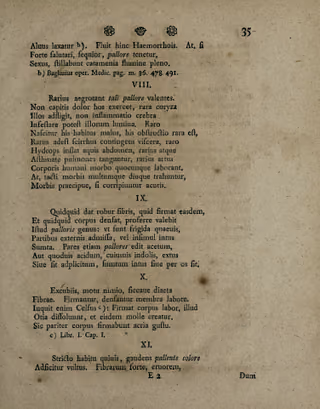
VIII.

Poet
Christian Tobias Ephraim Reinhard
Book
Medicus poeta , 1762
Form
Not identifiable from book
Open the page in the book
The page this poem fills. Each opens in the Medicus poeta reader.

Hover or tap a word to see its match.

VIII.

Those who are healthy with such a pallor rarely fall ill.

Headache does not trouble them, coryza rarely

afflicts them, no frequent inflammation

can trouble their eyes. Rarely

does a bad habit of body arise in them, obstruction in them is rare,

rarely is a scirrhus present touching the viscera, rarely

does dropsy inflate the abdomen with waters, and more rarely

are the lungs touched by asthma, more rarely do the limbs

of the human body suffer from any disease whatsoever.

Yet, when touched by diseases, they are drawn out much and long,

especially if they are seized by acute diseases.

Rarius aegrotant tali pallore valentes.

Non capitis dolor hos exercet, rara coryza

Illos adfligit, non inflammatio crebra

Infestare potest illorum lumina. Raro

Nascitur his habitus malus, his obstructio rara est,

Rarus adest scirrhus contingens viscera, raro

Hydrops inflat aquis abdomen, rarius atque

Asthmate pulmones tanguntur, rarius artus

Corporis humani morbo quocunque laborant.

At, tacti morbis multumque diuque trahuntur,

Morbis praecipue, si corripiuntur acutis.
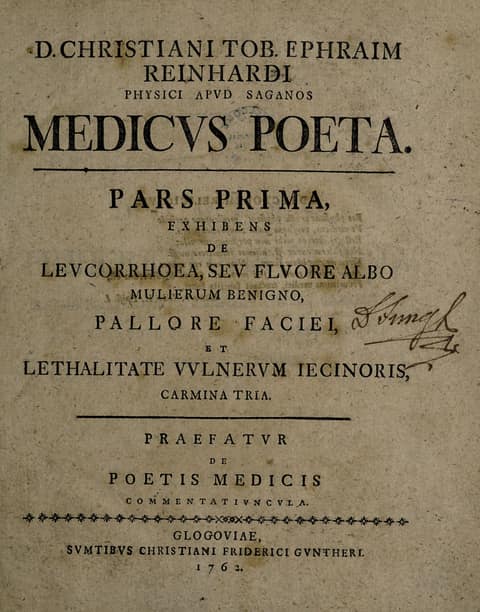
Title page of Medicus poeta
Title page of Medicus poeta , 1762

About this text

Provenance

This edition uses the Wellcome Collection copy, catalogued as _Medicus poeta. Pars prima, exhibens de leucorrhoea, pallore faciei, et lethalitate vulnerum jecinoris, carmina tria_ (b30503395). Scans 1 to 4 are the front cover and flyleaves with handwritten notes. Scan 5 is the title page. Scans 75 to 80 are blank leaves and the back cover.

Rights

The work is in the public domain by age. Wellcome Collection marks this copy with Public Domain Mark 1.0. Credit Wellcome Collection. Poet Doctor is a non-commercial site.

Original scans: Wellcome Collection ( Public Domain Mark 1.0 ).

Historian’s note. This text records the medicine of its own time, and later evidence has replaced most of it. It is not medical advice. We read it as history, and we ask what, if anything, connects it to medicine today. More on how we read old medical books