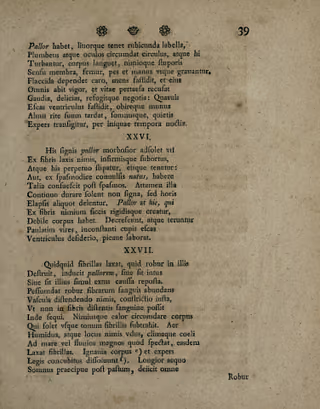
XXVI.

Poet
Christian Tobias Ephraim Reinhard
Book
Medicus poeta , 1762
Form
Not identifiable from book
Open the page in the book
The page this poem fills. Each opens in the Medicus poeta reader.

XXVI.

A more morbid pallor is accustomed to exhibit these signs

When arisen from fibres too lax and weak,

And it is perpetually attended by these, and held by them:

Or, born from spasmodically convulsed fibres, it is accustomed

To have such signs after spasms. Nevertheless those

Signs are not wont to last continually, but after some hours

Have elapsed they are effaced. But this pallor, which

Is created from fibres too dry and rigid,

Has a weak body. The strength decreases and is worn away

Gradually, with an inconstant desire the stomach

Craves foods, or suffers from pica.

His signis pallor morbosior adsolet vti

Ex fibris laxis nimis, infirmisque subortus,

Atque his perpetuo stipatur, eisque tenetur:

Aut, ex spasmodice conuulsis natus, habere

Talia consuescit post spasmos. Attamen illa

Continuo durare solent non signa, sed horis

Elapsis aliquot delentur. Pallor at hic, qui

Ex fibris nimium siccis rigidisque creatur,

Debile corpus habet. Decrescunt, atque teruntur

Paulatim vires, inconstanti cupit escas

Ventriculus desiderio, picaue laborat.
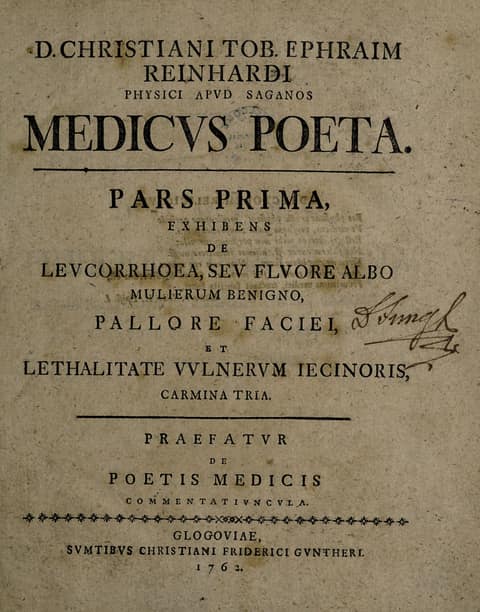
Title page of Medicus poeta
Title page of Medicus poeta , 1762

About this text

Provenance

This edition uses the Wellcome Collection copy, catalogued as _Medicus poeta. Pars prima, exhibens de leucorrhoea, pallore faciei, et lethalitate vulnerum jecinoris, carmina tria_ (b30503395). Scans 1 to 4 are the front cover and flyleaves with handwritten notes. Scan 5 is the title page. Scans 75 to 80 are blank leaves and the back cover.

Rights

The work is in the public domain by age. Wellcome Collection marks this copy with Public Domain Mark 1.0. Credit Wellcome Collection. Poet Doctor is a non-commercial site.

Original scans: Wellcome Collection ( Public Domain Mark 1.0 ).

Historian’s note. This text records the medicine of its own time, and later evidence has replaced most of it. It is not medical advice. We read it as history, and we ask what, if anything, connects it to medicine today. More on how we read old medical books