Hover or tap a word to see its match.
ON
THE PALLOR
OF THE FACE
A POEM.
I.
The face is wont to rejoice in varied colour:
For according to the different temperament of the body, and according to
The varying structure of its fibres, now there is
A purple colour, and now indeed a pale one upon the countenance.
II.
If through the tender web of the skin no crimson
Of blood shines through, that state is called pallor.
On the contrary, if through the network of the skin a pleasing redness,
Like a pale rose, shines through, that condition
Of the countenance does not deserve to bear the name of pallor.
III.
The causes of pallor are various. It is born
From a strong and tight fibre. A weak and
Overly lax little fibre likewise gives rise to pallors.
From overly rigid fibres, and from fibres curled
By spasm, pallor is wont to come into the face.
IV.
Therefore we call that pallor salutary,
Which proceeds from strong and tight fibres: But that which
Results from overly lax and infirm fibres,
Or arises from curled and rigid fibres,
Is called morbid pallor by medical doctors.
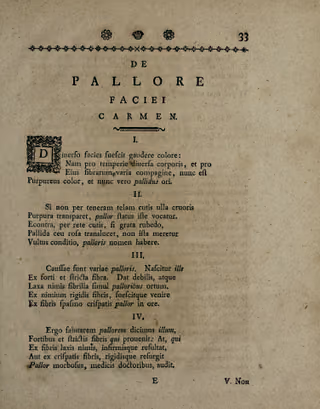
I.
Diuerso facies suescit gaudere colore:
Nam pro temperie diuersa corporis, et pro
Eius fibrarum varia compagine, nunc est
Purpureus color, et nunc vero pallidus ori.
II.
Si non per teneram telam cutis ulla cruoris
Purpura transparet, pallor status iste vocatur.
Econtra, per rete cutis, si grata rubedo,
Pallida ceu rosa translucet, non ista meretur
Vultus conditio, palloris nomen habere.
III.
Caussae sunt variae palloris. Nascitur ille
Ex forti et stricta fibra. Dat debilis, atque
Laxa nimis fibrilla simul palloribus ortum.
Ex nimium rigidis fibris, suescitque venire
Ex fibris spasmo crispatis pallor in ore.
IV.
Ergo salutarem pallorem dicimus illum,
Fortibus et strictis fibris qui prouenit: At, qui
Ex fibris laxis nimis, infirmisque resultat,
Aut ex crispatis fibris, rigidisque resurgit
Pallor morbosus, medicis doctoribus, audit.