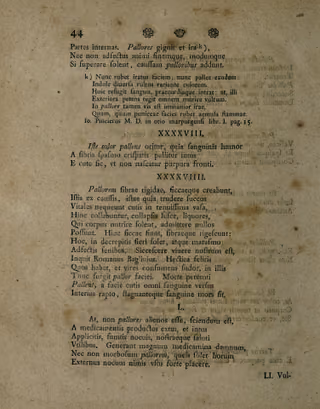
At, non pallores alienos esse, sciendum est,

Book
Medicus poeta , 1762
Form
Not identifiable from book
Open the page in the book
The pages this poem fills. Each opens in the Medicus poeta reader.

Hover or tap a word to see its match.

Part 1

Yet it must be known that pallors are not foreign to this,

Produced by medicines applied externally and

Taken internally, both harmful and useful to our

Health. Medicines generate great harm,

And likewise a morbid pallor, for those whom

The overly harmful external use of them perchance is wont to please.

At, non pallores alienos eſſe, ſciendum eſt,

A medicamentis productos extus, et intus

Applicitis, ſumtis nocuis, noſtraeque ſaluti

Vtilibus. Generant magnum medicamina damnum,

Nec non morboſum pallorem, queis ſolet horum

Externus nocuus nimis vſus forte placere.

Part 2

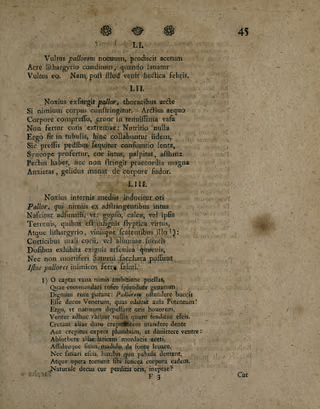
LI.

Sharp vinegar seasoned with litharge produces

a harmful pallor of the face, when the face is washed

with it. For after that comes hectic fever.

Vultus pallorem nocuum, producit acetum

Acre lithargyrio conditum, quando lauatur

Vultus eo. Nam poſt illud venit hectica febris.
Similar poems

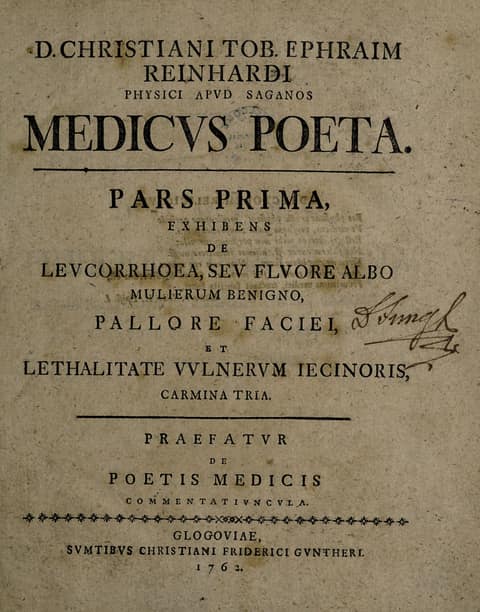
Title page of Medicus poeta
Title page of Medicus poeta , 1762

About this text

Provenance

This edition uses the Wellcome Collection copy, catalogued as _Medicus poeta. Pars prima, exhibens de leucorrhoea, pallore faciei, et lethalitate vulnerum jecinoris, carmina tria_ (b30503395). Scans 1 to 4 are the front cover and flyleaves with handwritten notes. Scan 5 is the title page. Scans 75 to 80 are blank leaves and the back cover.

Rights

The work is in the public domain by age. Wellcome Collection marks this copy with Public Domain Mark 1.0. Credit Wellcome Collection. Poet Doctor is a non-commercial site.

Original scans: Wellcome Collection ( Public Domain Mark 1.0 ).

Historian’s note. This text records the medicine of its own time, and later evidence has replaced most of it. It is not medical advice. We read it as history, and we ask what, if anything, connects it to medicine today. More on how we read old medical books