LV.

Poet
Christian Tobias Ephraim Reinhard
Book
Medicus poeta , 1762
Form
Not identifiable from book
Open the page in the book
The pages this poem fills. Each opens in the Medicus poeta reader.

Hover or tap a word to see its match.

Part 1

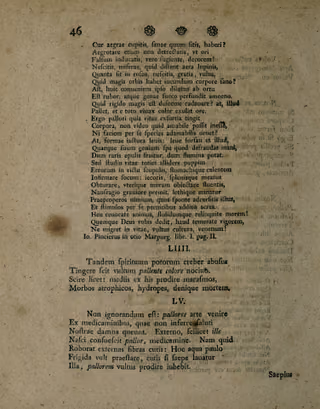
It must not be ignored: that pallors come artificially

From medicines which cannot inflict harm upon our

Health. To wit, that pallor is accustomed to be born

From an external medicine. For whatever

Strengthens the external fibers of the skin: this, water a little

Cold tends to perform; if the skin is often washed

With it, it will bid a pallor of the countenance come forth.

Non ignorandum eſt: pallores arte venire

Ex medicaminibus, quae non inferre ſaluti

Noſtrae damna queunt. Externo, ſcilicet ille

Naſci conſueſcit pallor, medicamine. Nam quid

Roborat externas fibras cutis: Hoc aqua paulo

Frigida vult praeſtare, cutis ſi ſaepe lauatur

Illa, pallorem vultus prodire iubebit.

Part 2

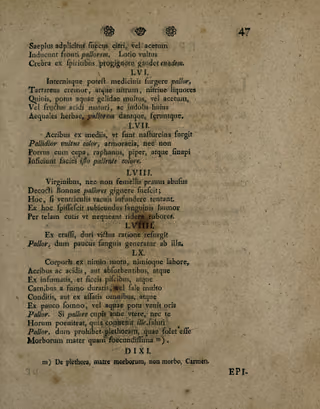
Citron juice applied quite often, or vinegar,

induces pallor upon the brow. Frequent washing of the face

with spirits delights in producing the same.

Saepius adplicitus ſuccus citri, vel acetum

Inducunt fronti pallorem. Lotio vultus

Crebra ex ſpiritibus progignere gaudet eundem.
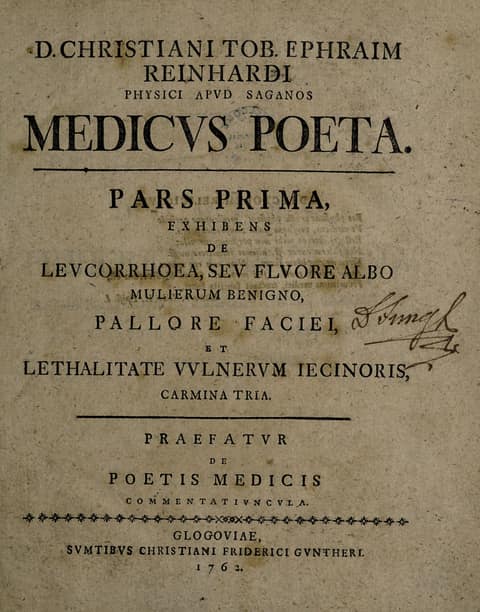
Title page of Medicus poeta
Title page of Medicus poeta , 1762

About this text

Provenance

This edition uses the Wellcome Collection copy, catalogued as _Medicus poeta. Pars prima, exhibens de leucorrhoea, pallore faciei, et lethalitate vulnerum jecinoris, carmina tria_ (b30503395). Scans 1 to 4 are the front cover and flyleaves with handwritten notes. Scan 5 is the title page. Scans 75 to 80 are blank leaves and the back cover.

Rights

The work is in the public domain by age. Wellcome Collection marks this copy with Public Domain Mark 1.0. Credit Wellcome Collection. Poet Doctor is a non-commercial site.

Original scans: Wellcome Collection ( Public Domain Mark 1.0 ).

Historian’s note. This text records the medicine of its own time, and later evidence has replaced most of it. It is not medical advice. We read it as history, and we ask what, if anything, connects it to medicine today. More on how we read old medical books