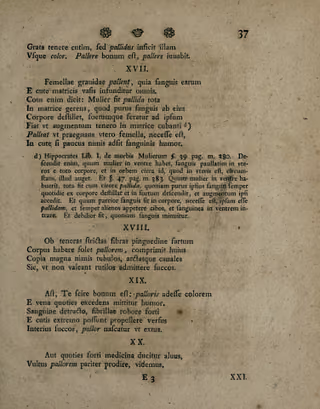
Femellae grauidae pallent, quia sanguis earum

Book
Medicus poeta , 1762
Form
Not identifiable from book
Open the page in the book
The page this poem fills. Each opens in the Medicus poeta reader.

Hover or tap a word to see its match.

Pregnant women are pale, because all their blood

is poured out from the skin into the vessels of the womb.

For Hippocrates of Cos says: A woman becomes entirely pale

when carrying in the womb, because the pure blood from her

body distills down, and is carried to the fetus itself

so that growth may come to the tender one lying in the womb d).

It is necessary that a woman pregnant in the womb be pale,

if too little moisture of blood is present in the skin.

Femellae grauidae pallent, quia sanguis earum

E cute matricis vasis infunditur omnis.

Cous enim dicit: Mulier fit pallida tota

In matrice gerens, quod purus sanguis ab eius

Corpore destillet, foetumque feratur ad ipsum

Fiat vt augmentum tenero in matrice cubanti d)

Palleat vt praegnans vtero femella, necesse est,

In cute si paucus nimis adsit sanguinis humor.
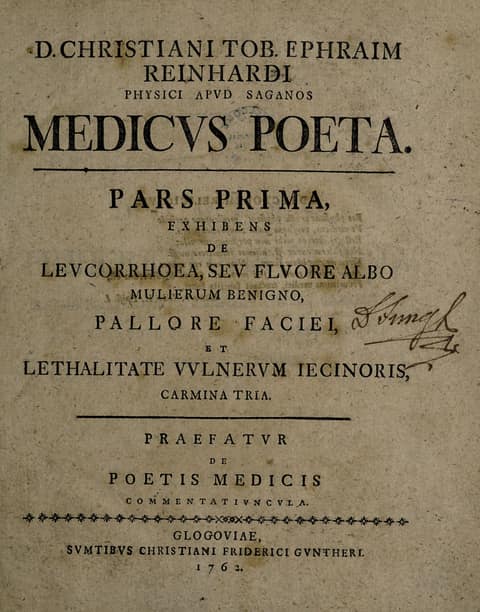
Title page of Medicus poeta
Title page of Medicus poeta , 1762

About this text

Provenance

This edition uses the Wellcome Collection copy, catalogued as _Medicus poeta. Pars prima, exhibens de leucorrhoea, pallore faciei, et lethalitate vulnerum jecinoris, carmina tria_ (b30503395). Scans 1 to 4 are the front cover and flyleaves with handwritten notes. Scan 5 is the title page. Scans 75 to 80 are blank leaves and the back cover.

Rights

The work is in the public domain by age. Wellcome Collection marks this copy with Public Domain Mark 1.0. Credit Wellcome Collection. Poet Doctor is a non-commercial site.

Original scans: Wellcome Collection ( Public Domain Mark 1.0 ).

Historian’s note. This text records the medicine of its own time, and later evidence has replaced most of it. It is not medical advice. We read it as history, and we ask what, if anything, connects it to medicine today. More on how we read old medical books