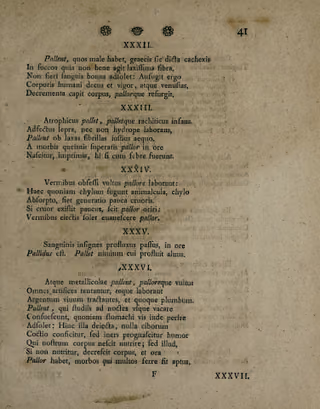
XXXIV.

Poet
Christian Tobias Ephraim Reinhard
Book
Medicus poeta , 1762
Form
Not identifiable from book
Open the page in the book
The page this poem fills. Each opens in the Medicus poeta reader.

XXXIV.

Those beset by worms suffer from pallor of the countenance:

Since these little creatures suck the chyle, when the chyle

Is absorbed, there will be a scanty generation of blood.

If the blood exists in small amount, pallor knows how to arise:

When the worms are expelled, the pallor is wont to vanish.

Vermibus obsessi vultus pallore laborant:

Haec quoniam chylum sugunt animalcula, chylo

Absorpto, fiet generatio pauca cruoris.

Si cruor existit paucus, scit pallor oriri:

Vermibus eiectis solet euanescere pallor.
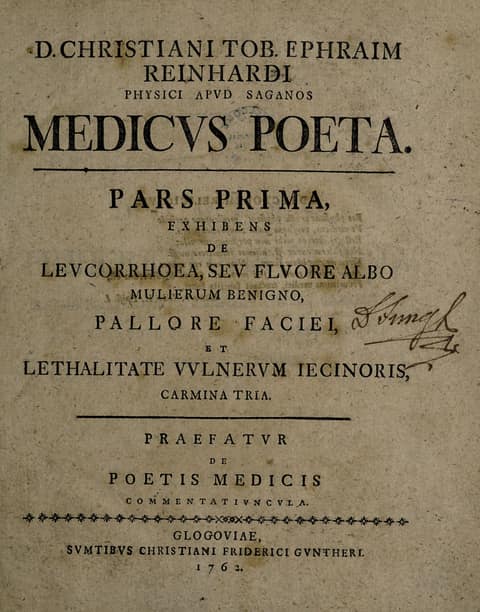
Title page of Medicus poeta
Title page of Medicus poeta , 1762

About this text

Provenance

This edition uses the Wellcome Collection copy, catalogued as _Medicus poeta. Pars prima, exhibens de leucorrhoea, pallore faciei, et lethalitate vulnerum jecinoris, carmina tria_ (b30503395). Scans 1 to 4 are the front cover and flyleaves with handwritten notes. Scan 5 is the title page. Scans 75 to 80 are blank leaves and the back cover.

Rights

The work is in the public domain by age. Wellcome Collection marks this copy with Public Domain Mark 1.0. Credit Wellcome Collection. Poet Doctor is a non-commercial site.

Original scans: Wellcome Collection ( Public Domain Mark 1.0 ).

Historian’s note. This text records the medicine of its own time, and later evidence has replaced most of it. It is not medical advice. We read it as history, and we ask what, if anything, connects it to medicine today. More on how we read old medical books